
Photo: Turkey Your Way
Bulgarians in Istanbul: From Byzantine Sieges to the Iron Church
The story of the Bulgarians in Istanbul: Krum and Simeon at the walls, dairymen and gardeners, the church struggle in Fener, the Iron Church and the community today.
On the Golden Horn shore at Balat, a white church with golden domes tells the story of the Bulgarians in Istanbul. It is made of iron, and it stands where their long struggle for a church of their own began. Today a few hundred Bulgarians live in the city. A century ago there were thousands, and they ran dairies, kept market gardens and sewed the army’s uniforms. Here is their story, and the places where you can still find it.
Bulgarians at the Gates of Constantinople
The first Bulgars came from the steppe, and they were Turkic in origin. Under their khan Asparuh, one group crossed the Danube and mixed with the Slavs they found there. In 681, Byzantium recognized their state. Within two centuries, these Bulgarians were knocking on the city’s own doors.
In 813, Khan Krum laid siege to Constantinople and burned the country around it. He planned a second attack, but he died in 814 before it began. Half a century later, the city won them over another way. In 864–865, Khan Boris accepted Christianity from Constantinople, and the Bulgarian church came under its patriarch.
The most ambitious ruler came next. Simeon reigned from 893 to 927. In August 913, he led his army to the land walls and met Patriarch Nicholas outside them. What the patriarch gave him that day is still debated. Simeon never took the city, because the land walls held.
How Did Bulgarians Settle in Ottoman Istanbul?
When the Ottomans crossed into Europe, Bulgarians stood among their first opponents. In the winter of 1352, Orhan’s son Süleyman Pasha defeated a Bulgarian army in Thrace. Then, a century later, the city itself changed hands.
After the conquest of 1453, Mehmed II ordered the emptied city filled again. Many Bulgarians came from the lands of today’s Bulgaria and settled here. Nobody knows how many there were in those first centuries. No register counted them apart from the other Orthodox Christians.
The large wave came much later. In 1826, the Ottoman state abolished the Janissaries and built a new army in European-style uniforms. Wool cloth for those uniforms came from Bulgarian workshops in Sliven and Plovdiv. Bulgarian tailors then sewed them in the capital. Some came for a season, others stayed for good. Livestock dealers, called celeps, and market gardeners followed. The center of their trade was Balkapanı Han, an old merchant inn.
In 1917, the community kept its own register, and it shows how the Bulgarians in Istanbul lived. Gardeners and dairymen made up about two thirds of the household heads. Most came from western Macedonia: men from Kostur ran dairies, and men from Resne grew vegetables and flowers. Kasımpaşa had the most Bulgarian households, most of them gardeners. Along the Bosphorus, in Bebek, Kuzguncuk and Çengelköy, they worked as dairymen, bakers and pudding makers. Community life, however, centered on Şişli, around the Bulgarian school and hospital.
The Church Struggle in Fener
For centuries, the Ottoman state counted every Orthodox Christian in one community, under the Patriarchate in Fener. Many Bulgarians spoke no Greek, so they wanted to hear the liturgy in their own language. The demand grew into a movement, and its heart was in Istanbul.
The first step was small. With the help of Stefan Bogoridi, the community opened a wooden church on the Golden Horn shore in October 1849. It stood between Fener and Balat, a short walk from the Patriarchate itself. At the Easter service of 1860, the cleric Ilarion Makariopolski left out the Patriarch’s name. He declared that he no longer recognized his authority. The quarrel lasted ten years.
In March 1870, Sultan Abdülaziz issued a ferman that created the Bulgarian Exarchate. From then on, the Bulgarians in Istanbul were a separate community. They had their own head, their own schools and their own lines in the state registers. In 1872, Antim I became the first Exarch, and the same year a Patriarchal council declared the Bulgarians in schism. The first Exarchate offices stood in Ortaköy, and in 1907 the community bought a building in Şişli.

The Churches of the Bulgarians in Istanbul
Three Bulgarian churches still stand in the city. The best known is the one on the shore. On the plot of the wooden church of 1849, the community raised a new church of iron. Its parts were cast in Vienna and brought by ship, and in 1898 the Bulgarian Iron Church, the church of St. Stephen, was finished. In Turkish, it is Sveti Stefan Kilisesi. It closed in 2009 for repairs. After seven years of restoration, it opened its doors again on January 7, 2018.
The other two are less known. Sveti İvan Rilski stands beside the Exarchate building in Şişli. Sveti Dimitar stands inside the Bulgarian cemetery in Feriköy, on a plot of about 5,500 square meters (1.4 acres). The sultan approved the cemetery in 1911. Around 1920, a community member named Dimitar Spirov paid for the small church himself. The painter Pando Stefanov made its icons. For both, we confirm access for your date.
In 1902, the community also opened a hospital in Şişli, named after Evlogi Georgiev, who led its founding.

How Many Bulgarians Live in Istanbul Today?
The numbers rose and fell with the empire. Ottoman records counted 5,758 Bulgarians in 1894, and in the early 1900s there were more than 5,000 in the city. Estimates for the mid-19th century run much higher, but nobody kept an exact count.
The Balkan Wars of 1912–13 changed everything. The Exarch moved to Sofia. After the armistice of March 1913, many Bulgarians in Istanbul and Çatalca were made to leave, or chose to leave. It happened within about two months. Each family could take one cartload of belongings. By 1915, about 700 Bulgarian households remained, and the 1917 register counted 1,737 people.
Further departures followed. In 1923, the Turkish-Greek population exchange reached some Bulgarians who were registered as Greek Orthodox. In the 1930s, a law barred foreign nationals from many trades. By then, most of the city’s Bulgarians held Bulgarian citizenship. Many tailors, gardeners and dairymen packed up and left. Later, young people moved overseas, to the United States, Canada and Australia.
Today, the Bulgarians in Istanbul number a few hundred. Most of them are at least the second generation born in the city. Their three churches remain the landmarks of the community.
Walk the Bulgarian Story in Balat and Fener
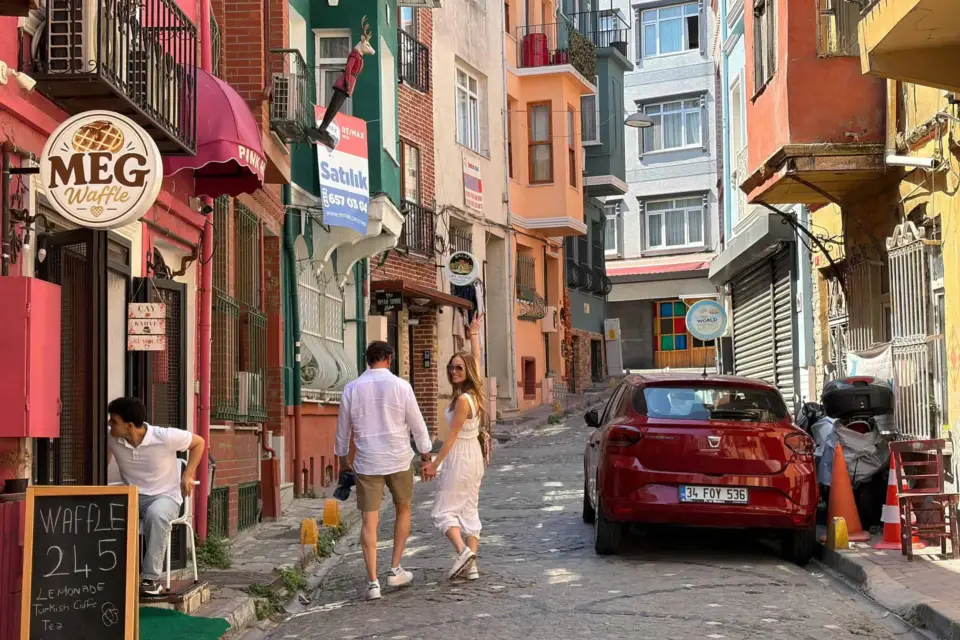
The best place to start is the shore where the story began. Our Balat and Fener tour walks down from the Ahrida Synagogue to the Iron Church, then on to the Patriarchate in Fener. In one morning, you see the church the Bulgarians built and the Patriarchate they once belonged to. Would you like to add Şişli or the cemetery in Feriköy? Tell us your dates, and we will shape the day around the Bulgarian churches and confirm access.
Frequently asked questions
Are there still Bulgarians in Istanbul?
Yes. A few hundred Bulgarians live in Istanbul today, most of them born in the city. Their churches stand in Balat, Şişli and Feriköy.
What is the Bulgarian church in Istanbul called?
The best known is the Church of St. Stephen, Sveti Stefan in Bulgarian, called the Iron Church. It stands on the Golden Horn shore between Balat and Fener and was finished in 1898.
When did Bulgarians come to Istanbul?
Some settled after the conquest of 1453. Most came in the 19th century, after 1826, as tailors, cloth makers, gardeners and dairymen.
What was the Bulgarian Exarchate?
It was the Bulgarian church created by a ferman of Sultan Abdülaziz in 1870. It gave the Bulgarians their own church head, separate from the Patriarchate in Fener.
Can you visit the Bulgarian churches in Istanbul?
Yes. Our Balat and Fener tour stops at the Iron Church. For Sveti İvan Rilski in Şişli and Sveti Dimitar in Feriköy, we confirm access for your date.
You may also like
-
 Tour
Private Balat and Fener Walking Tour in Istanbul
-
 Tour
Private Greek Orthodox Istanbul Tour: Fener and Heybeliada
-
 Place
Balat
-
 Place
Bulgarian Iron Church (St. Stephen)
-
 Place
Ecumenical Patriarchate and the Church of St. George
-
 Place
Fener
-
 Article
A Morning in Balat: Painted Streets and Sekiz Art House
-
 Article
Armenians of Istanbul: Kumkapı, the Patriarchate and the Balyans