Cappadocia is a Central Anatolian region where wind and water cut volcanic tuff into valleys. People carved churches, homes and underground cities into the soft rock.
Cappadocia is a historical region of Central Anatolia, where wind and water cut volcanic tuff into valleys and cliffs. Because that rock is soft, people carved churches, homes and underground cities into it. Since 1985, Göreme National Park and Cappadocia have been a mixed natural and cultural World Heritage Site.
Cappadocia at a Glance
Today the name covers five provinces: Nevşehir, Aksaray, Kayseri, Niğde and Kırşehir. Of these, the World Heritage property lies in Nevşehir and Kayseri. The region’s rock began as tuff from Mount Erciyes and Mount Hasan, which wind and water later wore down. Göreme, Ürgüp and Avanos belong to Nevşehir province, while Ihlara Valley lies in Aksaray and Soğanlı Valley in Kayseri. Near Niğde, see Gümüşler Monastery, and at Gülşehir, St. Jean Church. For the other listed sites, read UNESCO World Heritage sites in Turkey.
Quick facts
Good for: rock-cut churches, valley walks, underground cities, balloon flights, pottery
Photo: Turkey Your Way
Göreme and the Central Valleys
Rock-cut churches cluster at Göreme, Çavuşin, Zelve and Ürgüp, so this group holds many painted interiors. From Cappadocia, join our Gümüşler Monastery tour. If you are still deciding, read is Cappadocia worth it.
Göreme and the Open-Air Museum
Göreme gives its name to the national park on the World Heritage List. The Göreme Open-Air Museum gathers rock-cut churches, among them the Dark Church and the Tokalı Church.
Uçhisar, Ortahisar and the walking valleys
Uçhisar Castle pairs well with the walking path through Pigeon Valley. Walks of a few hours each lead through Love Valley, Rose Valley and Sword Valley. Ortahisar takes its name from the rock fortress at its center and joined the Cittaslow network in 2026. The Red Valley lies near the town and Çavuşin. For the villages compared, read where to stay in Cappadocia.
Photo: Turkey Your Way
Çavuşin, Paşabağ and Zelve
Çavuşin keeps the rock-cut Church of Saint John the Baptist. Paşabağ (Monks Valley) lies about 1 km (0.6 mile) off the Göreme–Avanos road, on the way to Zelve Open-Air Museum. Its chimneys hold a chapel of Saint Simeon. Further on, Zelve spreads across three valleys.
Photo: Turkey Your Way
Avanos on the Kızılırmak
Avanos stands on the Kızılırmak, 18 km (11 miles) from Nevşehir. The town is famous for its pottery. In 2017, Turkey's patent office registered Avanos Çömleği, Avanos pottery, as an appellation of origin. Potters take their clay from old beds of the river and the hills around town. The pots turn red because that clay holds hematite.
Ürgüp and Mustafapaşa
Ürgüp is one of the largest towns in the heart of Cappadocia. Mustafapaşa, once called Sinasos, lies south of Ürgüp. Its Church of Constantine and Helen dates from the late 19th century. For the painted churches of the smaller valleys, join our hidden Cappadocia churches tour.
Underground Cities and the Southern Valleys
Derinkuyu and Kaymaklı
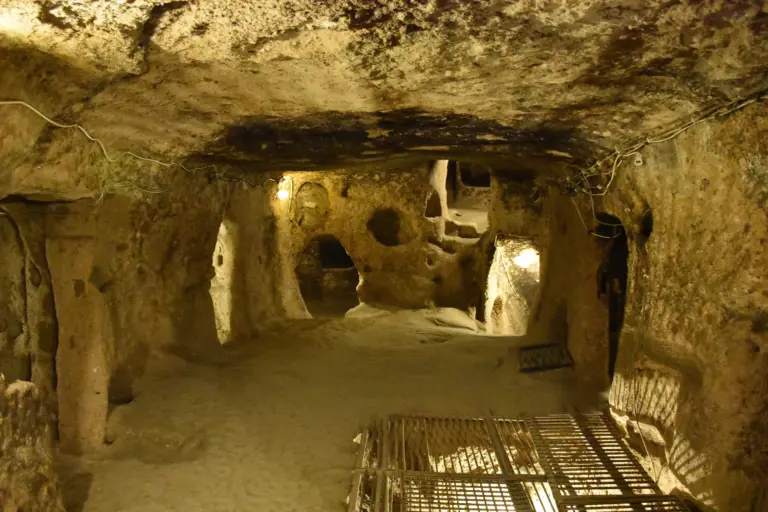
Derinkuyu Underground City and Kaymaklı Underground City are among the World Heritage sites of the area. Christians carved such cities into the soft rock between the 6th and 9th centuries. When Arab raids came, people probably sheltered in them. More underground cities lie at Özkonak, 14 km (9 miles) from Avanos, and at Mazı, 18 km (11 miles) south of Ürgüp.
Ihlara Valley and Güzelyurt
Ihlara Valley lies in Aksaray province, about 35 km (22 miles) from the city of Aksaray. The Melendiz River cut the canyon, which runs about 14 km (9 miles). At its deepest it reaches about 120 meters (394 feet). Ihlara, Belisırma and Gelveri, today's Güzelyurt, lie inside Cappadocia's boundaries. Painted rock churches then continue down the valley to Selime. Our South Cappadocia tour walks part of this valley and ends at Selime.
Photo: Bernard Gagnon / Wikimedia Commons, CC BY-SA 3.0
Soğanlı Valley
Soğanlı Valley lies in Yeşilhisar district of Kayseri province, about 15 km (9 miles) from Yeşilhisar. It was one of the main Christian centers of Cappadocia from the 4th century. Its domed rock churches set it apart, while their frescoes date from about the 10th to the 12th centuries.
History of Cappadocia
Katpatuka and the Kingdom of Cappadocia
The name comes from Katpatuka, the form the Iranians used, in its Greek pronunciation. Persian rule lasted from 546 to 334 BC, until Alexander ended it. After that, the Kingdom of Cappadocia ruled from 332 BC until Rome annexed the region in 17 AD. Much earlier, Assyrian merchants traded at Kültepe near Kayseri. It was the center of the network of Assyrian trading colonies in Anatolia.
Monks and painted rock churches of Cappadocia
Göreme became an important Christian center because believers fleeing pressure settled there between the 7th and 13th centuries. Still, many believe monastic life began there in the 4th century, with followers of Basil of Caesarea. However, the earliest archaeological evidence of Christianity in the region dates from the 6th century. Basil is one of the theologians on our Cappadocian Fathers page.
Photo: Turkey Your Way
Seljuk inns and Ottoman Nevşehir
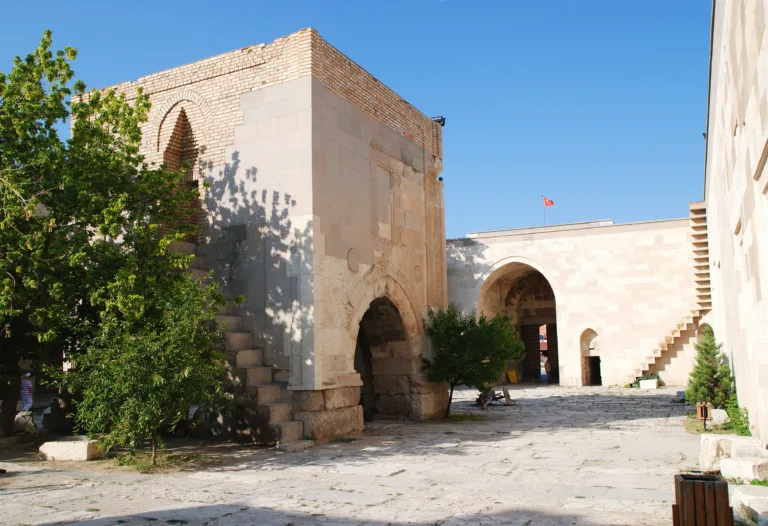
In 1075 Seljuk rule began, and Kayseri fell in 1085. Across the region stand Seljuk caravanserais, among them Sultanhanı Caravanserai, Karatay Hanı and Ağzıkarahan. Later, grand vizier Damat İbrahim Paşa rebuilt his birthplace, the village of Muşkara, as a town. It took the name Nevşehir in 1725. Much later, in 1954, it became a province.
Balloons over Cappadocia
Balloon flights from Göreme
Balloon flights leave from around Göreme early in the morning. They rise up to 500 meters (1,640 feet), and visitors book them through companies based in Göreme. Before you book, read our article on Cappadocia Hot Air Balloons: What to Know Before You Fly.
Eat & Drink in Cappadocia
Testi kebab and Nevşehir mantı
Nevşehir's own dishes include mantı, testi kebabı, tandır fasulyesi and düğü çorbası. For testi kebab, cooks seal meat, vegetables and lentils in a clay pot. Then they break it open at the table. Cooks fold Nevşehir mantısı, small squares of dough around minced meat, into triangles. After that, they serve them with garlic yogurt, spiced butter, sumac and mint. Our page on Turkish Manti: Tiny Dumplings with Garlic Yogurt covers the wider family. To cook with a local family, book our Cappadocia cooking class.
Grapes and wine of Cappadocia
The region's vineyards grow on volcanic tuff soil. Anatolian grapes include Öküzgözü, Kalecik Karası, Boğazkere, Narince and Emir. Many wineries welcome visitors all year. Nevşehir is also known for its dried grapes and grape juice. For more on the grapes, see Turkish Wine: Native Grapes, Regions and Vineyard Routes. For coffee and breakfast, see the best cafés in Cappadocia.
Our notes for Cappadocia
Potter’s wheelAvanos workshops let visitors try the wheel, with a master potter beside them.
Horse ridingThe Meskendir and Güllüdere valleys suit a ride.
Our suggestion Try the potter's wheel in Avanos in the morning, then order testi kebab for lunch and watch the pot come open.
Planning Your Days in Cappadocia
Our suggestion for two days
Our suggestion: spend the first day around Göreme, with the Open-Air Museum, Uçhisar Castle and the Pigeon Valley path, which our Cappadocia hiking tour follows on foot. On the second day, go south to Derinkuyu or Kaymaklı before you continue to Ihlara Valley.
Nevşehir stands at about 1,150 meters (3,770 feet). Its warmest afternoons come in July and August. Then the average high reaches about 28.5 °C (83 °F). January is the coldest month, with an average low of −3.6 °C (26 °F). May brings the most rain, 57.9 mm (2.3 inches) on average, while July and August stay almost dry. Average highs sit near 16 °C (61 °F) in April and 18 °C (64 °F) in October. Because of that, we suggest spring and autumn for long valley walks.
A double rainbow over the valleys of Cappadocia after a summer storm, filmed on one of our tours · Video: Turkey Your WayPhoto: Turkey Your Way
Beyond the Valleys
Hacıbektaş
Hacıbektaş lies about 45 km (28 miles) from Nevşehir. For the lodge itself, see our page on the Hacı Bektaş Veli Lodge. Its 14th-century complex holds the tomb of Haji Bektash Veli, and the complex is also on UNESCO's Tentative List.
Getting to Cappadocia
Kapadokya Airport
Kapadokya Airport (NAV) lies in Nevşehir province, 30 km (19 miles) from the city center. A shuttle runs on times that follow scheduled flights, while the airport has a taxi stand and rental-car desks.
Kayseri Airport
Kayseri Airport (ASR) serves Kayseri and handles both civil and military traffic. Like Kapadokya Airport, it entered service in 1998.