

Çatalhöyük
Çatalhöyük near Konya: a 9,000-year-old Neolithic town of mud-brick houses entered from the roof, with burials…
Photo: Dosseman / Wikimedia Commons, CC BY-SA 4.0
Stone carved like lace and coral: a 13th-century mosque and hospital in a small mountain town, among the masterpieces of Anatolian architecture.
In a small mountain town of Sivas province, far from any tourist trail, stands an astonishing building. There, the portals of the Divriği Great Mosque and Hospital explode with stone carving so deep and dense that it looks more like lace, coral or jungle than masonry. No wonder UNESCO listed the complex as early as 1985.
Admittedly, it takes effort to get here. Still, anyone who loves architecture should see these portals at least once, especially now that a long restoration ended in 2024. From Sivas, our Sivas and Divriği tour pairs it with the city’s madrasas in one day.
The Divriği Great Mosque and Hospital, in Turkish Divriği Ulu Cami ve Darüşşifası, stands in the upper town of Divriği, below the citadel. The local Mengücek dynasty built it in 1228–1229. The complex joins a mosque and a hospital that share one wall. A tomb chamber is also attached to the hospital.
Its carving and its mix of styles make it a landmark of Anatolian architecture. The Divriği Great Mosque reopened in May 2024 after a restoration that had begun in 2015.
Divriği Great Mosque in numbers
First, after the Battle of Manzikert in 1071, Turkish tribes settled the region. In the 12th century, the Mengücek dynasty ruled Divriği and Erzincan as allies of the Seljuks of Konya. These rulers were also great patrons of art, science and literature, which may explain how such gifted craftsmen came to this small town.
An inscription on the north portal names the patron of the mosque as Ahmadshah, a Mengücek ruler of Divriği, and gives the date 1228–1229. Another inscription, on the hospital, names Turan Malik, daughter of the ruler Fakhr al-Din Bahramshah of Erzincan. The chief architect also signed his name inside both buildings: Khurramshah of Ahlat. For his hometown on Lake Van, see our Ahlat tour.
Over the centuries, builders restored the complex several times between the 15th and 19th centuries, and again in the 20th. Then, in 2015, a major restoration began. After several pauses, it was completed, and the mosque reopened in May 2024.
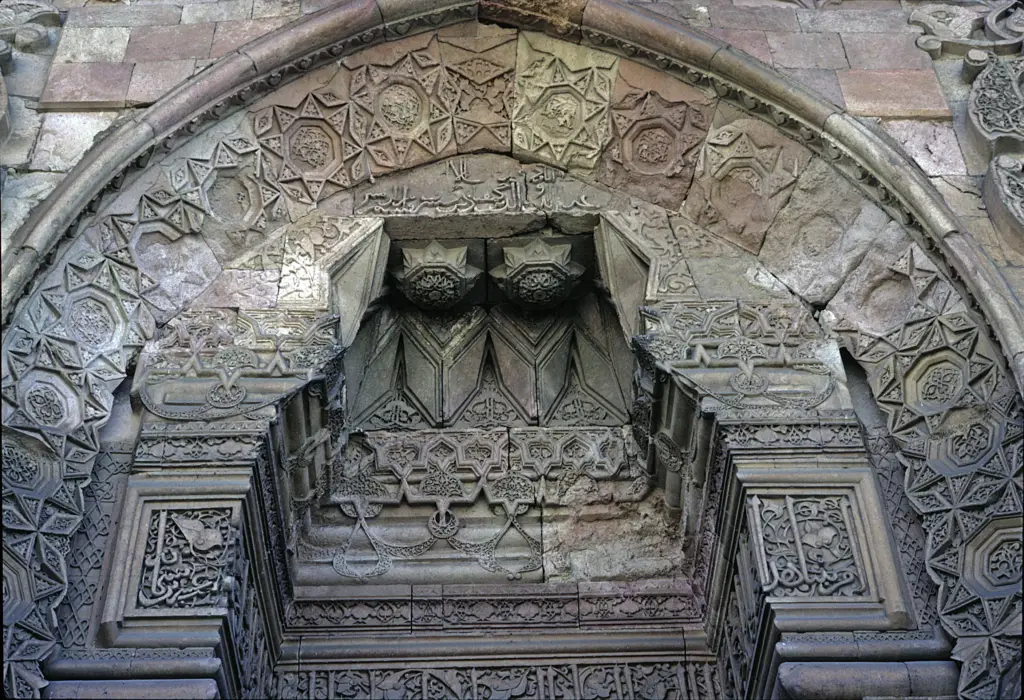
To begin with, the main entrance on the north side is the most famous part of the complex. Its high-relief carving is so dense that motifs seem to grow out of the stone. For example, look for stars, palmettes and plant forms layered on top of one another.
Next door, the hospital, the Darüşşifa or “house of healing”, has its own portal on the west side. A great pointed arch frames it, with a window in the center. Its carving is just as fine, although less dense and in places unfinished. Inside, rooms and iwans surround a covered courtyard with a small pool, and one room served as the dynastic tomb.

Inside the mosque, by contrast, stone piers carry the vaults, and the central bay was once open to the sky. Along the qibla wall, for instance, survives the carved wooden minbar of 1243, signed by İbrahim of Tiflis. However, some carved panels from the royal platform are now in the Museum of Pious Foundations in Ankara.

Divriği is a small town of red roofs below a ruined citadel. It was founded in the 9th century under Byzantine rule, and its old upper town still gathers around the mosque and the castle hill.

Our notes for Divriği
Our suggestion Stay into the afternoon. Watch the west portal as the sun moves across it, and you may see the shadow of a man reading and then praying.
Because no other portal in Anatolia looks like this. Stand before the north gate of the mosque, then walk round to the hospital portal and step into the courtyard of a 13th-century house of healing.
Çatalhöyük near Konya: a 9,000-year-old Neolithic town of mud-brick houses entered from the roof, with burials…
Open in Google Maps (opens in a new tab) Open in Apple Maps (opens in a new tab)
For the extraordinary high-relief stone carving of its portals, among the finest in Anatolia; UNESCO listed it in 1985.
The Mengücek dynasty in 1228–1229: Ahmadshah for the mosque and Turan Malik for the hospital, with the architect Khurramshah of Ahlat.
It reopened in May 2024 after a long restoration. Ask us to confirm visiting times before you plan a visit.
The hospital, or house of healing, built against the mosque, with rooms around a covered courtyard and a tomb chamber.
In Sivas province in Central Anatolia, southeast of the city of Sivas.
 Tour
Private Sivas and Divriği Tour: Seljuk Portals and UNESCO
 Article
The Eastern Express: Turkey’s Famous Train From Ankara to Kars
 Article
Turkey for Architecture Lovers: From Byzantine Domes to Sinan
 Article
UNESCO World Heritage Sites in Turkey: All 22
 Place
Şifaiye Madrasa, Sivas
 Place
Çifte Minareli Madrasa, Sivas
 Place
Kangal Dog Breeding Farm
 Place
Sivas Congress Museum
