Neighborhood
Kaş
A small harbor town on the Lycian coast: the Lion Tomb and Antiphellos theater, diving to…
Photo: Turkey Your Way
Rock tombs above the Dalyan River and a Carian harbor city that lost its sea, between Caria and Lycia.
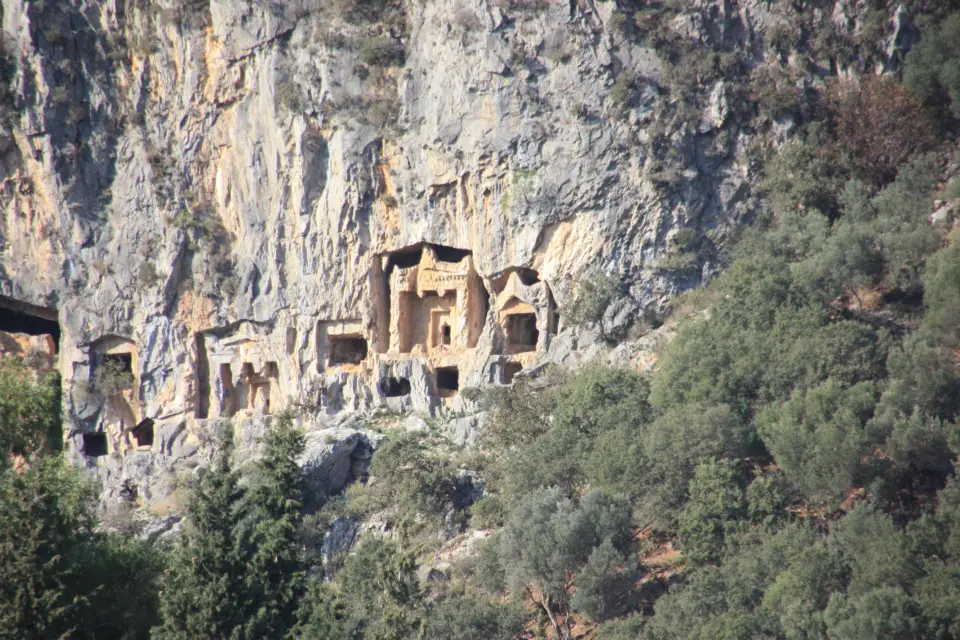
From a boat on the river at Dalyan, you look up at temple fronts carved straight into a cliff, with columns, pediments and dark doorways high above the reeds. These are the rock tombs of Kaunos, a harbor city on the old border between Caria and Lycia. Its ruins lie just across the river from the town of Dalyan. From Fethiye, join our Dalyan tour.
Beyond the tombs, a short walk leads to a theater, Roman baths, a domed church and a harbor that is now a lake. The sea has retreated far beyond the delta.
Kaunos stands on the west bank of the Dalyan River, the ancient Calbys, in Muğla province. In ancient times, the river marked the border between Caria and Lycia, and the city belonged in turn to each. It was also an important sea port, perhaps as early as the 10th century BC.
Over time, however, the river silted up the bay, and the sand bar of İztuzu Beach formed. Kaunos therefore lost its sea. Today, the site lies inside the Köyceğiz-Dalyan Special Environmental Protection Area, rich in wildlife and wide views.

In their own language, the people called their city Kbid. The Kaunians fought hard against the Persian general Harpagus but lost.
Much later, archaeologists found a bilingual inscription in Greek and Carian here. Along with other texts from Kaunos, it helped scholars decipher the Carian alphabet.
In the 5th century BC, Kaunos joined the Delian League. Later, it grew into a busy port exporting salt, salted fish, pine resin and dried figs. The Persian satrap Mausolus, who ruled from 377 to 353 BC and lies in the famous Mausoleum, enlarged the city, built terraces and ringed it with huge walls.
After that, early in the 2nd century BC, Rhodes bought Kaunos for 200 talents. Under Rome, the city prospered again; it enlarged its theater and built baths and a palaestra.
Later, Arab and pirate raids began. In the 14th century, sea trade fell sharply, and in the 15th century malaria struck. So the city was abandoned, and an earthquake, sand and thick vegetation covered it. A Royal Navy surveyor visited the ruins in the 19th century, and later Professor Baki Öğün began the excavations.

Rock tombs cut into the cliff face the river. Their facades copy Hellenistic temples, with two Ionic columns, a triangular pediment and toothed friezes. Because they sit outside the main site, the best view is from Dalyan or from a boat.
The acropolis rises on a high rock, fortified with Byzantine walls. From the top, you see the ancient city, Dalyan, the river and İztuzu Beach. On its slope stands the theater. Today, it is still in fairly good shape and still hosts occasional performances.

On the palaestra terrace, the Roman baths later lost their cold room to a church. Nearby, a domed basilica of the 5th century AD still stands. Look also for the base of a round platform.
By Sülüklü Lake, the “Lake of the Leeches” that was once the inner port, lies the harbor agora of the 4th century BC. A covered stoa and a fountain house also stand beside it. Under Hadrian, inscriptions show, the city lowered harbor tolls as the port silted up. Up on a terrace, a temple of the 3rd century BC faces a circle of columns, where an obelisk once honored the mythical founder Kaunos.
Dalyan lives by its river. Its name means “fishing weir” in Turkish: sea bass, mullet and sea bream swim up to Köyceğiz Lake to spawn and are caught in the weirs on their way back. Around the town, pomegranate orchards have largely replaced the old cotton fields.
Further south, İztuzu Beach is a nesting ground for loggerhead sea turtles. Today the beach lies inside the Köyceğiz-Dalyan Special Environmental Protection Area, where people use it by day and the turtles by night. The easiest way to arrive is by river; see our Dalyan boat tour.
Our notes for Kaunos and Dalyan
Our suggestion Take a river boat from Dalyan, see the tombs from the water, climb Kaunos, and end the day with a mud bath and a swim at İztuzu.
Because few ruins are reached by river boat. Glide past the temple tombs in the cliff, climb to the theater, and look from the acropolis over the reeds to İztuzu Beach.

Open in Google Maps (opens in a new tab) Open in Apple Maps (opens in a new tab)
Rock tombs cut into the cliff above the Dalyan River, with facades like Ionic temple fronts.
The ruins are a short boat trip across the river from Dalyan.
Over time the river silted up the bay, so the old harbor city now lies well inland from the coast.
It sits on the slope of the acropolis and looks out over the old harbor.
From May to September the beach closes between 8 p.m. and 8 a.m. to protect nesting loggerhead turtles.
 Tour
Private Dalyan Boat Tour: Rock Tombs, Hot Springs and İztuzu Beach
 Tour
Fethiye to Marmaris Blue Cruise: 4 Days on a Gulet
 Tour
Marmaris to Fethiye Blue Cruise: 4 Days on a Gulet
 Tour
Dalyan Tour from Marmaris: Private Day on the River
 Article
Is Dalyan Worth It?
 Place
Sultaniye Hot Springs, Köyceğiz
 Place
İztuzu Beach
 Place
Sobesos