James Mellaart
A brilliant site-spotter who found Hacılar and Çatalhöyük, and the inventor of the missing Dorak treasure and of goddesses that never existed.

In November 1958, a British archaeologist walked across a mound on the Konya plain and saw the signs of a very old town under his feet. It was Çatalhöyük, and his excavations there in the 1960s made it one of the most famous Neolithic sites in the world. Yet the same man, James Mellaart, also left behind one of the strangest trails of forgery in modern archaeology.
His story is worth knowing before you visit Çatalhöyük, because it explains why some of the most famous “finds” from the site never existed. So read on for a tale of real discoveries, a missing treasure and decades of doubt.
Who Was James Mellaart?
James Mellaart was born in London on November 14, 1925, to a Dutch father, and he grew up partly in the Netherlands. After the Second World War he studied archaeology at University College London. In 1951 he won a fellowship at the British Institute of Archaeology at Ankara, and from 1957 to 1961 he served as its assistant director.
After that, he taught prehistoric archaeology at Istanbul University until 1963. From 1964 until 1991 he lectured on Anatolian archaeology at the Institute of Archaeology in London. Earlier, in 1954, he had married Arlette Meryem Cenani, whom he had met on an excavation near Istanbul.
James Mellaart in numbers
- 1925born in London
- 1958identifies Neolithic Çatalhöyük
- 2012dies in London
The Discoveries of James Mellaart
A gifted site-spotter
In the 1950s Mellaart surveyed southwestern Anatolia and became famous as a “site-spotter”. Because he could recognize a buried settlement from slight bumps in a field, he found hundreds of pre-classical sites. From 1954 to 1959 he also worked with Seton Lloyd at Beycesultan, a long-lived Bronze Age town.
In 1956 he found Hacılar, near Burdur, and he excavated it from 1957 to 1960. Today its painted pottery and clay figures are in the Museum of Anatolian Civilizations in Ankara.

Çatalhöyük
In 1958 Mellaart, David French and Alan Hall identified the Neolithic layers of Çatalhöyük. Then, in four seasons up to 1965, his team exposed more than 150 buildings. They also found houses packed so tightly that people entered through the roofs, as well as bull horns, reliefs and wall paintings that nobody had seen before in the Near East.

His reports in the Illustrated London News made the site famous far beyond archaeology. In 1967 his book Çatal Hüyük: A Neolithic Town in Anatolia argued that farming and town life developed in Anatolia, not only in the Fertile Crescent.
Forgeries and Doubt
The Dorak treasure
In 1959 Mellaart published a royal treasure from the 3rd millennium BC, said to come from Dorak near Lake Uluabat. He claimed that a young woman on a train to İzmir had shown it to him at her home. However, nobody could ever find the treasure, the woman or the address. In 1962 the Turkish press accused him of smuggling, and in 1964 he lost his permit to dig at Çatalhöyük. A British inquiry cleared him in 1968, but the doubts never went away.
Goddesses and kilims
In the 1980s he presented new “wall paintings” from Çatalhöyük that looked like modern kilims and showed a great goddess. The originals had not survived. Carpet experts showed that the motifs could not have been woven at the time, and later excavations found nothing like them. After his death, researchers also found forged objects and drawings among his papers in London.
Death and Legacy
The British Academy elected him a fellow in 1980, and in 1999 he returned to Çatalhöyük, where Ian Hodder had restarted excavations in 1993. Mellaart died in London on July 29, 2012, and the excavation team then held a memorial gathering on top of the mound.
Today scholars still credit him with real discoveries at Hacılar, Beycesultan and Çatalhöyük. Since then, however, his forgeries have taught archaeologists to check every drawing and every story. So when you visit Çatalhöyük, a UNESCO World Heritage Site, trust the excavated houses over the legends.
You can judge the site for yourself on our Çatalhöyük and Sille tour from Konya. Tell us your dates, and we arrange the car and the guide.
Following James Mellaart in Turkey
- Çatalhöyük: walk the excavated houses under the shelters southeast of Konya.
- Ankara: see finds from Çatalhöyük and Hacılar in the Museum of Anatolian Civilizations.
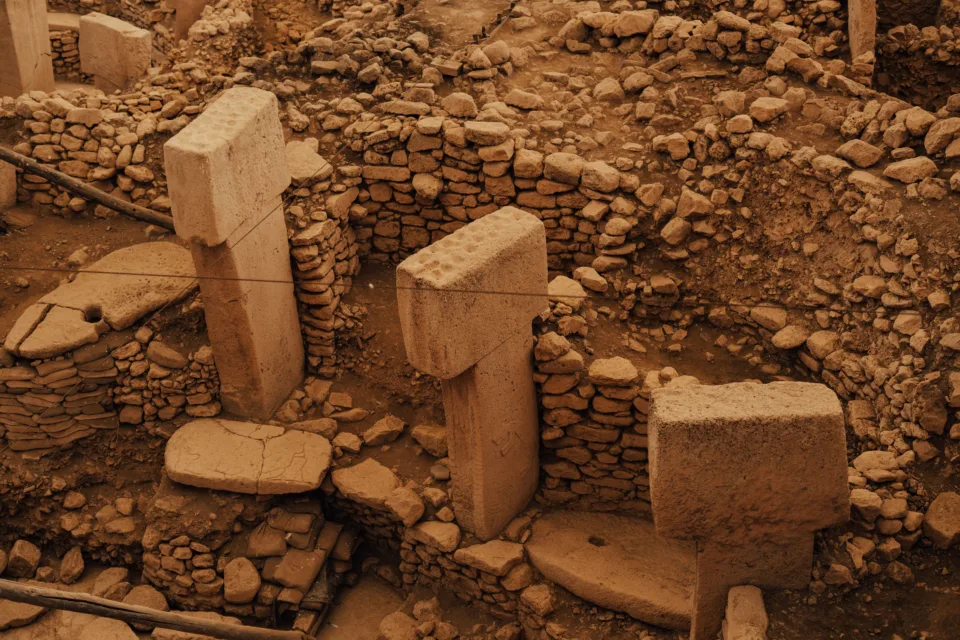
- Göbeklitepe: compare with an even older site, excavated by Klaus Schmidt at Göbeklitepe.
His traces today
- ÇatalhöyükNear Çumra, the mound he first dug in the early 1960s has a shelter, a replica house and a visitor center.
- HacılarHis other famous site lies near Burdur. Some of its finds are in the Burdur Museum.
- The questionSome of his drawings were later shown to be invented. Guides at the site will tell you about it.
Our suggestion Visit Çatalhöyük and then the Museum of Anatolian Civilizations in Ankara, where the wall paintings and figurines he found are on display.