
Photo: İhsan Deniz Kılıçoğlu / Wikimedia Commons, CC BY-SA 3.0
Anadoluhisarı
The Beauteous Fortress of the Asian shore: older than Rumelihisarı, smaller, at the mouth of the Göksu stream.
Overview
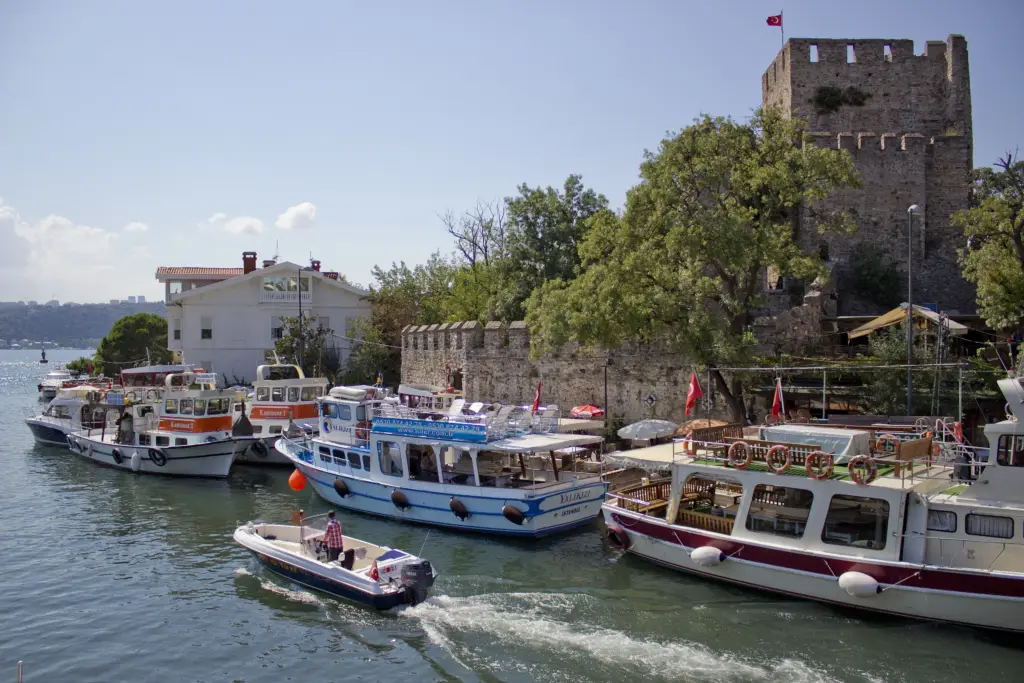
On the Asian shore, where the Bosphorus is at its narrowest, a little stream called the Göksu flows into the strait. Fishing boats crowd its mouth, while wooden mansions lean over the water, and above them all stands an old square stone keep. Across the strait, the great towers of Rumelihisarı face it. This is Anadoluhisarı, the Anatolian Fortress, built in the 1390s. To fish these waters with a local captain, see our fishing trips.
So look for it from your boat, on the right as you sail north.
- Good for
- History lovers, Bosphorus cruises, waterside walks
- Best combined with
- Rumelihisarı, Kanlıca, a Bosphorus cruise
Anadoluhisarı at the Narrowest Point
To begin with, the fortress stands in the Beykoz district, on the Asian side, at the narrowest point of the Bosphorus. The Göksu stream marks its southern edge. Today, in turn, a small neighborhood of wooden yalıs and narrow lanes surrounds the walls, and it shares the fortress’s name.
Anadoluhisarı in numbers
- 1390sBayezid I builds the fortress
- 1452Rumelihisarı rises across the water
History of Anadoluhisarı
Bayezid’s watch fort
Sultan Bayezid I built the fortress in the 1390s, as he prepared to besiege Byzantine Constantinople. At the time, its name was Güzelce Hisar, the Beauteous Fortress. Inside the five-sided walls, at the same time, a tall square keep watched over the strait. However, his siege failed. First a crusade at Nicopolis interrupted it, and then his defeat at the Battle of Ankara ended it.
Two fortresses, one strait
Half a century later, his great-grandson Mehmed II strengthened the fortress with a thick new wall and more towers. Then, in 1452, Mehmed II built Rumelihisarı right across the water. Together, the two fortresses closed the Bosphorus to ships in 1453, and so they helped the Ottomans take the city. Afterward, Anadoluhisarı became a customs house and a military prison and slowly fell into ruin, until a restoration in 1991 to 1993 and new work from 2021.
What to See at Anadoluhisarı
The keep and the walls
Although you cannot go inside, the fortress is easy to see. From the shore road, you walk right past its walls and towers. Even better, from a boat you see the keep rise over the water, exactly as sailors did six centuries ago.

The Göksu stream
Just south of the walls, the Göksu stream winds inland under the trees. In Ottoman times, it was a favorite place for outings by boat, and painters loved it too. For example, the Italian court painter Fausto Zonaro painted a young woman in a light veil beside the boats here.
The Many Names of Anadoluhisarı
Early Ottoman writers called the fortress Güzelcehisar, though one copy of a chronicle gives Gözlücehisar, the watch fortress, a name that fits its task. Others knew it as Yenicehisar, the New Fortress, or Akçehisar, and Western travelers translated the first of these as Neo-Castrum. In the 17th century, a warden and 200 soldiers from Kocaeli manned it, with guns aimed across at Rumelihisarı and toward Akıntıburnu, and a small mosque stood outside the walls. Later, it served as a prison. From the 1830s it was left empty, wooden houses filled the shore between the walls, the Göksu and the sea, and the gates of the outer wall were widened to let the shore road through.

Our notes for Anadoluhisarı
- Best viewFrom the water, on a Bosphorus cruise heading north.
- ClosedThe fortress is not open inside, so plan just a short stop on land.
- YalısWooden mansions line the shore around the walls.
- Sister fortressRumelihisarı, across the water, is open as a museum.
Our suggestion See both fortresses on one cruise: Rumelihisarı on the left, Anadoluhisarı on the right, at the narrowest point of the Bosphorus.
How to Visit Anadoluhisarı
Getting there
In general, the first view is from a Bosphorus boat. By land, buses run north along the Asian shore road from Üsküdar.
Seeing it with us
You pass it on our Bosphorus tour and on a Bosphorus cruise, and we can stop here on our Bosphorus villages tour. Afterward, cross over to Rumelihisarı, its younger sister, and read about the man who joined them, Mehmed the Conqueror. Just south, the little Küçüksu Pavilion makes a lovely second stop.
Because here the Ottoman story of Istanbul began, sixty years before the conquest. See the old keep rise over the fishing boats of the Göksu, then look across the water to its younger sister, Rumelihisarı.
Map
Open in Google Maps (opens in a new tab) Open in Apple Maps (opens in a new tab)
Frequently asked questions
Who built Anadoluhisarı?
Sultan Bayezid I, in the 1390s, as he prepared to besiege Byzantine Constantinople. Later, Mehmed II strengthened it.
What is the difference between Anadoluhisarı and Rumelihisarı?
Anadoluhisarı stands on the Asian shore and is about sixty years older. Rumelihisarı, built by Mehmed II in 1452, faces it on the European shore.
Can I go inside Anadoluhisarı?
It is not open to the public, so you see it from the street, from the Göksu stream and best of all from a boat.
Why was it built here?
This is the narrowest point of the Bosphorus, so the fortress could watch every ship.
How do I get to Anadoluhisarı?
Bosphorus boats pass right in front of it. By land, buses run along the Asian shore road from Üsküdar.
What was Anadoluhisarı called in Ottoman times?
Güzelcehisar in the early chronicles, and also Yenicehisar and Akçehisar; Western travelers called it Neo-Castrum.


