Photo: Turkey Your Way
Aynalıkavak Pavilion
A yellow wooden pavilion on the Golden Horn, named for Venetian mirrors and remembered for a treaty with Russia.
Overview
On the north shore of the Golden Horn, in the old neighborhood of Hasköy, a yellow wooden pavilion stands in a walled garden of cedars and lawns. Even from afar, its two rows of windows are crowned with white tracery, and its eaves reach far out over the walls. This is the Aynalıkavak Pavilion, what remains of an Ottoman palace whose halls once stood in these gardens. With a guide, join our Aynalıkavak Pavilion tour.
- Good for
- Ottoman history, a garden pavilion, the Golden Horn
- Best combined with
- Rahmi M. Koç Museum, Balat, Pierre Loti Hill
The Story of the Aynalıkavak Pavilion
Originally, when the Ottomans took the city in 1453, this slope below Okmeydanı was a large grove that ran down to the shore. Later, under Selim I, the imperial shipyard grew up nearby, and the grove became known as the Shipyard Garden.
The Shipyard Palace
While Sultan Ahmed I was away in Edirne, his grand admiral, Halil Pasha of Kayseri, ordered a palace fit for a sultan in the Shipyard Garden. So the first buildings were finished in 1613. After that, Murad IV and Sultan İbrahim added new wings. However, under Mehmed IV, a fire destroyed the palace, and it had to be rebuilt.
Why “Aynalı”? The Venetian mirrors
Then, after the Ottoman–Venetian war of 1715, the Venetians sent Ahmed III a gift of large, precious mirrors. In turn, the sultan hung them in the halls and rooms of the Shipyard Palace. From then on, people called it the palace of the mirrors, Aynalıkavak. Ahmed III also stayed here with his household after the great circumcision festival he held at Okmeydanı.

A Treaty and a Crimean Khan
Afterward, on March 10, 1779, the Ottoman Empire and the Russian Empire signed a treaty here, with the French ambassador as mediator. Known as the Treaty of Aynalıkavak, it was an attempt to settle the struggle over the Crimea.
Curiously enough, the pavilion’s later history is tied to the Crimea too. By the end of the 18th century, however, under Abdülhamid I, the old palace was in ruins. Then Devlet IV Giray, the former Crimean khan, repaired it, and his descendants owned it until 1923.
What to See at the Aynalıkavak Pavilion
The pavilion and its rooms
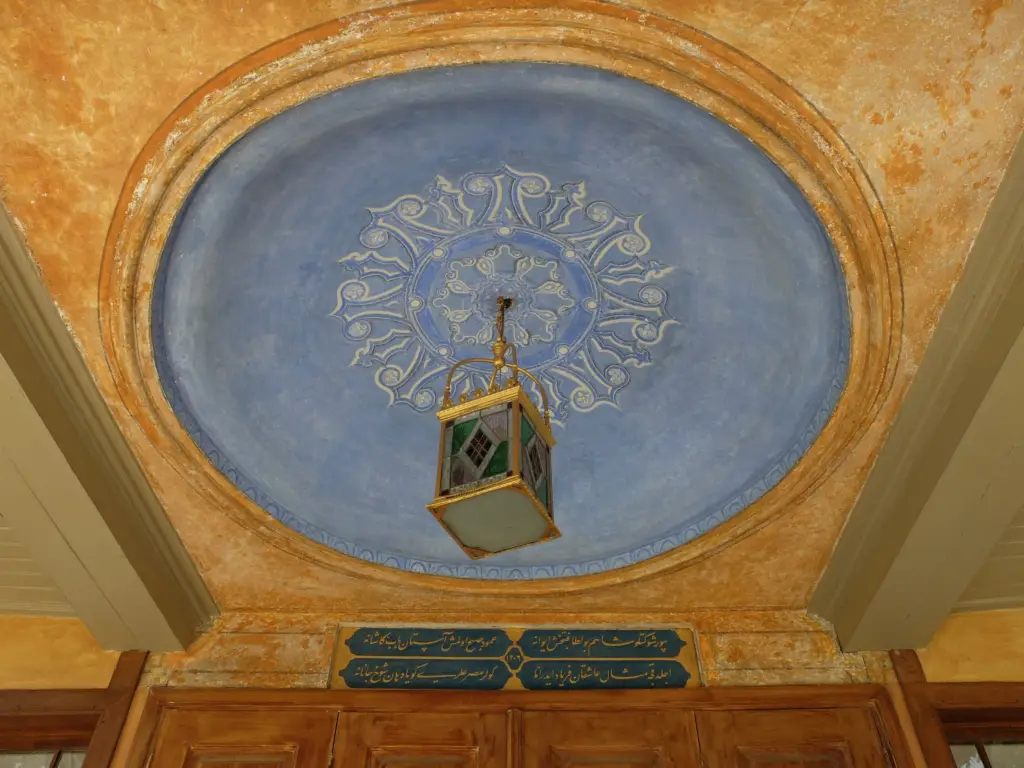
First, walk around the pavilion to see its two tiers of windows. The upper ones carry white wooden tracery, set between slender painted columns. Inside, then, look up at the painted ceilings, where medallions of calligraphy float on pale blue.
The garden and the gate
Next, stroll through the garden, with its pool and fountain, its old trees and garden paths. Leave through the stone gate, which carries the monogram of the sultan. Today the sign at the gate names the pavilion as a museum of music.

Tips for visiting the Aynalıkavak Pavilion
Our notes for Aynalıkavak
- MirrorsThe name comes from Venetian mirrors of 1715.
- TreatyThe 1779 treaty with Russia was signed here.
- GardenCedars and lawns make it a green stop.
Our suggestion Combine Aynalıkavak with the Rahmi M. Koç Museum, a short walk along the Golden Horn.
How to Visit the Aynalıkavak Pavilion
The pavilion stands in Hasköy, in the Beyoğlu district, on the Golden Horn. We confirm the opening hours with the National Palaces for your day.

Then combine it with the Rahmi M. Koç Museum, a walk along the Golden Horn, the colorful streets of Balat and the view from Pierre Loti Hill.

Because it is one of Istanbul's most intimate palaces. Walk through a walled garden on the Golden Horn, look up at painted ceilings, and remember that a sultan once hung Venetian mirrors in these rooms.

Map
Open in Google Maps (opens in a new tab) Open in Apple Maps (opens in a new tab)
Gallery
Frequently asked questions
Where is the Aynalıkavak Pavilion?
In Hasköy, in the Beyoğlu district of Istanbul, on the north shore of the Golden Horn.
Why is it called Aynalıkavak?
After the Ottoman–Venetian war of 1715, Venice gave Ahmed III large mirrors, which he hung in the palace. Ayna means mirror in Turkish.
What happened at Aynalıkavak in 1779?
The Ottoman and Russian empires signed the Treaty of Aynalıkavak here, with the French ambassador as mediator, over the question of the Crimea.
Who manages the Aynalıkavak Pavilion?
The Turkish Directorate of National Palaces, which also runs Dolmabahçe and other Ottoman palaces.