

Neighborhood
Balat
Beyond the colorful houses: a ship-shaped synagogue pulpit, an iron church from Vienna and the only…
Photo: Turkey Your Way
The curving harbor of Constantinople, closed by a chain, crossed by Leonardo on paper, and lined today with old quarters and parks.
North of the old city, a curving inlet of water runs inland from the Bosphorus for 7.5 kilometers (4.7 miles). For more than two thousand years, the Golden Horn was the great harbor of Byzantium, Constantinople and Istanbul. Today, its shores hold old Greek and Jewish quarters, mosques, churches and parks. A hilltop café also looks out over the water. Our Golden Horn tour ends the day with tea on Pierre Loti Hill.
So ride the ferry upstream, walk the lanes of Fener and Balat, and end the day above the water at Eyüp. It shows a residential side of Istanbul, too. See also Surp Hreşdagabet Church. To see the Patriarchate in Fener and the Ahrida Synagogue in Balat with a guide, join our Three Faiths of Istanbul tour. Choosing one? Read Bosphorus cruise or Golden Horn.
The Golden Horn, in Turkish Haliç, is the estuary of the Alibey and Kağıthane creeks. It widens from about 200 meters (660 feet) at Eyüp to about 700 meters (2,300 feet) between Cibali and Kasımpaşa, and it grows deeper toward the Bosphorus. Near Cibali, in the Ayakapı quarter, stands the Gül Mosque, a Byzantine church turned mosque. Its waters also form the northern edge of the historic peninsula, whose tip is Sarayburnu, the point of the old city.

Nobody is sure why it is called “golden”. Some historians think of the riches that reached the harbor. Others think of the yellow light on the water at sunset.
The Golden Horn in numbers

First, the Byzantine navy kept its headquarters here, and walls guarded the shore. In times of danger, a great chain closed the entrance. It ran across to the old tower of Galata to stop enemy ships. However, in 1203, Crusader knights took the Galata tower that held one end and opened it. In 1453, Mehmed II could not force the chain. So he had his ships dragged overland across Galata on greased logs and launched into the Horn.
After the conquest, Mehmed II settled Greeks in the Phanar, today’s Fener. Later, Bayezid II invited Jews expelled from Spain to settle in Balat. Around 1502–1503, Leonardo da Vinci even drew a single-span bridge over the Golden Horn for Bayezid II, though it was never built.
For decades, however, factories, warehouses and shipyards polluted the inlet. Later, clean-up work brought back fish and wildlife. Parks now line both shores.
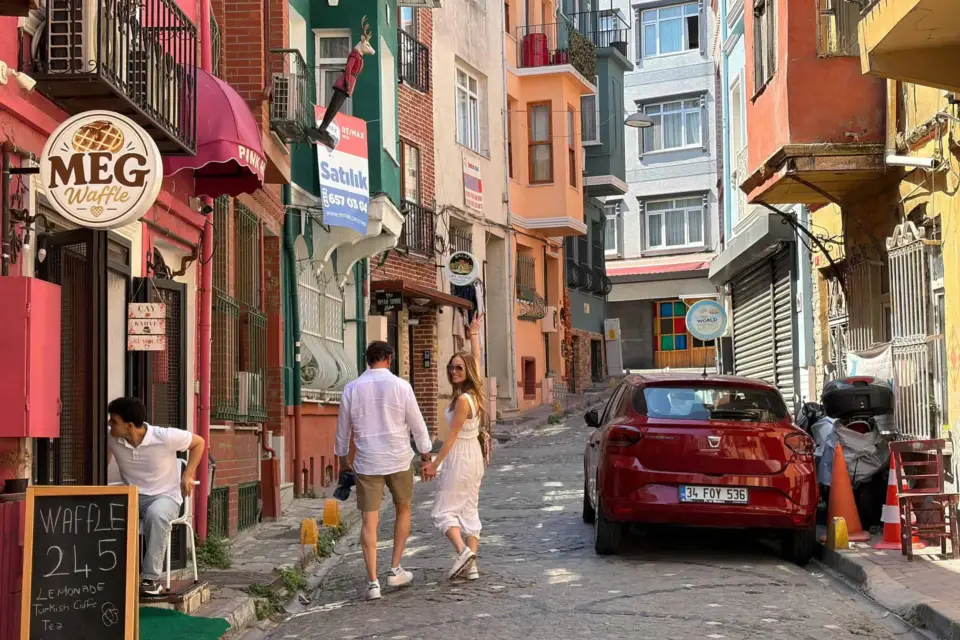
On the western shore, the old quarters of Fener and Balat climb the hill in colorful houses. Here, for example, you will find the Bulgarian Iron Church by the water, and uphill the Chora and the Theodosian Walls.

Further upstream, the Eyüp Sultan Mosque is a revered place of pilgrimage. Above it, Pierre Loti Hill offers tea with a sweeping view down the whole inlet.
Finally, four bridges cross the Golden Horn today, from the Galata Bridge at its mouth to the Haliç Bridge upstream. In between, the metro bridge carries the M2 metro line across the water. The old Galata Bridge, by contrast, lies near Ayvansaray as an event space.

Along the shores, you also find parks, cemeteries of three faiths, museums and university campuses. The T5 tram runs along the western shore. Yet the best way up the inlet is still the small Golden Horn ferry, which zigzags between both banks and ends at Eyüp.
Our notes for the inlet
Our suggestion Take the little ferry up to Eyüp in the morning, visit the Eyüp Sultan Mosque, ride the cable car to Pierre Loti for tea, then come back down by boat and get off at Balat or Fener to walk the old quarters.

Because the Golden Horn holds the stories the Bosphorus skips. Ride the ferry upstream past Fener and Balat, then climb to Pierre Loti Hill for tea above the water at Eyüp.
Neighborhood
Beyond the colorful houses: a ship-shaped synagogue pulpit, an iron church from Vienna and the only…

The Bulgarian Iron Church of Saint Stephen in Balat: a Neo-Byzantine church made of cast iron…

The Chora, now the Kariye Mosque, in Edirnekapı, Istanbul: a Byzantine church with some of the…

The Eyüp Sultan Mosque on the Golden Horn: the shrine of a companion of the Prophet,…

Open in Google Maps (opens in a new tab) Open in Apple Maps (opens in a new tab)
The horn refers to its curving shape; golden may refer to the riches of the harbor or the sunset light on the water.
In 1453, unable to break the chain, he had them hauled overland across Galata on greased logs.
Yes. Around 1502–1503 he drew a single-span bridge over the Golden Horn for Sultan Bayezid II; it was never built.
Take the Golden Horn ferry from Karaköy or Üsküdar, or the T5 tram along the western shore.
Fener and Balat, the Bulgarian Iron Church, the Eyüp Sultan Mosque and Pierre Loti Hill.
 Journey
Turkey Photography Tour in 10 Days: Istanbul, Cappadocia and the Turquoise Coast
 Journey
Turkey Tour with Kids in 8 Days: Istanbul, Cappadocia and the Antalya Coast
 Tour
Private Balat and Fener Walking Tour in Istanbul
 Tour
Private Istanbul Photography Walk at Sunrise
 Tour
Private Istanbul Hans Tour: Hidden Courtyards
 Tour
Private Galata and Karaköy Evening Walk in Istanbul
 Tour
Private Pierre Loti Sunset Tour: Eyüp and the Golden Horn
 Tour
Private Literary Istanbul Tour: Books, Pera Palace and Pamuk
