
Photo: Semih Ekinci / Wikimedia Commons, CC BY-SA 3.0
Datça
A slender peninsula between two seas: clear bays, almond groves, the stone lanes of Eski Datça and ancient Knidos, home of Praxiteles' Aphrodite.
Overview
Datça is a long, thin finger of land that points from Türkiye’s southwest coast toward the Greek islands. On one side lies the Aegean, on the other the Mediterranean, and the wind seems to come from both at once. Pine-covered hills then drop into coves of clear water. Old stone villages smell of thyme and almond blossom, and at the very tip an ancient city looks across the sea to Kos. For a day at the tip of the peninsula, join our Knidos day trip.
Datça is known for its bays and its slow pace, but there is more. Yet the peninsula also hides some of the best stories on the Turkish coast. Here the ancients worshipped one of the first life-size nude statues of a goddess in Greek art. A local astronomer built an observatory, and an architect from Knidos went on to design one of the Seven Wonders of the World. Even the oracle of Delphi once told the people of Knidos to stop digging, as you will see below.
- Good for
- Slow travel, swimming, sailing, couples, history lovers
- Best combined with
- Bodrum, Marmaris, Bozburun, Symi, a gulet cruise
Datça, the Peninsula Between Two Seas
Administratively, the Datça Peninsula belongs to Muğla province. It stretches about 70 kilometers (43 miles) west from the Marmaris area, between the Gulf of Gökova to the north and the Gulf of Hisarönü to the south. At one point, near Balıkaşıran, it is barely a kilometer wide. The main town, also called Datça, sits halfway along the peninsula around a small harbor. Then the road continues west through almond groves to Knidos at the tip.
Datça still has no mass tourism, no big resorts and few nightclubs. Instead, it has fishing villages, stone houses, boutique hotels and some of the cleanest water on the coast. Instead, it attracts writers, artists, sailors and Turkish families who return every year.
How much time do you need in Datça?
| Time you have | What we suggest |
|---|---|
| One day | Datça town, Eski Datça and a sunset in Knidos |
| Three days | Add the bays of Palamutbükü and Hayıtbükü, a boat trip and long lunches |
| A week | Slow down: swim every day, walk the old paths and add Bozburun or Symi |
From Knidos to Almond Country
The land of Knidos
In antiquity the peninsula belonged to Knidos, one of the great cities of the Dorian Greeks. Knidos was famous for its wine, its medical school and its scholars, and it traded across the whole eastern Mediterranean. Its people initially lived near today’s Datça town. Later, around the 4th century BC, they moved the city to the tip of the peninsula, where two harbors could shelter a fleet.
The canal that Delphi forbade
The most curious story, however, comes from the Greek historian Herodotus. In the 6th century BC, the Persian general Harpagus marched against the Greek cities of Asia Minor. The people of Knidos decided to dig a canal across the narrowest part of the peninsula and turn their land into an island. However, the work went badly. Stone splinters injured the workers, especially their eyes, more often than seemed natural. So the Knidians sent to Delphi to ask the oracle why. The answer was short: if Zeus had wanted an island, he would have made one. The Knidians stopped digging, and soon afterwards they surrendered to the Persians without a fight.
From Knidos to Reşadiye
Knidos faded in the Byzantine period, so the peninsula became a land of small villages, olive groves and almond trees. In Ottoman times the main village sat inland, at today’s Eski Datça, because the coast was exposed to pirates. For a brief period in the early 20th century, the town and the peninsula were called Reşadiye, after Sultan Mehmed V Reşad; the name survives today in one quarter of the town. In the second half of the 20th century, writers and artists discovered the peninsula, and Datça began its second life as a place for people who want to slow down.
Bays, Villages and Knidos
Knidos

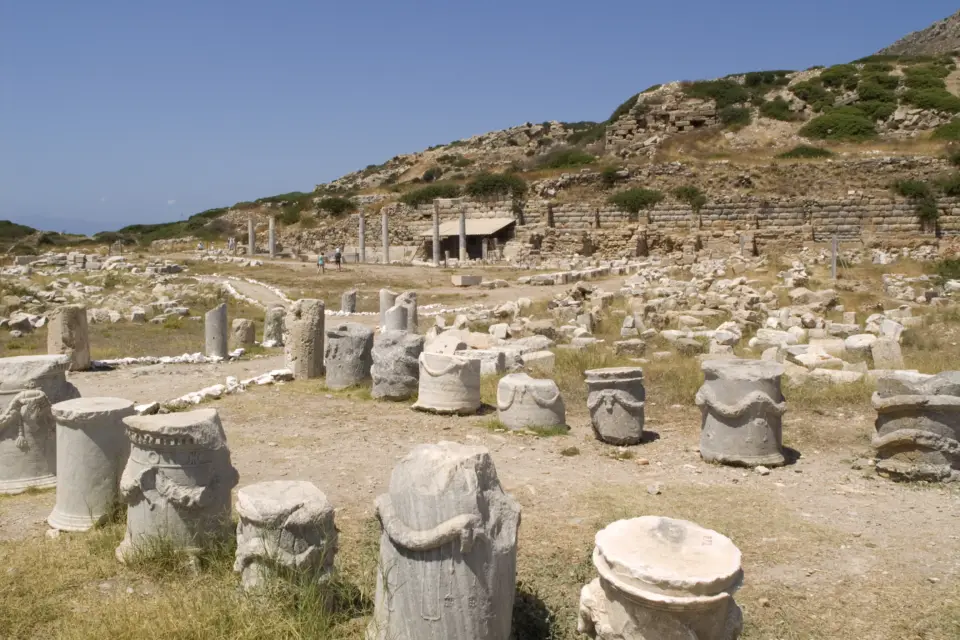
At the tip of the peninsula, about 35 kilometers (22 miles) west of Datça town, the ruins of Knidos spread over terraces between two bays. First, walk down to the two ancient harbors, still enclosed by their stone moles. Climb past the theaters, the agora and the temples to the round foundation of a small temple on the upper terrace. Some archaeologists think it may also have held the most famous statue of the ancient world.
The Aphrodite of Knidos
In the 4th century BC, the sculptor Praxiteles carved two statues of Aphrodite. The island of Kos chose the clothed one. The Knidians bought the nude. It was one of the first life-size statues of a nude woman in Greek art, and it became a sensation. Travelers sailed to Knidos just to see her, while ancient writers told stories of her beauty. Sadly, the original is lost, but Roman copies survive in museums from Rome to Munich. When you stand on the terrace, you can imagine the crowds that once came here for her.
The scientists and the lighthouse
Knidos was also a city of science. The mathematician and astronomer Eudoxus, whose ideas fed into Euclid’s Elements, built an observatory here in the 4th century BC. Ancient writers also name Sostratus of Knidos as the architect, or patron, of the Lighthouse of Alexandria, one of the Seven Wonders of the World. The story goes that he carved his own name into its base, hidden under plaster that bore the king’s name. When the plaster fell away, his name remained.
The Lion of Knidos in London

Surprisingly, some of the finest sculptures of Knidos are in the British Museum. In the 1850s the British archaeologist Charles Newton excavated here. He shipped to London a colossal marble lion from a tomb on a headland east of the city, along with the seated statue of the goddess Demeter. Today the Lion of Knidos lies in the Great Court of the British Museum. Its headland still looks out over the sea.
On our private Knidos visit: we time it for the late afternoon, when the light turns gold and the day boats have gone. Your guide then reads the ruins with you, from the harbors to the temple terrace, and we stay for the sunset.
Eski Datça
Two kilometers inland from the harbor, Eski Datça (“Old Datça”) is the old village of the peninsula. Its stone houses, bougainvillea, cobbled lanes and tiny squares are perfect for a slow walk in the evening. The poet Can Yücel, one of Türkiye’s most loved writers and translators, spent his last years in a modest stone house here. His poems still appear on the walls of cafés. He is buried in Datça, and his grave is a place of pilgrimage for his readers.
Datça town and its harbor
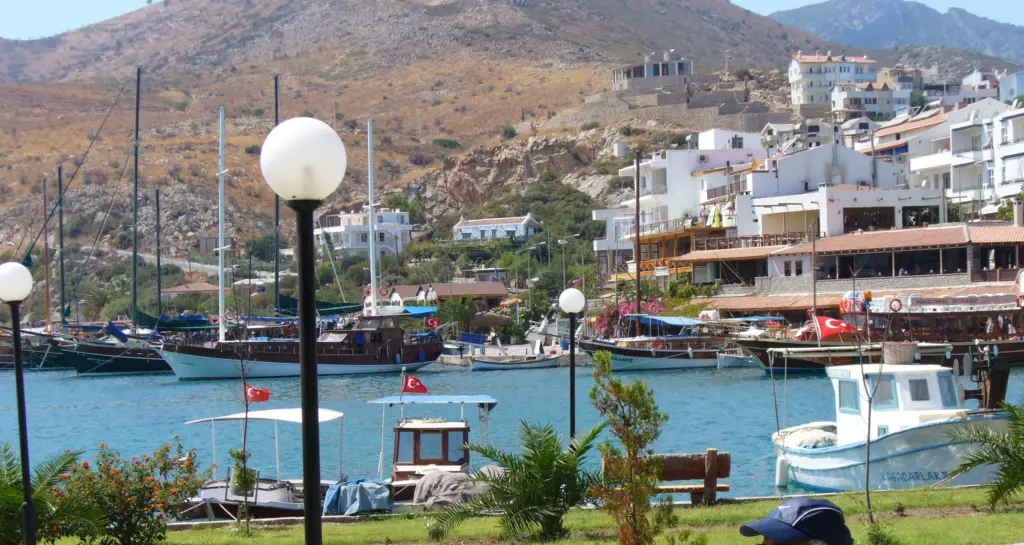
The town itself, by contrast, is small and friendly. In the morning, fishermen sell their catch at the harbor, while in the evening families walk along the waterfront. Kumluk, the town beach, is also a short walk from the center. Ferries leave from here in season for the Greek islands of Symi and Rhodes.
The bays: Palamutbükü, Hayıtbükü and more

The coast of Datça is a string of bays, each with its own character:
- Palamutbükü: a long pebble beach with fish restaurants on the sand, on the road to Knidos.
- Hayıtbükü (Mesudiye): a small, sheltered bay with clear water and a few guesthouses.
- Ovabükü: a wide bay with a family atmosphere.
- Kargı: a sandy beach a short drive from town, popular with families.
However, many bays can only be reached by boat. For that reason, a day on a gulet or a private boat is the best way to see the peninsula from the water.
Balıkaşıran, the narrowest point
East of Datça town, the road crosses the narrow neck of the peninsula near Balıkaşıran, where the land is barely wide enough for the road and a few fields. The name means “where the fish jump across”, because the two seas almost touch here. This is the neck the Knidians tried to cut in Herodotus’s story. Stop for a moment, then look at the two seas on either side.
The best photo spots in Datça
- Knidos at sunset: the temple terrace and the sea toward Kos.
- Eski Datça: stone walls, blue doors and bougainvillea.
- Palamutbükü: fishing boats on a long pebble shore.
- The road to Knidos: almond groves and two seas below.
- Datça harbor: fishing boats in the morning light.
Almonds, Honey and Slow Days
Almonds, honey and herbs
Datça’s almonds are famous across Türkiye, especially the oval, smooth nurlu badem. Groves cover the inland villages, so in late winter the hills bloom white and pink. The harvest comes in late summer. In November 2023, Datça Nurlu Bademi was registered as a protected designation of origin by the Turkish Patent and Trademark Office. Also look for thyme honey, olive oil, sage and dried herbs sold by village women in town.
Datça in numbers
- ~1 kmwide at Balıkaşıran, its narrowest point (0.6 mi)
- Februarythe Almond Blossom Festival, held since 2018
The slow life
People in Datça also like to say that time moves differently here. A saying often attributed to the ancient geographer Strabo claims that “God sends his favorite servants to Datça to live long”. No ancient text actually contains it. Still, spend a few days here and you will understand why everyone repeats it.
The wind
Datça is windy, especially in the afternoons in summer. Sailors love it, and in fact the wind keeps the heat bearable. Early mornings, however, are often calm, so swim before breakfast when the water is like glass.
The Datça Table
- Fresh fish: eat it by the water in Palamutbükü or at the harbor in Datça. Ask what came in that morning.
- Almonds: raw, roasted, in cookies and in badem ezmesi, the soft almond paste.
- Olive-oil dishes and wild greens: village cooking based on what grows on the peninsula.
- Thyme honey: with village bread and cheese at breakfast.
- Local wine: vineyards on the peninsula are reviving the wine tradition of ancient Knidos.
Come in early February for the Almond Blossom Festival, when the groves turn white and pink. Restaurants change from season to season.
How to Visit Datça
Getting to Datça
- From Dalaman Airport: about 2.5–3 hours by car, via Marmaris. The same airport serves Ölüdeniz and Fethiye.
- From Bodrum: in season, a car ferry crosses the Gulf of Gökova to Körmen port, about 9 kilometers (5.6 miles) from Datça town.
- From the Greek islands: seasonal ferries connect Datça with Symi and Rhodes.
- By sea: Datça is a classic stop on gulet cruises along the Carian coast, the western end of the Turquoise Coast.
- On the way: stop at Akyaka, at the head of the Gulf of Gökova, for its clear Azmak stream and white wooden houses.
When to go
May, June, September and early October are ideal: warm sea and softer light. By contrast, July and August are hot, while winter is green. The almond blossom in late winter is also a beautiful, little-known season. The longest section of the Carian Trail also crosses the peninsula, all the way to Knidos.
Local tips for Datça
- Rent a car or travel with a driver: the bays and Knidos are spread out, while public transport is limited.
- Go to Knidos late: the light is better, since the day boats have left.
- Bring water shoes, because many beaches are pebbly.
- Swim early: the wind usually rises in the afternoon.
- Carry cash for village stalls and small restaurants, because many do not take cards.
Because Datça still moves at the speed of the wind. You swim in water so clear you can count the pebbles, eat fish that came in that morning and walk home through lanes of bougainvillea in Eski Datça. Then, at the tip of the peninsula, Knidos waits: the city of Praxiteles' Aphrodite, of an astronomer's observatory and of the architect of a Wonder of the World. Watch the sun set there over the sea toward Kos, and you will understand why people come back every year.

Map
Open in Google Maps (opens in a new tab) Open in Apple Maps (opens in a new tab)
Gallery
Frequently asked questions
Is Datça worth visiting?
Yes, for clear bays, stone villages, almond groves and the ruins of Knidos.
How far is Knidos from Datça?
About 35 kilometers (22 miles) west of Datça town, at the tip of the peninsula; allow 45–60 minutes by car.
How do I get to Datça?
Drive about 2.5–3 hours from Dalaman Airport, or take the seasonal ferry from Bodrum to Körmen port.
What is Eski Datça?
The old stone village two kilometers inland, with cobbled lanes and bougainvillea; the poet Can Yücel spent his last years here.
What are the best beaches in Datça?
Palamutbükü, Hayıtbükü, Ovabükü and Kargı, plus many bays reachable only by boat.
What is Datça famous for?
Its almonds, thyme honey, clear water and the ancient city of Knidos.

You may also like
-
 Tour
Private Knidos Day Trip: Ancient City at the Tip of Datça
-
 Tour
Private Gulet Charter: Bodrum, Datça Coves and Knidos
-
 Place
Bozcaada
-
 Place
Kekova
-
 Place
Ölüdeniz
-
 Article
The 5 Best Restaurants in Marmaris, From the Old Harbor to Selimiye
-
 Place
Bays of the Gulf of Hisarönü
-
 Article
Marmaris or Fethiye: Which Harbor Town Suits You?