Balıklıgöl (Pool of Abraham)
Balıklıgöl, the Pool of Abraham in Şanlıurfa: sacred carp pools, the Halil-ür Rahman and Rızvaniye mosques,…
Photo: R Prazeres / Wikimedia Commons, CC BY-SA 4.0
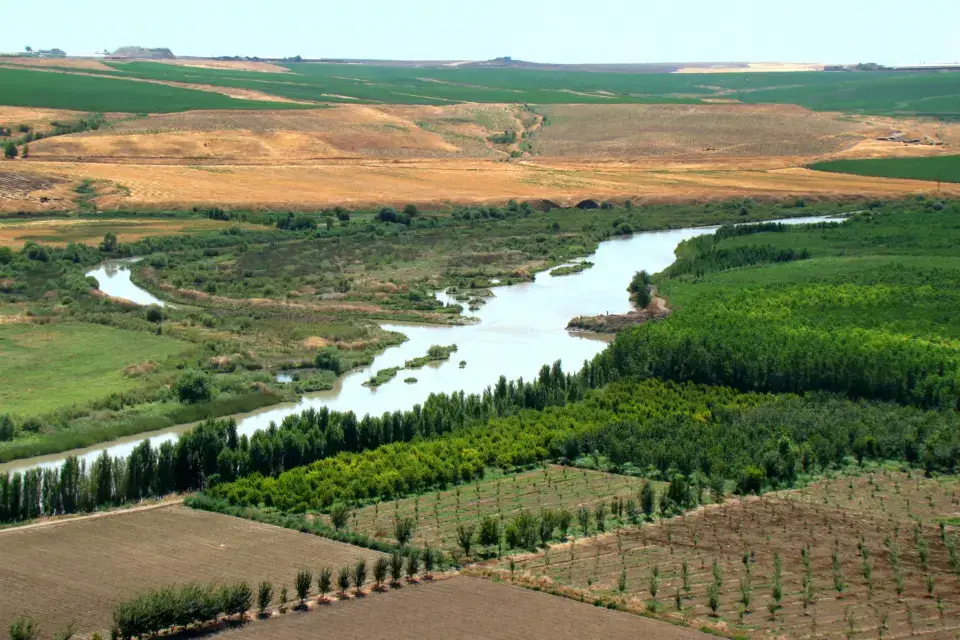
Black basalt walls about 5.8 km long, above gardens fed by springs on the banks of the Tigris.
A ring of black basalt nearly 6 kilometers (3.6 miles) long surrounds the old city of Diyarbakır, with 82 towers, four great gates and inscriptions from a dozen dynasties. Below the walls, terraced gardens run down to the Tigris, the river of ancient Mesopotamia. Together, the Diyarbakır Fortress and the Hevsel Gardens have been a UNESCO World Heritage Site since 2015. Our Diyarbakır tour walks the walls and goes down to the gardens.
They run for about 5.8 km (3.6 miles), with towers, gates and inscriptions. Walk a stretch of the ramparts, look down over the green valley, then drive out to the ten-arched bridge on the Tigris.
Today, the Diyarbakır Fortress encloses Sur, the historic district of Diyarbakır in southeastern Turkey. Torn between the two cities of the region? Read Diyarbakır or Mardin. It has two parts: the inner citadel in the northeast, the oldest part of the city, and the outer ring of city walls. Its main gates, for example, are the Dağ (Mountain) Gate, the Urfa Gate, the Mardin Gate and the Yeni (New) Gate.
On average, the walls are over 10 meters (33 feet) high and 3 to 5 meters (10–16 feet) thick. About 63 inscriptions from different periods survive on them, and 65 of the original 82 outer towers still stand.
Diyarbakır Fortress in numbers
Originally, the city was Roman Amida. First, the Romans walled it in 297 AD, and in 349 Emperor Constantius II greatly expanded the walls. Justinian I strengthened them again in the 6th century.
Later, after the Muslim conquest in the 7th century, Abbasids, Marwanids, Seljuks and Artuqids all rebuilt and decorated the walls. From around 900, craftsmen began to carve animals into the stone beside Arabic inscriptions. The Artuqids rebuilt the citadel in 1206–1207 and, in 1208–1209, added the two most famous towers on the southern wall, Yedi Kardeş and Evli Beden. The Ottomans repaired the walls after taking the city in 1515, in a plainer style.
In 1930, two openings were cut to ease traffic. Otherwise, however, the ring is largely intact. After that, a major restoration ran from 2000 to 2007.

The black basalt has also made the walls exceptionally durable. Next, look for the carved Artuqid towers of Yedi Kardeş, the “Seven Brothers”, and Evli Beden, covered with calligraphy and figures of animals and mythical creatures. Elsewhere, too, inscriptions in Arabic record each rebuilding.

Between the walls and the Tigris lie the Hevsel Gardens. They cover some 700 hectares of fertile land on five terraces fed by springs. Aramean chronicles mention them as early as the 9th century BC. Later, in the 19th century, travelers praised their melons, grapes, apricots and famous watermelons, grown on islands in the river. The gardens have even been compared to the Garden of Eden.

About 3 kilometers (1.9 miles) south of the Mardin Gate, the Dicle Bridge crosses the Tigris on ten arches, so locals call it On Gözlü, “Ten Eyes”. Built of black stone in 1065 under the Marwanids, it is 178 meters (584 feet) long. Since 2009, a new bridge has carried the traffic, so you can walk across the old one.

Inside the walls, the old district of Sur still keeps its narrow lanes, mosques and churches. Outside, by contrast, the Hevsel Gardens are still farmed, with poplars and fruit trees between the vegetable plots, as they have been for centuries.
Our notes for Diyarbakır
Our suggestion Start with breakfast in the Hasan Paşa Han, walk the walls before noon, and return to the city in the evening for liver kebab.
Because two thousand years of builders signed these walls. Read the carved Artuqid towers of the southern wall, look down over the Hevsel Gardens to the Tigris, then cross the ten-arched Dicle Bridge of 1065.
Balıklıgöl, the Pool of Abraham in Şanlıurfa: sacred carp pools, the Halil-ür Rahman and Rızvaniye mosques,…

The Malabadi Bridge near Silvan: a 12th-century Artuqid bridge over the Batman River, with a 38.6-meter…

Neighborhood
A city of honey-colored stone above the Mesopotamian plain: Artuqid madrasas, a Syriac monastery that was…
Open in Google Maps (opens in a new tab) Open in Apple Maps (opens in a new tab)
About 5.8 kilometers (3.6 miles), with 82 towers and four main gates.
Yes. The Diyarbakır Fortress and Hevsel Gardens Cultural Landscape joined the World Heritage List in 2015.
The Romans first walled the city, then Byzantines, Arab dynasties, Seljuks, Artuqids and Ottomans rebuilt and decorated them.
About 700 hectares of spring-fed garden terraces between the walls and the Tigris, farmed since antiquity.
The Dicle Bridge of 1065 over the Tigris, with ten arches and a length of 178 meters (584 feet).