

Aspendos
Aspendos near Antalya: the best-preserved Roman theater of the ancient world, a Roman aqueduct with a…
Photo: Turkey Your Way
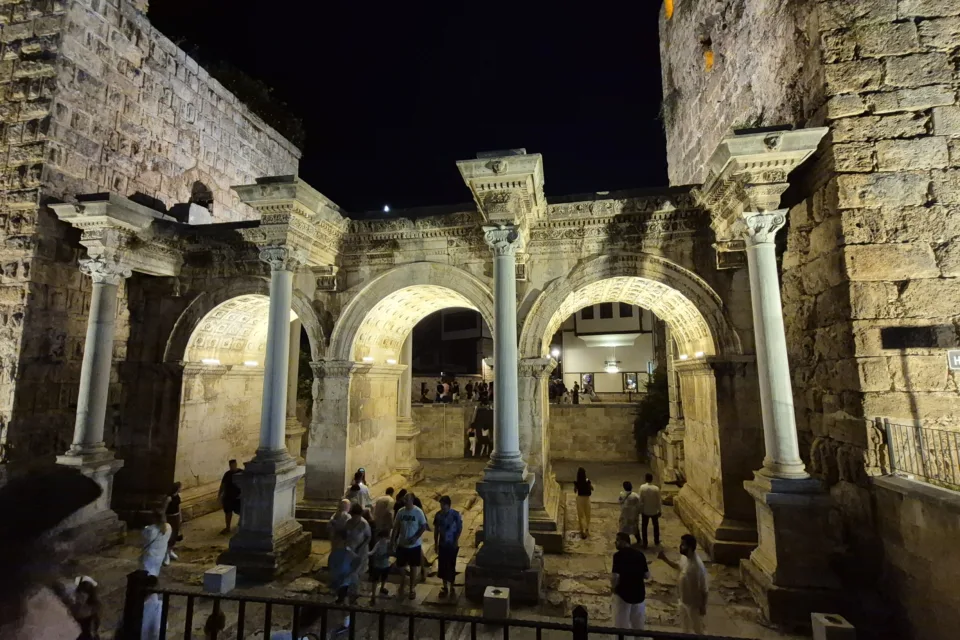
A Roman triple arch of white marble at the edge of Kaleiçi, with the ruts of ancient carts still in its road.
Where the busy Atatürk Avenue meets the old town of Antalya, three white marble arches stand between two stone towers. This is Hadrian’s Gate, which the city raised in honor of the Roman emperor who visited around AD 130. Then walk through the middle arch and look down: under a glass floor, the Roman road still shows the deep ruts of carts that passed here for centuries. Just inside, the hotel Casa Sur Antalya looks straight at the gate from its garden.

Turks call the monument Üçkapılar, “the Three Gates”. The city of Attaleia raised it in the name of Hadrian, the traveling emperor, and it later became part of the walls around the city and its harbor. Inside the walls, the cafés on our list of the best cafés in Antalya are a short walk away.
For a long time, however, the city walls enclosed the gate and nobody used it. Because nobody could see it, nobody damaged it. The gate came back into view in 1882, when the remains of the walls around it were removed. Restorers repaired it in the late 1950s. During the work, they also lifted the later pavement to reveal the original Roman road underneath.
At the end of the 19th century, European visitors took the gilded bronze letters of an inscription that once honored Hadrian from the rubble at the foot of the gate. Today, some of them are in museums abroad, among them the Ashmolean Museum in Oxford.

In all, the gate has three arches, which is why locals call it Üçkapılar. Two colonnaded fronts and three arches rest on four pylons, and except for the granite columns, everything is white marble. Next, under the arches, look up at the reliefs of rosettes and flowers, and along the top for a frieze with lion heads. Originally the gate had a second story, which probably held statues of the emperor and his family.
The two towers come from different ages. First, the southern one, known as the Julia Sancta, is Roman. Second, the lower part of the northern tower is Roman too, but the Seljuk sultan Alaeddin Keykubad I rebuilt its upper part in the 13th century, and it carries an inscription in Arabic script.
A short walk south through Kaleiçi brings you to the other Roman landmark of the old walls. The Roman Hıdırlık Tower rises where the land walls once met the sea walls. At first it had a square plan; then, in the same century, it became a round tower on a square base. Later it served the Byzantines as a military post and, at times, as a lighthouse. Its name comes from Hıdırellez, the spring festival. Today it stands at the edge of Karaalioğlu Park, a good place to watch the sunset over the bay. Our Kaleiçi evening walk watches the sunset from here.

Our notes for Hadrian's Gate
Our suggestion Walk through the gate in the evening, when it is lit up, then cross Kaleiçi to the Hıdırlık Tower for sunset in Karaalioğlu Park.
The gate stands on Atatürk Avenue at the eastern edge of the old town, and it is free to walk through at any time. Afterward, the lanes of Kaleiçi lead you down to the old harbor. Our Antalya city tour starts here, and our Kaleiçi evening walk passes through it too. Also, for more of Roman Antalya, drive out to Perge and the great theater of Aspendos, and see our Antalya guide for the rest of the city.
Because you can still walk through a gate built for a Roman emperor and look down at the grooves left by carts nearly two thousand years ago. Come back after dark, when it glows.
Aspendos near Antalya: the best-preserved Roman theater of the ancient world, a Roman aqueduct with a…

Neighborhood
Antalya's walled old town above a Roman harbor: Hadrian's Gate, the Fluted Minaret, a temple that…
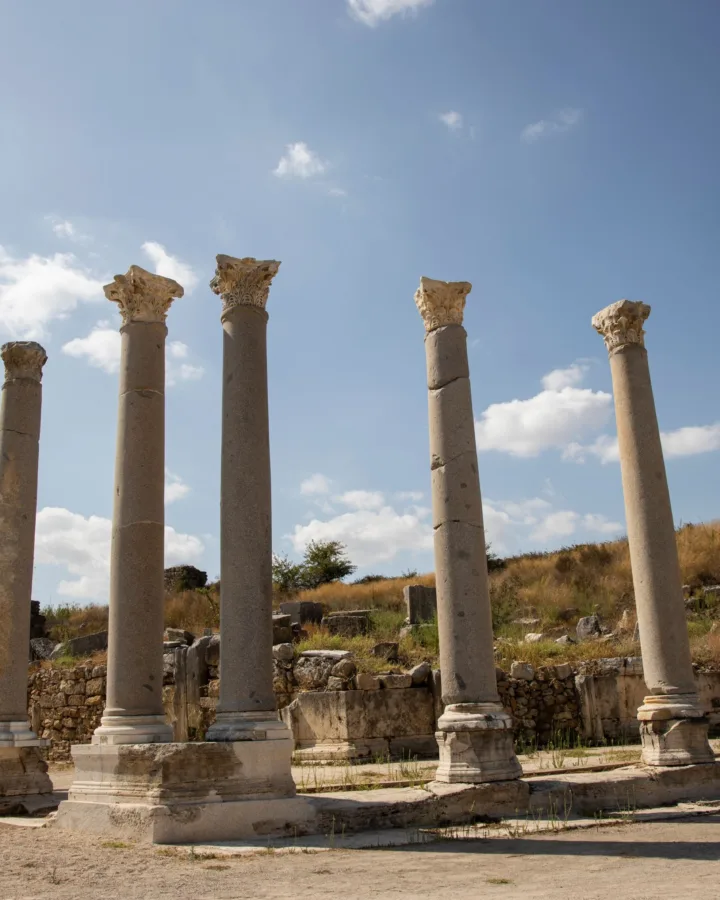
Perge near Antalya: a Hellenistic gate with round towers, a colonnaded street with a running water…

Open in Google Maps (opens in a new tab) Open in Apple Maps (opens in a new tab)
It was built in the name of the Roman emperor Hadrian, who visited the city around AD 130. In Turkish it is called Üçkapılar, the Three Gates.
They are ruts worn into the original Roman pavement by carts passing in and out of the city, visible under a glass floor.
A 14-meter Roman tower from the 2nd century AD, where the land walls of Antalya met the sea walls, at the edge of Karaalioğlu Park.
 Tour
Private Kaleiçi Evening Walk in Antalya
 Tour
Antalya City Tour: Kaleiçi, the Düden Waterfalls and the Cable Car at Sunset
 Tour
Termessos and Kaleiçi Private Tour: The Eagle’s Nest and Old Antalya
 Article
The 5 Best Cafés in Antalya, From Kaleiçi to Karaalioğlu Park
 Article
Where to Stay in Antalya: Kaleiçi, Lara, Belek or Side
 Article
The 5 Best Hotels in Antalya, From Kaleiçi to the Mountains
 Place
Casa Sur Antalya
 Article
Where to Eat in Antalya: Our Five Favorite Restaurants
