Aspendos
Aspendos near Antalya: the best-preserved Roman theater of the ancient world, a Roman aqueduct with a…
Photo: Daniel Åhs Karlsson / Wikimedia Commons, CC BY-SA 3.0
A Roman port and a busy resort on the same peninsula: the Temple of Apollo at sunset, a Roman theater, the old agora and a museum in a bath.
At the tip of a narrow peninsula, white marble columns stand against the sea. In the evening, the sun drops behind them, and the people on the rocks stop to watch. Behind you, a resort town of shops and cafés fills the streets of an ancient port. This is Side, where Roman ruins and holiday life share the same small piece of land. Our Side and Manavgat tour stops here, and so does our Perge, Aspendos and Side tour.
Come for the beaches, and you find a theater, a temple and a museum on your way to dinner. So walk the old town slowly. Its best ruins sit just a few minutes apart, so you can see them all in one walk. Choosing one? Read Side or Alanya.
Side lies on the coast of Antalya province, about 7 kilometers (4 miles) southwest of Manavgat and about 75 kilometers (47 miles) east of Antalya. For the rest of the coast, see our guide to the Turkish Riviera. The ancient city covers a small peninsula, 350 to 400 meters (1,150 to 1,300 feet) wide. City walls once enclosed it.
Today, the modern town is part of the municipality of Manavgat. Its main street, Liman Caddesi, runs past the museum and the theater, so the whole town is easy to explore on foot.
Side in numbers
Greek settlers from Cyme in Aeolis founded Side, probably in the 7th century BC. Its name is older, though. In the local Anatolian language, it meant “pomegranate.”
In 334 BC, Alexander the Great took the city without a fight. Later, Side could not hold off the pirates of the coast and had to open its harbor and markets to them. In 78 BC, the Roman commander Publius Servilius cleared out the pirates, and Side joined the Roman world.
Under Rome, the main port of Pamphylia reached its peak in the 2nd and 3rd centuries AD. Most of the ruins you see today date from this time. Tribonian, a 6th-century jurist at the court of Justinian, came from Side. However, the city declined from the 4th century, and Arab raids hit it again in the 9th and 10th centuries. By the 12th century, the town was known as “Burnt Antalya,” and its people had moved to “New Antalya.”
In the early 20th century, migrants from Crete built a village among the ruins and named it Selimiye. Later, tourism turned that village into the resort you see today.
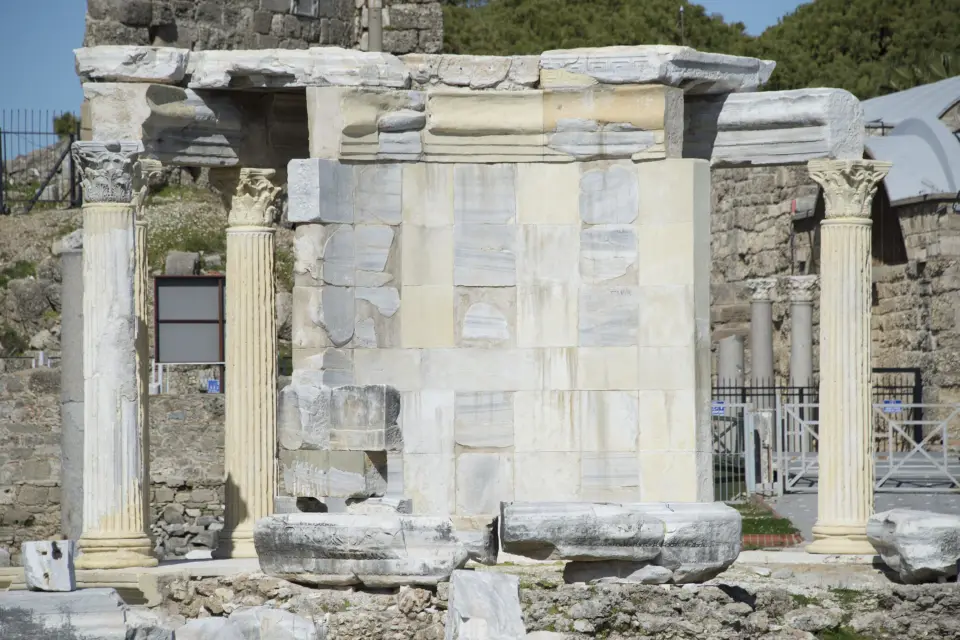
At the end of the peninsula, a row of marble columns with a carved beam stands on the edge of the water. They belong to the Temple of Apollo, which stood beside a temple of Athena at the harbor entrance. Come at sunset, when the marble turns gold.

The great theater is Hellenistic in plan and Roman in technique. Part of its seating rests on arches and vaults, so look at its outer walls as well. In the 5th century, chapels were built inside it, and the theater became a holy place.

Beside the theater lies the agora, the city’s old market square.

Across the street, the Side Museum fills a restored Roman bath. It was the first museum in Türkiye to open in a village. Inside, you see statues, busts, sarcophagi and reliefs from the excavations.
The main street of the ancient city starts at the Great Gate in the northeast. From there, the line of the old colonnaded street leads past the theater toward the sea.
Side is a resort town, so the old town is full of shops, bars and restaurants from spring to autumn. In the evening, the sun drops behind the Temple of Apollo, and its columns turn gold above the sea.
Restaurants around the harbor serve fish and meze (small dishes shared at the start of a meal), often with a view of the sunset. For a simpler local meal, try piyaz and köfte, or gözleme. Look for pomegranates in autumn, since the fruit gave the city its name.
Our notes for Side
Our suggestion Stay the night instead of coming on a day trip. Start at the theater and the museum in the Roman bath across from the agora, then follow the colonnaded street to the sea. Be at the Temple of Apollo for the sunset, when the columns turn gold against the sea.
Because here you can walk from a Roman theater to dinner in five minutes. Explore the old agora, see the statues in the bath museum, then watch the sun set behind the columns of the Temple of Apollo.
Aspendos near Antalya: the best-preserved Roman theater of the ancient world, a Roman aqueduct with a…

Neighborhood
Antalya's walled old town above a Roman harbor: Hadrian's Gate, the Fluted Minaret, a temple that…
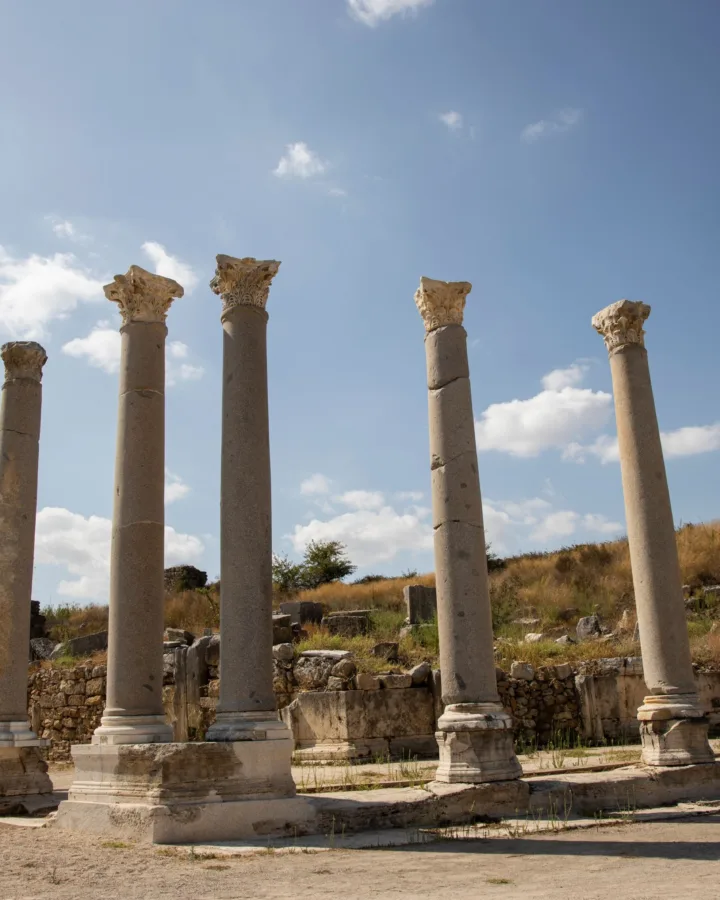
Perge near Antalya: a Hellenistic gate with round towers, a colonnaded street with a running water…
Open in Google Maps (opens in a new tab) Open in Apple Maps (opens in a new tab)
Its ancient ruins inside a resort town, above all the Temple of Apollo by the sea, the Roman theater and the Side Museum.
About 75 km (47 miles) east of Antalya, close to Manavgat.
At sunset, when the columns glow against the sea, or early in the morning, in the soft light.
It comes from a local Anatolian word for pomegranate.
Yes. Perge and Aspendos lie on the road from Antalya, so you can see all three in one day.