

Neighborhood
Kaleiçi
Antalya's walled old town above a Roman harbor: Hadrian's Gate, the Fluted Minaret, a temple that…
Türkiye GMT+3
Monday, November 9, 2026
Replies within 24 hours
Photo: Josh.artofwayfaring / Wikimedia Commons, CC BY-SA 4.0
A Lycian port city in a green valley, a long beach at Çıralı and the eternal flames of Yanartaş on the hill above.
At dusk, walkers climb a stony path above the village of Çıralı. Near the top, small flames burn straight out of the rock, as they did when ancient sailors saw them from the sea. Below, in a wooded valley that runs down to a long beach, lie the ruins of Olympos, a Lycian port that once sheltered pirates. Our Olympos Chimaera tour comes here too.
Olympos and the flames of the Chimaera belong together. One gives you an ancient city among trees and streams, while the other is a fire that inspired a Greek myth. So spend a day between the two, with a swim at Çıralı in between. Our Antalya to Istanbul tour with a blue cruise starts with a pick-up here in Olympos.
Olympos lies on the coast of Antalya province, southwest of Antalya beyond Kemer, inside Beydağları Coastal National Park. The ancient city spreads along both banks of a stream in a deep valley, which then flows into the Mediterranean. Mount Tahtalı rises above the coast to the north. The Kemer Kekova blue cruise anchors off this coast on its way to Kekova. For the wider coast, see our guide to the Turkish Riviera.
The village of Çıralı sits on the beach just north of the ruins, while the flames of Yanartaş burn on the hillside above it. The Lycian Way passes through both, so walkers can stop here for a night. By sea, our Olympos Fethiye blue cruise starts here with a week on a gulet.
Olympos was a port city like Patara and Myra. It was one of the six leading members of the Lycian League, with three votes in its assembly. Its Hellenistic walls of fitted polygonal stones still stand on the south bank of the stream.
In the 1st century BC, however, Olympos became famous for piracy. At that time, a local leader named Zeniketes held a fortress near the city. Then, in 78 BC, Roman forces under Publius Servilius Vatia took the city. Rather than surrender, Zeniketes set fire to his house and died with his family. So Rome expelled Olympos from the Lycian League, and the city returned only in the 1st century AD.
By the 2nd century AD, Olympos was wealthy again. Its leading citizen, Marcus Aurelius Archepolis, held the highest office of the league, and his tomb still stands today. Later, Methodius of Olympus became the first known bishop here, and he was executed in 312. In the 5th and 6th centuries the Byzantine city grew larger than the Roman one, until Arab raids finally emptied it.
A path follows the stream through the ruins, so you walk between walls that trees half hide. Look especially for the Roman bridge, the baths and the remains of a temple. In the bishop’s church, archaeologists found the names of the bishops Theophiletus and Nicholas carved on stone.

Along the necropolis, sarcophagi stand among the trees. One of them carries the relief of a ship, a fitting image for a city that lived from the sea.

Above Çıralı, dozens of small fires burn from vents in the rock, high on the slope above the beach. The gas is methane, which seeps through cracks in the rock from a natural gas source. Directly below the flames lie the ruins of a temple of Hephaistos, the Greek god of fire.

The Chimera of Greek myth was a fire-breathing monster, part lion, part goat and part serpent. The British naval officer Francis Beaufort surveyed this coast and identified Yanartaş with the mountain of that legend.
Between Olympos and Çıralı runs a long beach of sand and pebbles, with orchards and mountains behind it. Our Olympos–Fethiye–Olympos blue cruise takes you from this coast to Fethiye and back in eight days on a gulet. The water is clear, and Mount Tahtalı rises behind the bay.

Çıralı is a small village of orchards and guesthouses. In the evening, we head up the hill to see the flames, because the fires are most spectacular after dark.
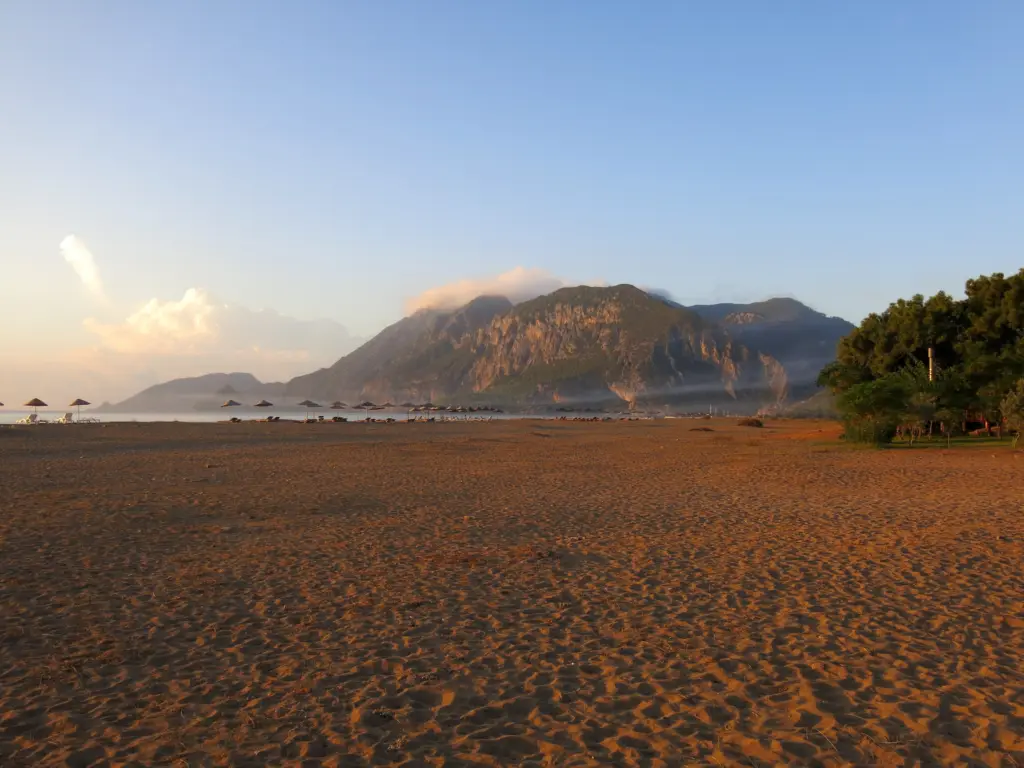
Small restaurants in Çıralı serve grilled fish and gözleme. At Yanartaş, people have also long used the flames to brew tea. Our Olympos to Fethiye blue cruise picks up its guests here.
Our notes for Olympos and Çıralı
Our suggestion Walk from Çıralı along the beach to the ruins in the morning, swim at midday, and climb to the Chimaera flames after dark with a torch.
Because few places mix myth and ruins so well. Walk the stream through the ruins of Olympos in the morning, swim at Çıralı in the afternoon, and climb to the flames of the Chimaera after dark.
Neighborhood
Antalya's walled old town above a Roman harbor: Hadrian's Gate, the Fluted Minaret, a temple that…

Myra in Demre: the Church of St. Nicholas, the bishop behind Santa Claus, the Lycian rock…

Archaeological site
A Lycian capital half-buried in sand beside a protected beach: the assembly hall of the Lycian…
Open in Google Maps (opens in a new tab) Open in Apple Maps (opens in a new tab)
Yanartaş, a hillside above Çıralı where natural gas burns from dozens of vents in the rock. Since 1811 it has been linked to the Mount Chimaera of Greek legend.
After dark, when the fires look most impressive. The walk up takes about half an hour.
It lies on the coast southwest of Antalya, beyond Kemer, so plan a full day for the trip.
Yes, the long beach between Olympos and Çıralı is right below the ruins.
Yes. The trail passes through Olympos and Çıralı, and many walkers stop here for a night.
 Tour
Private Olympos and Chimaera Tour from Antalya
 Tour
Kemer Kekova Blue Cruise: 8 Days on a Gulet
 Tour
Olympos to Ölüdeniz Blue Cruise: 3 Days on a Gulet
 Tour
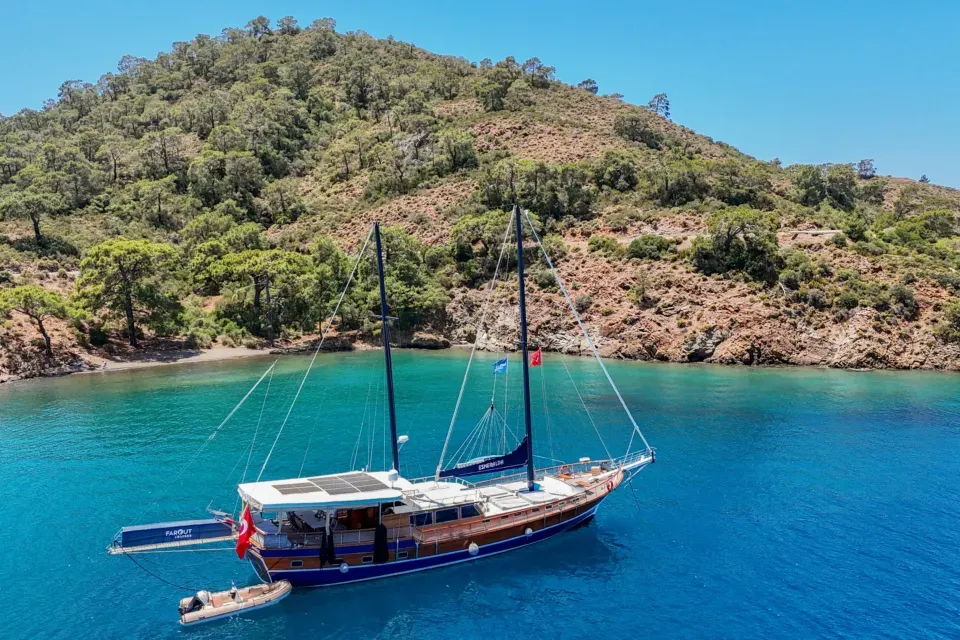
Fethiye to Olympos Blue Cruise: 4 Days on a Gulet
 Tour
Olympos to Fethiye Blue Cruise: 4 Days West on a Gulet
 Tour
Kaş to Olympos Blue Cruise: 3 Days on a Gulet
 Tour
Olympos–Fethiye–Olympos Blue Cruise: 8 Days on a Gulet
 Article
The Lycian League: An Ancient Federation and the US Constitution
