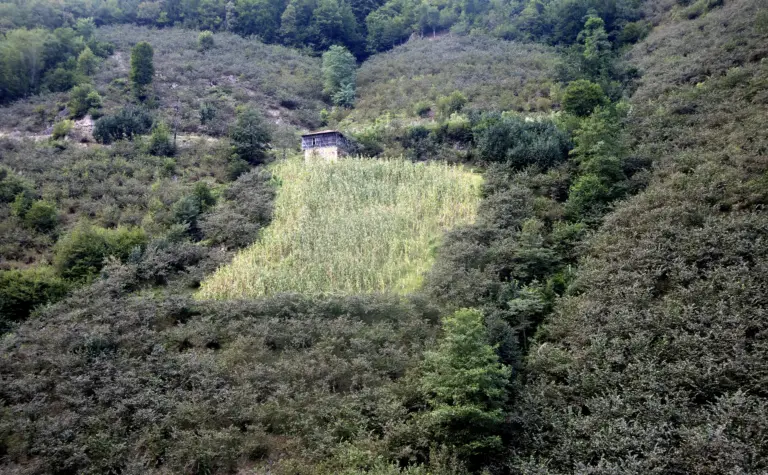
Full day (about 9 hours) · Black Sea, Giresun
Private Giresun and Şebinkarahisar Tour: Museum and Castle
A private Giresun and Şebinkarahisar tour: the Giresun Museum in a 19th-century…
Best for Returning visitors
Photo: Zeynel Cebeci / Wikimedia Commons, CC BY-SA 4.0
Destination
A Black Sea city with an island 1.6 km (1 mile) offshore, a castle on its peninsula, and July festivals on the plateaus of Dereli.
Giresun is a Black Sea city on a peninsula, with a castle above it and an island off its shore. Giresun Island is the only island in the eastern Black Sea settled since antiquity and the Middle Ages. In the city center are the old Zeytinlik quarter and the Giresun Museum.
The province covers 6,934 km² (2,677 square miles), so much of what draws visitors lies outside the city. Tirebolu, Örenkaya and Espiye each have a castle. Dereli district has Mavi Göl, the Kuzalan Waterfall and the Kümbet and Bektaş plateaus. Farther away, 109 km (68 miles) by road, Şebinkarahisar has a castle on a rock hill. It also has a monastery built into a rock recess.
Quick facts
Giresun Island lies opposite Gedikkaya, off the city center.
Giresun Island in figures
The island is protected as a second-degree archaeological site. Its remains include medieval walls, a church, a chapel, a cistern, storage jars (pithoi) and tombs, and excavations are still going on. Birds also breed on the island. It has its myths too, and the Hamza Stone is the focus of a fertility tradition. Childless couples pray around it, and some spend a night on the island.
Boats to the island usually run from early summer into autumn, weather permitting; check locally before you go.
The Mayıs Yedisi ceremonies and the Aksu Festival take place on the island every year on May 20. The 49th International Giresun Aksu Festival, hosted by Giresun Municipality, opened on May 19, 2026, and ran until May 23. The main day was May 20. Its program included a wreath at the Atatürk Monument and folk-dance groups, among them teams from Kosovo, North Ossetia and Georgia. There was also a wishes ritual, with stones thrown where the Aksu stream meets the sea. The program included a boat trip to the island and events at the castle.
Giresun Castle stands on a volcanic rock at the highest point of the peninsula, in Kale neighborhood, overlooking the city. Its founding date is uncertain. It is sometimes linked to Pharnakes I in the 2nd century BC, and the walls are thought to be Hellenistic. Inside the walls are the ruins of a palace. Today the castle is a picnic and sightseeing area, protected as a first-degree natural site. Visitors walk up or take the kale dolmuşları, the shared minibuses to the castle. No ticket is needed, and there is a tea garden at the top.
Zeytinlik, once called Gogora, is a third-degree urban conservation area in the city center. It also takes in parts of the Çınarlar, Hacı Hüseyin and Kale neighborhoods. The Trabzon regional conservation board registered it in 1991. About 80 registered houses here were built roughly 200 years ago.
The Giresun Museum occupies the former Gogora church, later called Aziz Nikola. After its years as a church, the building served as a prison from 1948 to 1967. It was restored between 1982 and 1988 and opened as a museum in 1988. Its collection runs from the Early Bronze Age to the Ottoman period.
Tirebolu lies about 45 km (28 miles) from Giresun. Its small fortress sits on a peninsula north of the town center, reached by a stone stairway. Inside are a small chapel known as the Meryem Ana Church, the ruin of a mosque and Ottoman gravestones.
Bedrama Castle stands on a steep rock above the sea at Örenkaya village, about 8 km (5 miles) from Tirebolu. A narrow footpath leads up from the main road. Its date is unknown, although it is thought to be medieval, and it has been protected since 1992.
In Espiye, about 32 km (20 miles) from Giresun, Andoz Castle rises in Sakarya neighborhood, about 2 km (1 mile) from the center. An access road and then a footpath lead to it. A conservation board decision has protected it since 1990.
Both sit in Kuzalan Nature Park in Dereli district, about 45 km (28 miles) from Giresun. Mavi Göl, the "blue lake," is in Pınarlar village, about 20 km (12 miles) from Dereli town. It is three joined lakes, known locally as Sodalı Göl or Göğ Göl. Its water turns turquoise in summer. The Kuzalan Waterfall drops about 20 m (66 feet), with a viewing terrace opposite, about 13 km (8 miles) from Dereli.
Kümbet, a yayla or high plateau about 60 km (37 miles) from Giresun, became a tourism center in 1991. Its grassy flats lie scattered through the forest. The International Kümbet Culture and Arts Festival usually takes place on the plateau in July. Our Black Sea plateaus tour climbs to Kümbet from Giresun.
Bektaş, about 56 km (35 miles) from Giresun, lies where Dereli meets Bulancak district. It became a tourism center in 1990, and it also hosts highland festivals in July. Another July festival takes place at Sağrak Lake. The Bektaş festival usually falls in the last weeks of July.
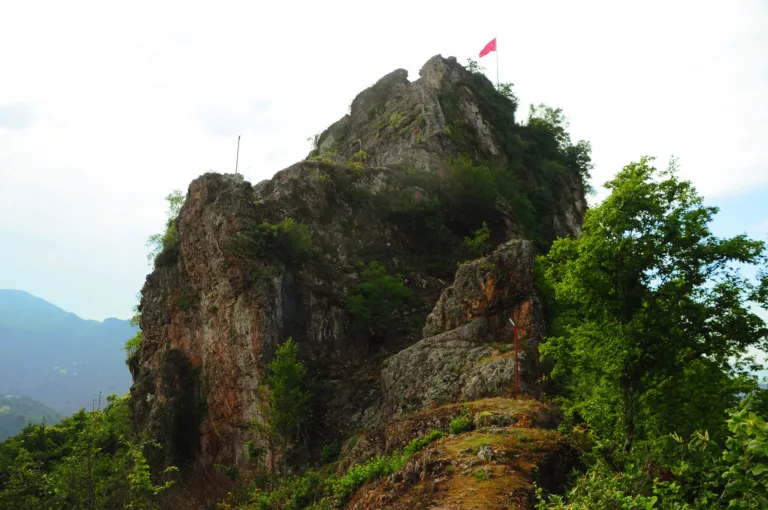
Şebinkarahisar is 109 km (68 miles) by road from Giresun. Its castle crowns Hacı Kayası hill, north of the town center, with outer and inner sections joined by a stepped road. Cisterns are also cut into the rock, among them the water tunnel known as Kırk Badal. The 17th-century traveler Evliya Çelebi mentions about seventy houses inside the walls. Our Şebinkarahisar tour drives there from Giresun, after the Giresun Museum.
The Meryemana Monastery sits in a rock recess at Sarıyer village, about 11 km (7 miles) east of the town. Its origins go back to the Byzantine era, but most of what stands is from the 19th century. After a restoration in 2013 and 2014, it opened as an ören yeri, an open-air heritage site, in 2014. It is also protected as a first-degree natural and archaeological site.
The ancient name, Kerasus, is usually traced to cherries. Another view derives it from the Greek keras, "horn." In the early 2nd century BC, the Pontic king Pharnakes I built a city named Pharnakeia here. Some scholars doubt that Giresun stands on the exact site of ancient Kerasus.
A tradition holds that the Roman commander Lucullus took wild cherry saplings from here to Rome. Still, cherries were already known there.
Giresun dates
Early Ottoman registers describe a fortress town with a small Christian population. The hazelnut trade had already gained prominence in the Middle Ages. In the 17th century, Evliya Çelebi wrote that Cossack raiders hid their boats behind the small island west of the harbor before attacking the city.
Topal Osman Ağa's tomb stands in Giresun Castle. He was the municipal head who organized local resistance in Giresun during the National Struggle.
During World War I, he led local militias and took part in the eastern-front activities of the Teşkîlât-ı Mahsûsa (Special Organization), and after 1918 he became mayor of Giresun. In 1919, an Istanbul court-martial ordered his arrest, to be tried "as a deportation offender" (tehcir suçlusu olarak); on July 7, 1919, the Ottoman cabinet pardoned him and 168 others.
On March 27, 1923, Ali Şükrü Bey, a deputy for Trabzon, was called away and strangled at Osman's house. His body was found outside Ankara, near Mühye village. An arrest order for Osman followed, and he died in a clash with the Presidential Guard on April 2, 1923.
In June 1915, Armenians in Şebinkarahisar gathered in the castle. Ottoman forces besieged it and took it in July.
The Armenian genocide of 1915–16 was the Ottoman government's destruction of its Armenian population.
The Lausanne convention of January 30, 1923, ordered a compulsory exchange of Turkey's Greek Orthodox citizens and Greece's Muslim citizens. The Greeks of Istanbul and the Muslims of Western Thrace were exempt. In Giresun, the Gogora church, built by the local Rum community, served as a church until 1924 and then stood empty.

Giresun Tombul Fındığı, the Tombul hazelnut of Giresun, became a registered appellation of origin (menşe adı) on October 10, 2001. The union of hazelnut agricultural sales cooperatives applied for its registration. Giresun Fındık Ezmesi, a hazelnut paste, was registered later, in 2020, as a designation of origin (mahreç işareti).
The register also holds foods from the districts. Piraziz Elması, an apple, has been an appellation of origin since 2016, on the application of the Piraziz chamber of agriculture. On the application of Görele Municipality, Görele Dondurması, an ice cream, was registered in 2019, and Çavuşlu Ekmeği, a bread, in 2020. Alucra Oğlak Kebabı, a kid kebab, entered the register in 2020. Çamoluk Şeker Kuru Fasulyesi, a dried bean, has been an appellation of origin since 2018.
We arrange a visit to a local hazelnut-growing family during the harvest, which usually starts in early August.
One Giresun dish is acı mantar yahnisi. It is a stew of a wild white mushroom with onion, potato, tomato and corn flour, cooked with butter and hazelnut oil. Another is ayranlı çorba, a soup of wheat, chickpeas and beans with thick ayran and dill. For something to take home, look for Giresun hazelnuts.
Updated: October 22, 2026.
Ordu-Giresun Airport (IATA OGU, ICAO LTCB) is 28 km (17 miles) from Giresun city center and 18 km (11 miles) from Ordu. Turkey's state airports authority runs it, and officially it is an Ordu airport. From Ordu, our Ordu tour rides the cable car up to Boztepe. It opened to civil flights on May 22, 2015, and has operated around the clock since February 10, 2016. One terminal serves both domestic and international flights. The airport stands over the sea on reclaimed land, the first airport of its kind in Turkey. Its runway is 3,000 m (9,840 feet) long.
For the ride into town, Havaş runs shuttle buses, and we tell you the next departure. Taxis wait in front of the terminal, and there are rental-car desks.
Kümbet lies on the Giresun–Dereli–Şebinkarahisar road, and the road up to the plateau was paved in July 2004. Three roads approach Bektaş: via Yavuzkemal, via Batlama Deresi and İnişdibi, and from Bulancak.
Full day (about 9 hours) · Black Sea, Giresun
A private Giresun and Şebinkarahisar tour: the Giresun Museum in a 19th-century…
Best for Returning visitors

3 days (2 if you prefer) · Black Sea, Giresun
A private Black Sea plateaus tour in Giresun and Ordu: Kümbet Plateau,…
Best for Families · Returning visitors
 Istanbul
 spreads across Europe and Asia on both shores of the Bosphorus. Explore the…
 Cappadocia
 is a Central Anatolian region where wind and water cut volcanic tuff into…
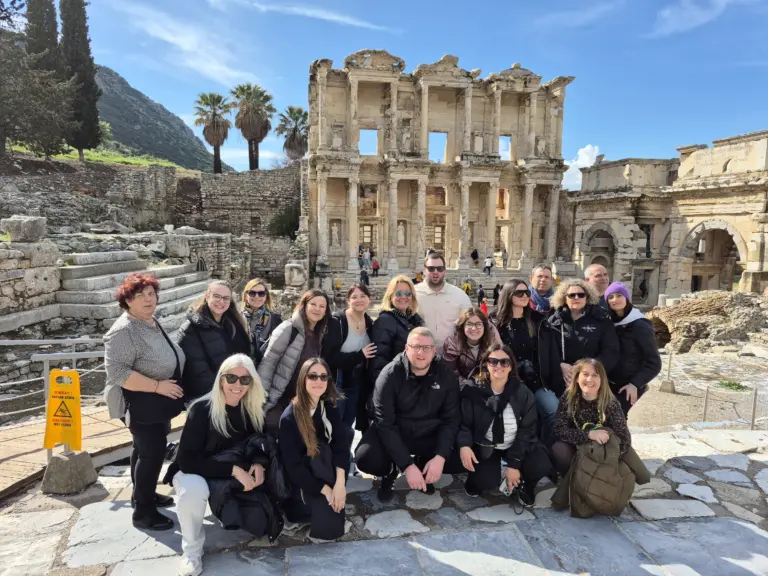 Ephesus
Selçuk is the town beside the ancient ruins of Ephesus and holds the Ephesus…
 Pamukkale
 and Denizli, from the white travertines and the Roman spa city to red…