Kösem Sultan
A captive who became the favorite of Sultan Ahmed I, ruled for two sultans and a grandson, built the Çinili Mosque and died in a palace coup in 1651.

In the domed tomb of Sultan Ahmed I, next to the Blue Mosque, one coffin carries the name Mahpeyker. It belongs to a woman who arrived in Istanbul as a teenage captive and went on to rule an empire through her sons and grandson. Fans of Turkish TV dramas know her well. This is Kösem Sultan, one of the most powerful women in Ottoman history.
Kösem Sultan left her mark on the city, too: a tiled mosque in Üsküdar, a great merchant inn near the Grand Bazaar and charities for the poor. So her story is also a guide to some lesser-known corners of Istanbul.
Who Was Kösem Sultan?
Kösem was born around 1589. Her origins are uncertain, but she was probably Greek, possibly from the island of Tinos, or Bosnian. Then, around 1604, raiders captured her, and she was sent to the harem of the young Sultan Ahmed I. There, she also studied religion, mathematics, music and literature, and around 1605 she became his favorite consort. Her Muslim name was Mahpeyker, while Ahmed called her Kösem.
Kösem Sultan through time
- c. 1589Born, probably in Greece or Bosnia
- 1605Becomes the favorite of Sultan Ahmed I
- 1623–1632Rules as regent for her son Murad IV
- 1640Founds the Çinili Mosque in Üsküdar
- 1648Becomes regent for her grandson Mehmed IV
- 1651Murdered in Topkapı Palace on 2 September
The Power Behind the Throne
Wife of Ahmed I
Kösem had great influence over Ahmed, the sultan who built the Blue Mosque. She probably helped save the life of his half-brother Mustafa. So the Ottoman custom changed: instead of a son, the eldest male of the family now often inherited the throne.
Mother of sultans
After Ahmed died in 1617, two of her sons later became sultan. When Murad IV took the throne as a boy in 1623, Kösem ruled as his regent until 1632. Afterward, during the unstable reign of her son İbrahim, she again held power from 1640 to 1648. In 1645, she pushed İbrahim into a war with Venice over Crete.
Grandmother of an emperor
In 1648, İbrahim was deposed, and his young son Mehmed IV became sultan. So Kösem ruled once more, now as the “great valide sultan”. However, she soon clashed with the boy’s mother, Turhan Sultan. Finally, on the night of 2 September 1651, armed men of the palace entered Kösem’s rooms in Topkapı Palace and killed her.
Kösem Sultan and Istanbul
The Çinili Mosque

In 1640, Kösem paid for a mosque and a school in Üsküdar, on the Asian side. Because tiles cover much of its interior, people call it the Çinili Mosque, the “Tiled Mosque”. Today it is a neighborhood mosque, with a shady courtyard and a domed fountain.

The Büyük Valide Han
In 1651, she also funded the Büyük Valide Han, a huge inn for foreign traders, workshops and stores near the Grand Bazaar. After her death, the treasury found twenty boxes of gold coins hidden there. Today the old building is worn, but it still stands behind the bazaar.
Charity
Kösem was also popular with ordinary people. Every year in the month of Rajab, it is said, she left the palace in disguise and paid the debts of prisoners so they could go free. She also gave dowries to poor girls and set up soup kitchens for the hungry.
The Legacy of Kösem Sultan
Historians still argue about Kösem. Some blame her for weakening the empire, while others see her as a ruler who held the dynasty together in dangerous times. Either way, she was a central figure of the age often called the Sultanate of Women, after Hürrem Sultan. Later, a Turkish TV series about her life, a sequel to Magnificent Century, made her famous far beyond Turkey.
Would you like to see the rooms where she ruled? Our Sultanate of Women tour follows her story through the Harem. Send us your dates, and we make it your private day.

Following Kösem Sultan in Istanbul
- Tomb of Ahmed I: next to the Blue Mosque, where she lies beside her husband and sons.
- Çinili Mosque, Üsküdar: her own foundation on the Asian side.
- Büyük Valide Han: her great inn behind the Grand Bazaar.
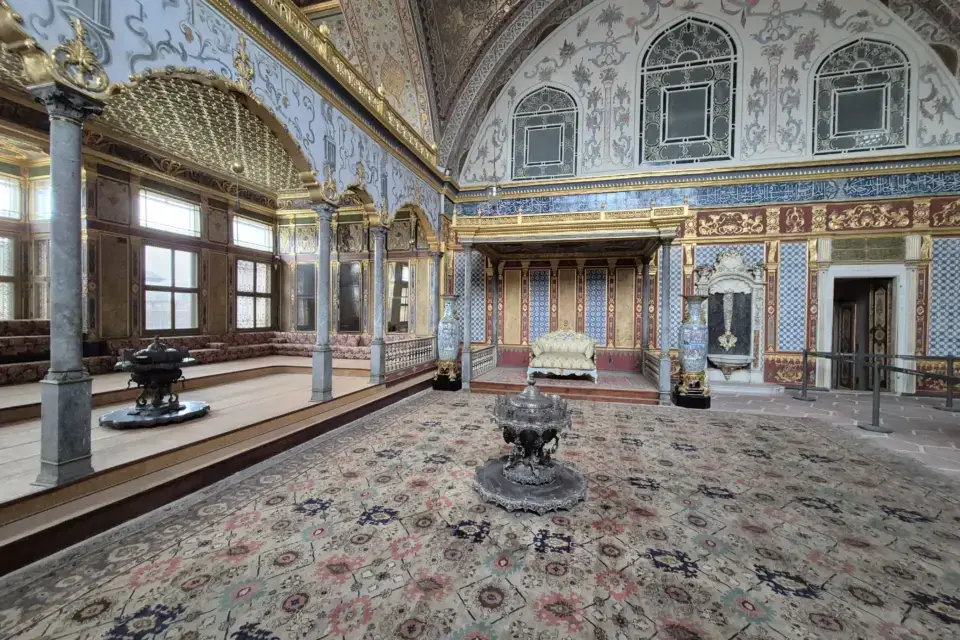
- Topkapı Palace: the harem where she lived and died, part of the UNESCO Historic Areas of Istanbul.
Where to find her today
- Valide HanHer great han on Çakmakçılar Yokuşu is still full of workshops.
- Çinili MosqueHer tiled mosque in Üsküdar, completed in 1640, has a bathhouse nearby.
- Her tombShe lies in the tomb of her husband, Sultan Ahmed I, beside the Blue Mosque.
Our suggestion Climb to the roof of the Valide Han, if the guard lets you, for one of the best views of the old city.

You may also like
-
 Tour
The Sultanate of Women Private Tour: Hürrem, Kösem and the Harem
-
 Tour
Topkapı Palace Private Tour with the Harem
-
 Place
Blue Mosque (Sultan Ahmed Mosque)
-
 Place
Grand Bazaar
-
 Place
Topkapı Palace
-
 Person
Hürrem Sultan
-
 Person
Suleiman the Magnificent
-
 Article
Armenians of Istanbul: Kumkapı, the Patriarchate and the Balyans