
Photo: Turkey Your Way
Topkapı Palace
A city within the city on the point of the old peninsula: four courtyards, the Harem, the Treasury and terraces above the Bosphorus, begun by Mehmed II in 1459.
Overview
For almost four hundred years, an empire that stretched across three continents was ruled from a hill at the tip of Istanbul. Behind high walls, Topkapı Palace was also home to the sultans, their families and thousands of servants, soldiers, cooks and officials. It was not one building but a city within the city, arranged around courtyards that became more private and more powerful the further you went in. Today, you can walk through its gates, sit where viziers met, look into the rooms of the Harem and stand on terraces where sultans watched ships enter the Bosphorus. Our Topkapı Palace tour with the Harem takes half a day.
The palace opens courtyard by courtyard, each more private than the last. Walk from the Imperial Council to the palace kitchens, then on to the Treasury’s famous diamond and the tiled kiosks of the fourth courtyard. Official hours are listed below, together with tips for your visit. Choosing between palaces? Read Topkapı or Dolmabahçe.
- Good for
- History lovers, families, first-time visitors
- Best combined with
- Hagia Sophia, Hagia Irene, Gülhane Park, Archaeological Museums
Topkapı Palace Is Not One Building
Topkapı Palace stands on Sarayburnu, the point of the historic peninsula, between the Golden Horn, the Bosphorus and the Sea of Marmara, just behind Hagia Sophia. Mehmed II built it between 1460 and 1478, a few years after the conquest of Constantinople. It remained the main residence of the sultans until 1856, when the court moved to Dolmabahçe Palace. Later, on 3 April 1924, the young Turkish Republic turned it into a museum. It is part of the UNESCO World Heritage Site of the Historic Areas of Istanbul.
The palace is closed on Tuesdays. A combined ticket covers the palace, the Harem and Hagia Irene, so one ticket is enough for all three. It is valid on the day you buy it, and you can also buy e-tickets in the National Palaces mobile app.
Topkapı Palace in numbers
- 1460Mehmed II begins the palace
- 4courtyards, each more private
- 1924Topkapı becomes a museum

Four Centuries of Sultans at Topkapı
The palace of the conqueror
After the conquest of 1453, Mehmed II first lived in an older palace in the middle of the city. Then, in 1460, he began a new one on the point where the acropolis of ancient Byzantium had stood. Its position was perfect, because it watched over all the sea routes into the city. Over the next four centuries, almost every sultan added pavilions, rooms and gardens, so the palace became a collection of buildings from many periods. To taste the palace kitchen today, read Ottoman palace cuisine in Istanbul.
Courtyards of power
The palace was therefore organized as a series of courtyards. The first was open to the public; the second was the court of government, where the Imperial Council met; the third was the private world of the sultan and his pages; and the fourth held pavilions and gardens above the sea. Next to them lay the Harem, the family quarters, ruled by the sultan’s mother, the valide sultan. So access to each zone depended strictly on rank. Our Istanbul VIP tour stops here.


From palace to museum
In the 19th century, the sultans wanted a modern, European-style palace and moved to Dolmabahçe on the Bosphorus in 1856. Still, Topkapı remained in use for ceremonies and as a home for the treasury and the sacred relics. Finally, on 3 April 1924, it became the first museum of the new republic.
Topkapı Palace through time
- 1460Mehmed II begins the palace
- 17th c.Murad IV builds the Baghdad Kiosk
- 1856The court moves to Dolmabahçe
- 1924Topkapı becomes a museum
- 1985Part of a UNESCO World Heritage Site

Through the Gates: Our Route Inside
The Imperial Gate and the first courtyard
First, pass the marble Fountain of Ahmed III and enter through the Imperial Gate behind Hagia Sophia into the large first courtyard, once open to anyone. Here stands Hagia Irene, a Byzantine church that was never turned into a mosque and served the Ottomans as an arsenal. You can also visit it with the combined ticket.
The Imperial Council

In the second courtyard, the Imperial Council met under a dome in the Kubbealtı. Above one wall, a grilled window is believed to have let the sultan listen unseen, so the viziers never knew whether he was there. Look up especially at the painted dome and the tiles.
The kitchens of Topkapı Palace

Along one side of the second courtyard, domed kitchen buildings with tall chimneys fed the palace. Today, however, they hold displays of cooking and a large collection of Chinese porcelain.
The Gate of Felicity

Beyond the second courtyard, the Gate of Felicity leads into the private world of the sultan. Here new sultans sat on the throne for the first time, while ambassadors waited for an audience. So when you pass through it, you are in the heart of the empire.
The Treasury and the Sacred Relics
Next, in the third courtyard, the Treasury displays the most famous objects of the palace. Look for the Spoonmaker’s Diamond, a huge pear-shaped stone surrounded by smaller diamonds, and the Topkapı Dagger with its three great emeralds. Nearby, the Chamber of the Sacred Relics holds objects linked to the Prophet Muhammad, including his cloak and swords. Recitations of the Quran often fill these rooms, so speak quietly. Here, women and men alike must dress modestly, as they would in a mosque.
The Harem of Topkapı Palace

The Harem is included in the combined ticket, and it is worth every minute. It was not a place of legend but a complex institution with hundreds of rooms: the apartments of the valide sultan, the quarters of the concubines and the eunuchs, baths, courtyards and the Imperial Hall where the sultan received his family. Only part of it is open, but the tiles, gilding and painted domes are some of the most beautiful in Istanbul.
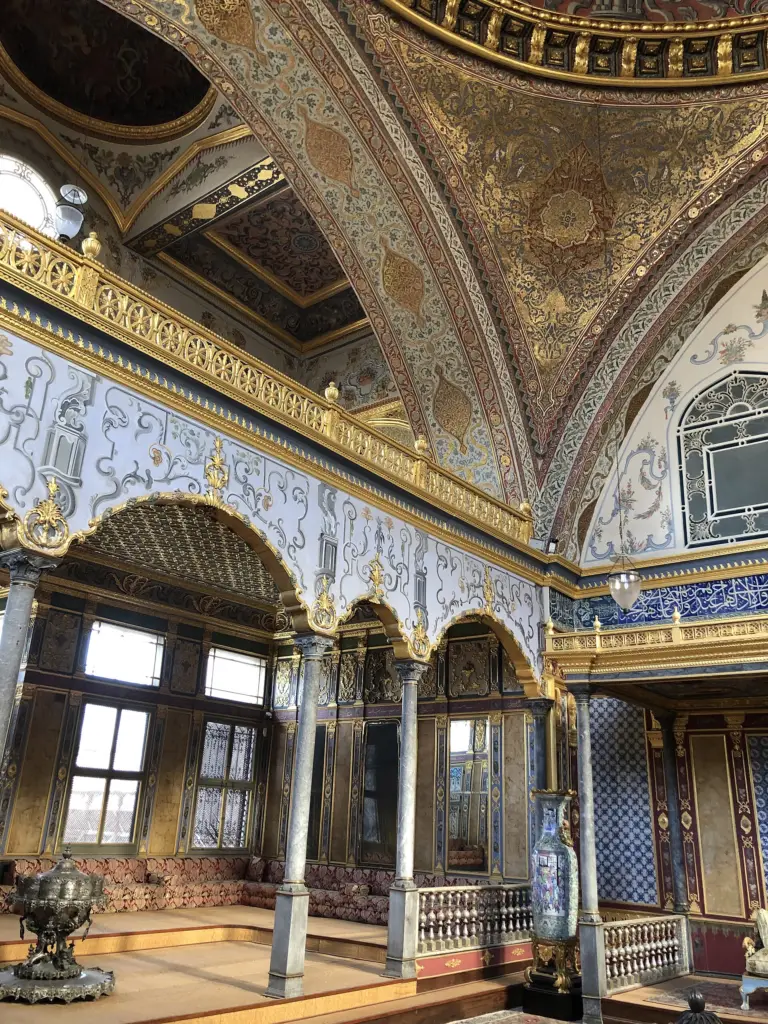
The fourth courtyard and the Baghdad Kiosk

Finally, the fourth courtyard has terraces over the water. Gardens and pavilions also overlook the Bosphorus and the Golden Horn. Look for the Baghdad Kiosk, built for Sultan Murad IV. Inside, the walls are covered with tiles and the doors with mother-of-pearl and tortoiseshell. From the marble terrace nearby, you see the whole meeting of the waters.

After the Palace: Gülhane and a Glass of Tea
Just below the palace walls, Gülhane Park was once part of the outer gardens of Topkapı. Its name means the House of Roses. Today, in contrast, Istanbul families walk under the plane trees, and in April the park fills with tulips, usually at their best in the middle of the month.
So after three hours of courtyards, your feet will thank you for a slow walk down through the park instead of another museum. Then, at its far end, on a point above the water, a tea garden looks out to where the Golden Horn meets the Bosphorus.
Our notes for a Topkapı day
- Set Üstü Çay BahçesiThe tea garden at the tip of Gülhane Park, with ferries crossing between Asia and Europe below you. Lovely early in the morning, too.
- Islamic Science and Technology MuseumInside Gülhane Park, in the old palace stables, with models of instruments from astrolabes to water clocks.
- Tarihi Sultanahmet KöftecisiOn Divanyolu, a short walk from the Imperial Gate: köfte with white-bean piyaz.
- Gülhane tram stopThe T1 tram stops right at the park gate, so you can leave by the lower end instead of climbing back up.
Our suggestion Buy the combined ticket, go to the Harem first, and leave the fourth courtyard for the end, when you need the terraces and the sea air most.
There is also a café inside the palace, naturally, with a terrace over the Bosphorus, but it is busy at lunchtime.
For the sultan’s painters and their work, read our guide to Ottoman miniatures.
How to Visit Topkapı Palace
Visiting Topkapı Palace
- Closed: on Tuesdays. We arrange your entry to the palace and the Harem and time it to their hours.
- Closed: on Tuesdays, on New Year’s Day and on the first day of Eid al-Fitr (Ramazan Bayramı).
- Tickets: we arrange one entry for the palace, the Harem and Hagia Irene as part of your day.
- Time needed: at least three hours; half a day with the Harem.
- Getting there: walk behind Hagia Sophia to the Imperial Gate; the Sultanahmet and Gülhane tram stops are close by.
Local tips for Topkapı Palace
- Arrive at opening time and go straight to the Harem or the Treasury.
- Never leave it for the last hour of your day, because it is too large.
- Save the fourth courtyard for last, to rest on the terraces above the Bosphorus.
- Check the day: it is closed on Tuesdays.
- Combine it with Hagia Sophia and the Archaeological Museums, a few steps away; our Istanbul Archaeology Museums tour gives them half a day.
- Go with a guide if you want the Harem to make sense: our guides in Istanbul explain who lived where, and why it mattered.
- Remember the map: the old world map of Piri Reis turned up in the palace library, and the museum still keeps it.
Because here you walk the layers of Ottoman power, gate by gate. Arrive at opening time, go straight to the Harem, find the window where the sultan listened unseen, and end on the terrace of the Baghdad Kiosk, where three seas meet below you.

Map
Open in Google Maps (opens in a new tab) Open in Apple Maps (opens in a new tab)
Gallery
Frequently asked questions
What are the opening hours of Topkapı Palace?
The ticket offices open from 09:00 to 17:00. The palace is closed on Tuesdays.
Is the Harem at Topkapı Palace worth it?
Yes. Its tiled and gilded rooms are among the most beautiful interiors in Istanbul.
What is the Spoonmaker's Diamond?
A large pear-shaped diamond surrounded by smaller stones, displayed in the palace Treasury.
Which day is Topkapı Palace closed?
Tuesday.

You may also like
-
 Tour
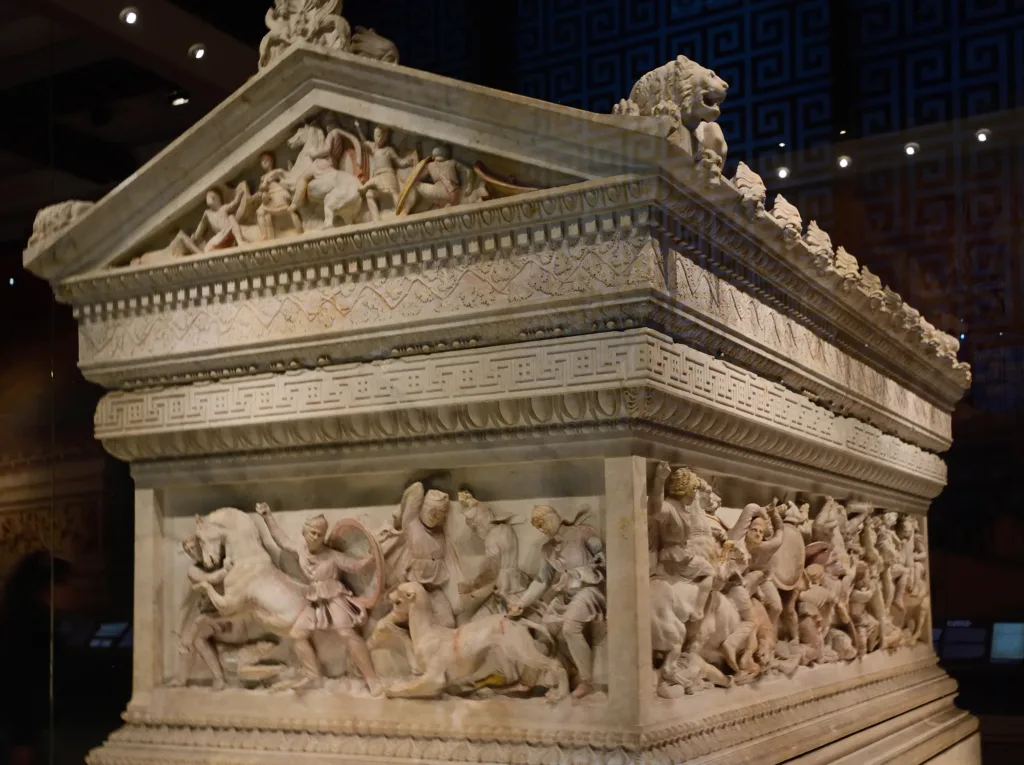
Private Istanbul Archaeology Museums Tour with a Guide
-
 Tour
Private Istanbul VIP Tour: Palace, Fine Dining and a Yacht
-
 Journey
Istanbul 3 Day Tour: The Old City, the Bosphorus and the Neighborhoods
-
 Journey
Istanbul in 2 Days: A Private Tour of the Old City, the Bazaars and the Bosphorus
-
 Journey
Istanbul and Cappadocia in 4 Days: A Private Tour with a Flight
-
 Journey
Istanbul, Ephesus and Pamukkale in 5 Days: A Private Tour
-
 Journey
Istanbul and Ephesus in 3 Days: A Private Tour with a Flight
-
 Journey
Istanbul, Bursa and İznik in 3 Days: A Private Tour of Early Ottoman Capitals