Photo: Zorka Sojka / Wikimedia Commons, CC BY-SA 4.0
Arsameia on the Nymphaios
The summer capital of the Commagene kings near Kâhta, with the tomb of Mithridates and a long Greek inscription cut into the rock.
Overview
Arsameia was the summer capital of the kingdom of Commagene, at Eski Kâhta on the road from Kâhta to Mount Nemrut. Arsames, an ancestor of the Commagene kings, founded it, and most of what remains dates from the reign of Antiochos I. On the hilltop lies the tomb of his father, Mithridates Callinichos. The site is part of Nemrut Dağı National Park.
The Inscription and the Relief
Above an underground passage, a long Greek inscription is cut into the rock. It records the founding of the city, its ceremonies and the royal laws, and it is the text that named the site Arsameia. Nearby, a relief shows a king shaking hands with Heracles, and a rock tunnel of about 158 meters runs into the hill, its purpose still unknown.
What to See at Arsameia, Step by Step
A path climbs the hill past the monuments. Low on the slope, a broken relief once showed a king beside the god Mithras. The god’s half survives, so it is unclear which king stood there. On the processional road to the south stands a relief stele of King Mithridates.
In the handshake relief, the king wears a tall royal crown, and Heracles stands naked with his club. This kind of scene is called a dexiosis, a handshake between a ruler and a god. Below the inscription, the tunnel runs steeply down, cut in steps into the rock.
The Long Greek Inscription
The text is cut in five columns. Besides the founding of the city, it describes the building work of Antiochos I and lists his royal line. It also gives rules for the priests and the festivals of the sanctuary.
The Hilltop and Yeni Kale
On the summit, the ruins of a summer palace stand near the tomb of Mithridates. Across the Kâhta stream rises Yeni Kale, the New Castle, at Kocahisar. An inscription on its gate names the Mamluk sultan Qalawun. Inside its walls are a mosque, cisterns and a dovecote.
Arsameia in History
The kingdom of Commagene lasted until AD 72, when Rome took it over under Vespasian. Antiochos I set up the cult here for his father. His own tomb lies under the great mound on the summit of Mount Nemrut. Excavations at the sanctuary ran from 1953 to 1956. The national park around the site covers 13,850 hectares (about 34,200 acres).
Getting to Arsameia
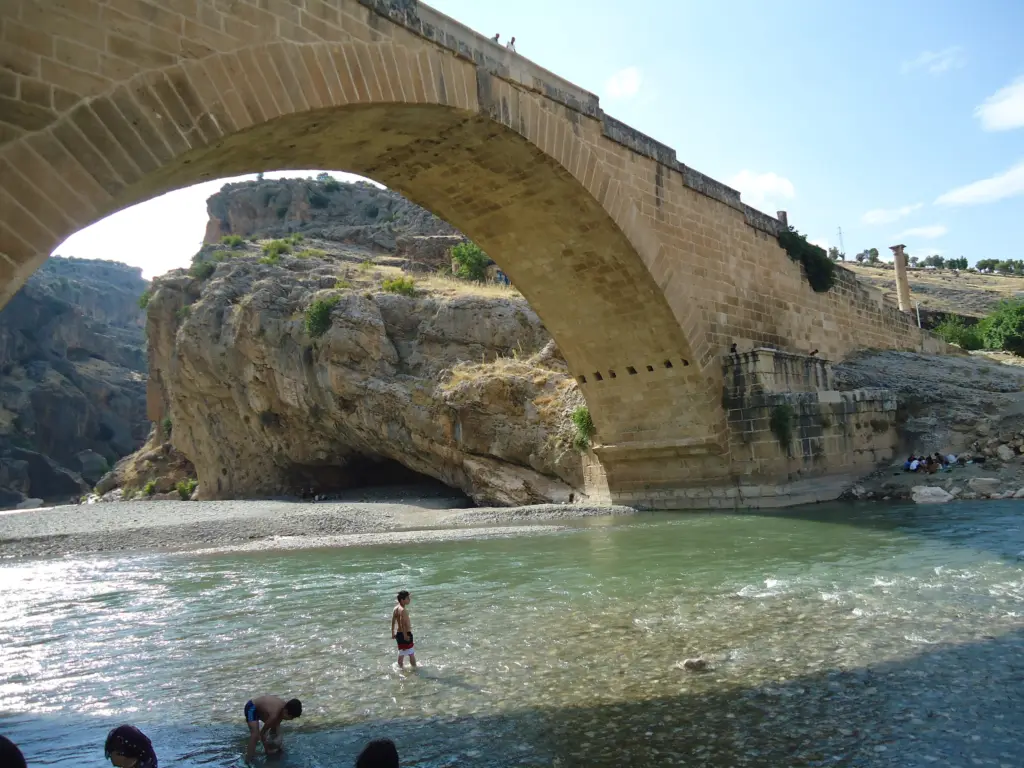
Arsameia lies at Eski Kâhta, on the road from Kâhta up to Mount Nemrut. On the drive up, you pass the Karakuş Tumulus and the Cendere Bridge before you reach it. Before your trip, we confirm the site for your dates and plan the walk up the hill.
Arsameia with Us
We stop at Arsameia and the Cendere Bridge on our Mount Nemrut sunset tour, on the way up to the summit. From Istanbul, we fly you to Şanlıurfa for our Göbeklitepe and Mount Nemrut tour in two days, with Mount Nemrut on the second day.
Frequently asked questions
What was Arsameia on the Nymphaios?
A seat of the Commagene kings for the summer months, beside the Kâhta stream, which the Greeks called the Nymphaios.
Who is buried at Arsameia?
Mithridates Callinichos, father of Antiochos I. His son set up a sanctuary at the grave, with its own priests and festivals.
What is the tunnel at Arsameia?
A passage cut into the rock, close to 158 meters (518 feet) long. Nobody knows what it was for.