Arsameia on the Nymphaios
The summer capital of the Commagene kings near Kâhta, with the tomb of Mithridates and a…
Türkiye GMT+3
Saturday, November 21, 2026
Replies within 24 hours
Photo: Klearchos Kapoutsis / Wikimedia Commons, CC BY 2.0
A Mamluk-era castle on a rocky ridge above the Kâhta stream, facing Arsameia inside Nemrut Dağı National Park.
Kâhta Castle, also called Yeni Kale, crowns a steep, rocky ridge at Kocahisar village in Adıyaman province. Below it runs the Kâhta stream, the Nymphaios of the ancient kings of Commagene. Across the water stands Arsameia, their summer capital, which locals call Eski Kale, the Old Castle. That is why this one became Yeni Kale, the New Castle. Kocahisar itself also goes by the name Eski Kâhta.
The castle lies inside Nemrut Dağı National Park, on the road from Kâhta up to the summit. Its gate carries the name of a Mamluk sultan of the late 13th century. Inside the walls lie the ruins of a palace, a mosque, a bazaar and a dovecote for messenger birds.
Nobody knows exactly when the first walls went up, or who built them. The ridge was probably fortified in the Commagene period, when Arsameia across the stream was a royal seat. Commagene lost its war with Rome in AD 72, and the Romans took over the region. They repaired the castle in their turn.
Much of what you see today is Mamluk-era work. The Mamluks were the sultans who ruled Egypt and Syria, and they restored the castle. The inscription over the entrance gate names Sultan Qalawun, who ruled from 1279 to 1290. Two of his sons, who reigned after him, are also linked to its building and repair. The stones carry traces of Artuqid, Seljuk and Ottoman work as well, from the centuries before and after.
Restoration work began in 2005 and ran in three phases, which ended in 2022. The works added a glass terrace and walkways for visitors along the old walls.
The castle has two parts, an inner palace and an outer palace. Within them lie a mosque, a prison, a dungeon and a cistern for water. A row of bastions guards the front line of the walls, and a single gate leads in. Shops once lined a bazaar inside the castle.
On the south slope, a hidden stair leads down to the dovecote. Its pigeon room holds 32 nesting places. The birds carried messages along the Mamluk state's chain of communication. From the castle, a secret passage also ran down to the stream and out to the far bank. A water channel led down to the Nymphaios, and the cistern stored water for times of siege.
The castle and the acropolis of Arsameia face each other across the Kâhta stream. From the acropolis of Arsameia, the castle is in plain view.
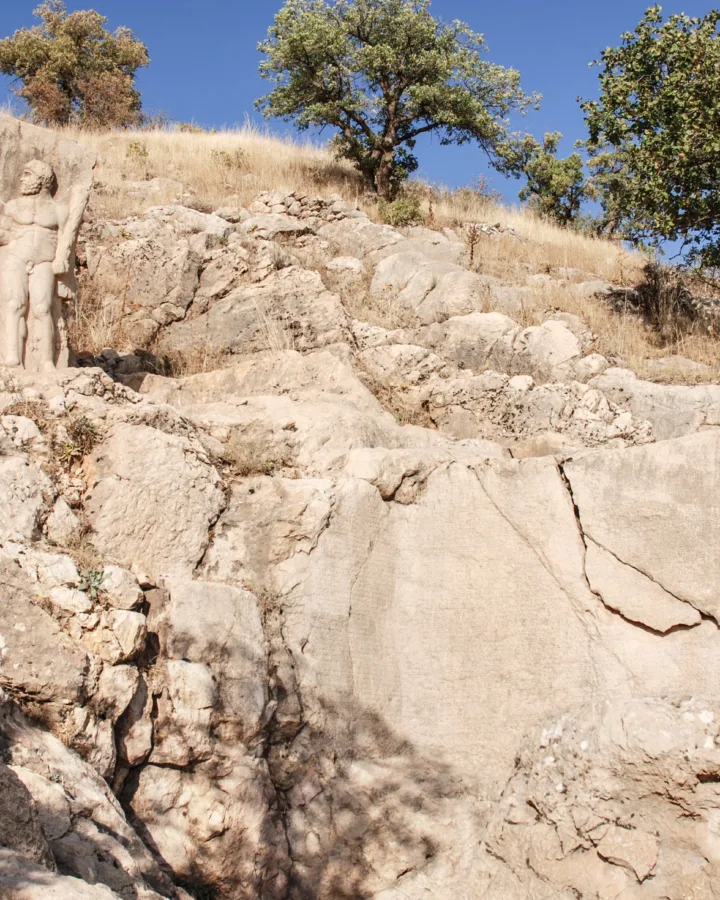
On that opposite hill, the Commagene king Antiochos I raised a tomb for his father, Mithridates Callinichos. Its rock face bears a long Greek text on the city's founding, its rites and the laws of the kings. Nearby, a rock tunnel runs about 158 m (518 ft) into the hill, and nobody knows what it was for.
Updated: November 18, 2026.
Nemrut Dağı National Park was declared on December 7, 1988, and covers 13,850 hectares (about 34,200 acres). The castle sits on the same road as the other sites inside it. Together they make one route: the Karakuş tumulus, the Cendere Bridge, Arsameia and Kâhta Castle. The road then climbs to the summit of Mount Nemrut, at 2,150 m (7,054 ft). Asphalt runs as far as Karadut village, and paving stone covers the last stretch.
The Karakuş tumulus, about 21 m (69 ft) tall, holds burials of women of the Commagene royal family. At the Cendere Bridge, the Roman XVI Legion spanned the Cendere stream under the emperor Septimius Severus. On the summit, a mound of broken rock about 50 m (164 ft) high covers the tomb of Antiochos I. His stone statues, 8 to 10 m (26 to 33 ft) tall, line the terraces around it.
On our journeys through the southeast, we stop here and at the Cendere Bridge on the drive north to Nemrut. We confirm access for your date.
We can add Kâhta Castle to our Mount Nemrut sunset tour, right beside the stop at Arsameia.
The summer capital of the Commagene kings near Kâhta, with the tomb of Mithridates and a…
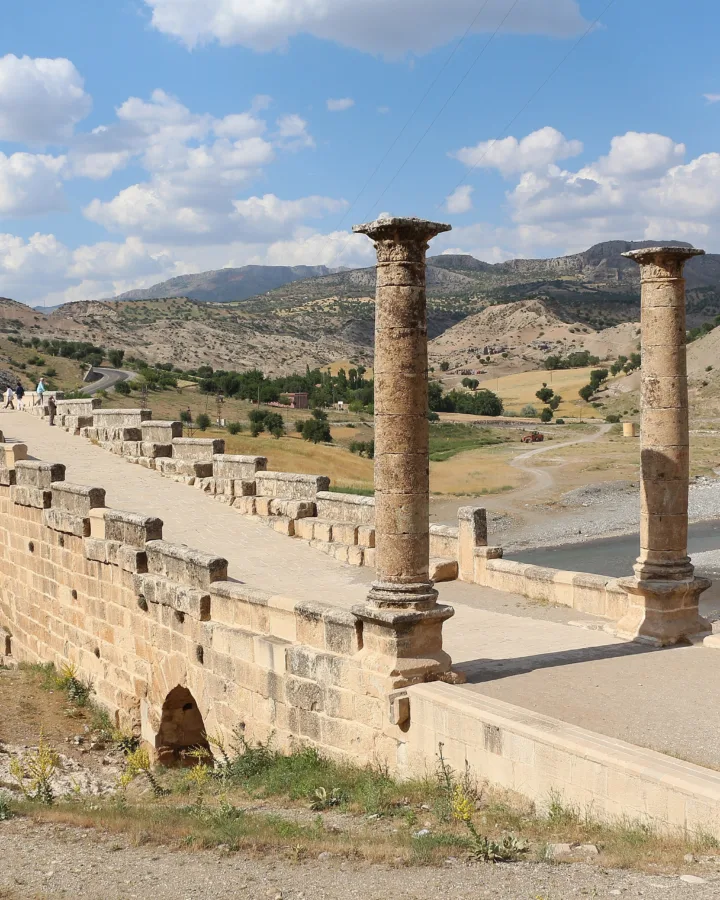
A Roman bridge of the reign of Septimius Severus over the Cendere stream near Kâhta, with…

Mount Nemrut in Adıyaman: the mountaintop tomb-sanctuary of King Antiochus I of Commagene, with giant stone…