
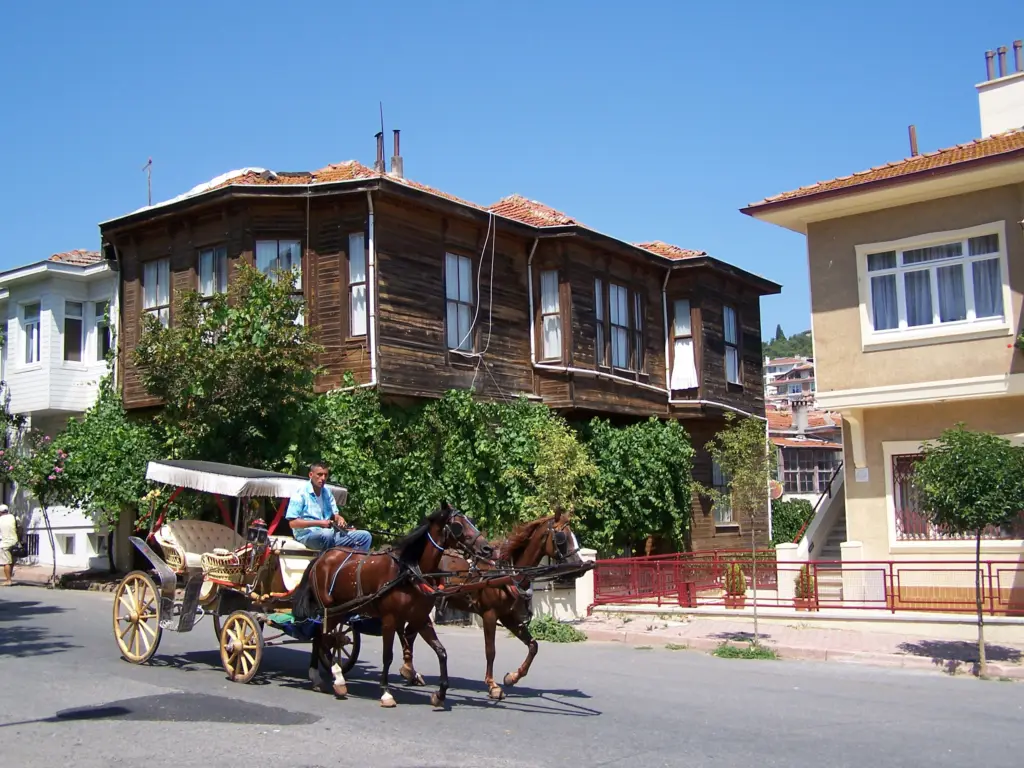
Photo: Darwinek / Wikimedia Commons, CC BY-SA 3.0
Heybeliada
Halki of the Byzantines: a ferry ride from the city to pine-covered hills, a famous seminary and a greener island than its big neighbor.
Overview
After the ferry leaves Kadıköy, the city slowly falls behind and four green hills rise out of the Sea of Marmara. Pine woods cover them, while old wooden mansions line the lanes below, and a red-roofed building sits on the top of one hill. This is Heybeliada, the second largest of the Princes’ Islands and a place to spend a slow day near Istanbul.
So bring good shoes, leave the car behind and let the island set the pace.
- Good for
- Walkers, cyclists, history lovers, an island day
- Best combined with
- Büyükada, Kadıköy, a ferry ride on the Sea of Marmara
Heybeliada, the Green Princes’ Island
To begin with, the island lies in the district of Adalar, south of the city in the Sea of Marmara. In winter, about 4,400 people live here. In summer, however, owners of summer houses return and the number grows to about 30,000. Even then, there are no private cars, so people walk, ride bicycles or take the small electric vehicles that replaced the horse-drawn phaetons in 2020.
Heybeliada in numbers
- 1773the Naval High School is founded by the pier
- 1844the Halki Seminary opens on Hope Hill
- 2020phaetons give way to electric vehicles
History of Heybeliada
Copper and a saddlebag
In ancient times, the island was called Halki, from the Greek word for copper, because copper was mined here. The Turkish name, on the other hand, came later. Heybeli means with a saddlebag, and the name comes from the dip between the hills, which looks like a bag thrown over a horse.
Monks, an ambassador and a president
For centuries, actually, monasteries stood on the hills. Then, in 1598, Edward Barton, the envoy of Queen Elizabeth I, came here to escape the plague in the city and died on the island. Much later, İsmet İnönü, the second president of Turkey, spent his summers here from 1924, and his family house is now a museum.
What to See on Heybeliada
The Halki Seminary on Hope Hill
On Ümit Tepesi, Hope Hill, the Monastery of the Holy Trinity looks out over the sea. In 1844, it opened as a school for Orthodox clergy, the Halki Theological Seminary, and after the earthquake of 1894 it was rebuilt. In 1971, a new law on private higher education closed it. Our Greek Orthodox Istanbul tour crosses here by ferry after Fener.

The Naval High School and Kamariotissa
First, right by the pier, the white buildings of the Naval High School catch the eye. The school was founded in 1773 and closed in 2016. In its grounds stands Kamariotissa, a late Byzantine church, but it is military land, so it is not open to visitors.
Churches, a synagogue and a mosque
Then, in the village center, the Greek church of Saint Nicholas dates from 1857 and keeps a sacred spring. Close by, the Beth Yaakov Synagogue and the island mosque stand only a few steps apart, a reminder of the many communities that once shared the island.
Çam Limanı Bay
Finally, walk or ride across the island to Çam Limanı, Pine Harbor, a bay on the far side. Above it, at the same time, the old sanatorium, now closed, looks down over the water.
The Old Village of Heybeliada
The flat land behind the quay was the island’s first settlement. There was no quay then, only a pebble beach, some buildings stood over the water, and sea baths lay near the breakwater. Behind them stood a village of one- and two-story wooden houses, mostly of fishermen, and the church stood where it stands today, with the sea in front of it. In time, the village spread uphill to the mosque, and the slopes from there to the beach were known as Ambela, the vineyards. The ancient copper mine that gave the island its old name, Halki, lay at Çam Limanı. Then, in 1868, a priest trained at the Christos Monastery built the Terki Dünya Monastery and the church of Arsenios, rebuilt in wood after the earthquake of 1894.

Our notes for Heybeliada
- HillsFour hills means steep lanes. Wear good shoes, or rent a bicycle near the pier.
- MansionsThe finest 19th-century houses stand on Refah Şehitleri and Lozan Zaferi Streets.
- SeasonsIn winter the island is almost empty. In summer, about 30,000 people live here.
- Two islandsWith a full day, combine it with Büyükada, a short hop away by ferry.
Our suggestion Take a morning ferry, walk up to Hope Hill for the view, cross the pine woods to Çam Limanı Bay, then catch a late ferry from the pier back to Kadıköy.
How to Visit Heybeliada
Getting there
In general, city ferries run from Kabataş and Eminönü in about 70 minutes, and also from Kadıköy. From Bostancı, motorboats take about 25 minutes. However, timetables change between summer and winter, and we plan your crossing on the current city ferry timetable.
Seeing it with us
Heybeliada fits well into our Princes’ Islands tour, together with its big neighbor Büyükada. Read more about all four islands in our guide to the Princes’ Islands, and for the Greek Orthodox world of Istanbul, visit Fener.
Because it is the green sister of Büyükada. Step off the ferry, walk up through the pines to Hope Hill and the old seminary, then come down to Çam Limanı Bay on the far side of the island.
Map
Open in Google Maps (opens in a new tab) Open in Apple Maps (opens in a new tab)
Frequently asked questions
How do I get to Heybeliada?
By city ferry from Kabataş or Eminönü, about 70 minutes, or from Kadıköy. From Bostancı, motorboats take about 25 minutes.
What does the name Heybeliada mean?
Island with a saddlebag, because the dip between its hills looks like a saddlebag thrown over a horse.
Can I visit the Halki Seminary?
It has been closed as a school since 1971, after a new law on private higher education. The building still stands on Hope Hill.
Are there cars on Heybeliada?
No private cars. People walk, ride bicycles or use the small electric vehicles that replaced the horse-drawn phaetons in 2020.
Heybeliada or Büyükada?
Büyükada is bigger. Heybeliada is greener, with pine woods, so it suits walkers. With a full day, you can visit both.
Where was the old village of Heybeliada?
On the flat land behind today's quay, where fishermen lived in one- and two-story wooden houses facing a pebble beach.

You may also like
-
 Tour
Princes’ Islands Private Tour: Büyükada and Heybeliada
-
 Tour
Private Greek Orthodox Istanbul Tour: Fener and Heybeliada
-
 Place
Büyükada
-
 Place
Fener
-
 Article
Greeks of Istanbul: Fener, the Patriarchate and the Rum Community
-
 Article
Are the Princes’ Islands Worth It?
-
 Place
Princes’ Islands
-
 Place
Burgazada