Photo: Carole Raddato from FRANKFURT, Germany / Wikimedia Commons, CC BY-SA 2.0
Labraunda
The holy mountain of the Carian kings: Zeus with his double axe, feasting halls and a granite tomb among the pines above Milas.
Overview
High in the pine forest above Milas, a road climbs past olive terraces until the air turns cool. Then, on a ledge of the mountain, marble terraces step down the slope, and a great stone doorway frames the sky. This is Labraunda, the holy mountain of the Carians, where the family of Mausolus came to honor Zeus with the double axe. For the Carian cities in one day, join our Carian heritage tour.
- Good for
- Ancient sanctuaries, mountain views, the story of Mausolus
- Best combined with
- Euromos, Mausoleum at Halicarnassus, Stratonikeia
The Zeus of Labraunda
Long before the Greeks wrote about it, Labraunda was already sacred to the Carians and to their neighbors, the Mysians. Here, however, Zeus was no ordinary Greek god. Instead, the local Zeus Labraundos stood with a tall scepter in one hand and a labrys, a double-headed axe, in the other.
The legend of the double axe
A Carian leader from Mylasa, today’s Milas, named Arselis, helped the Lydian king Gyges win his throne. In return, Gyges gave him a golden double axe, and the Carians kept it in the temple here. For this reason, many scholars read the very name of Labraunda as “the place of the labrys”, and the same root may lie behind the word labyrinth. Also in Caria, our Stratonikeia tour follows the sacred road from an ancient city to the temple of Hekate at Lagina.

Mausolus and the Kings of Caria
In the 4th century BC, Caria was a Persian province, but a local family ruled it almost like kings. First, Hecatomnus gave the cult statue of Zeus, as an inscription records. His son Mausolus, whose tomb at Halicarnassus became one of the Seven Wonders, rebuilt the sanctuary on grand terraces. His brother Idrieus added the Ionic temple and carved his name on it.
For this family, Labraunda was the ancestral shrine. So they mixed Persian and Greek ideas in their buildings, and in doing so, they foreshadowed the Hellenistic style. Later, in the 3rd century BC, the sanctuary passed to Mylasa, and people lived here until the middle Byzantine centuries.
What to See at Labraunda
The Temple of Zeus
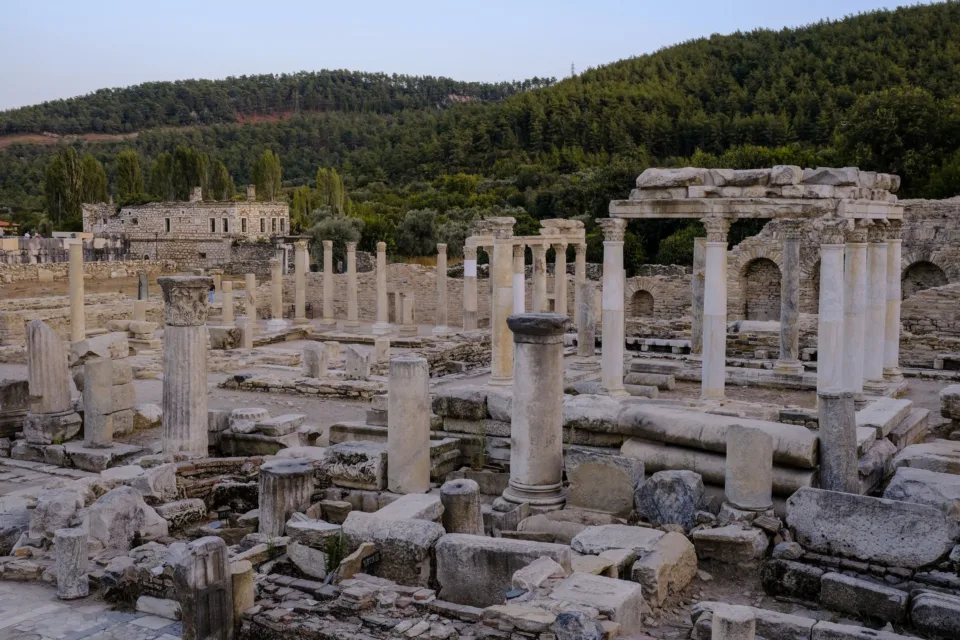
First, find the temple on its terrace. Only its foundations and some column drums remain, but the dedication of Idrieus survives. Besides, the cella was small, with a low ceiling, so the god lived in a modest room behind his columns.
The banqueting halls of Labraunda
Next, walk to the andrones, the great halls where guests feasted during the festivals of Zeus. Andron A still stands to an impressive height, and you can walk through its tall doorway and look out of its windows. Few buildings from the age of Mausolus survive this well.

The tomb, the stoas and the springs
Above the sanctuary, a built tomb of huge granite blocks guards the hillside. Below, look for the long terrace wall of the stoa, the two marble gateways, the baths and a later church. Finally, find the spring houses, because water was sacred here too.

Digging Labraunda
Swedish archaeologists began work here in 1948 under Axel W. Persson, and after his sudden death, Gösta Säflund continued it. Since then, Swedish, Turkish and international teams have kept on digging and publishing. For example, in recent seasons a team led by Olivier Henry and Ömür Dünya Çakmaklı has explored the site.
Our notes for Labraunda
- Sacred wayAn ancient road of about 15 km (9 miles) once linked Milas to the sanctuary.
- AltitudeHigh in the hills, it is cooler than the coast, so bring a layer.
- Getting therePublic transport does not reach the site, so come by car or taxi.
- ShadePines shade parts of the site, but the terraces are open.
Our suggestion Go on a Tuesday. Start at the weekly market in Milas, where villagers sell their own cheese, yogurt and bazlama flatbread, then drive up to Labraunda for a picnic among the pines.
How to Visit Labraunda
The sanctuary lies about five kilometers (three miles) west of the village of Ortaköy, in the hills north of Milas. We arrange your visit to Labraunda as part of a Carian day.
Then combine it with the temple of Euromos on the road to Lake Bafa, the great city of Stratonikeia, the seaside ruins of Iasos, the market hall of Queen Ada’s Alinda, and the site of the Mausoleum at Halicarnassus in Bodrum, the tomb of Mausolus himself.
Because few sanctuaries feel this close to the sky. Climb into the pines above Milas, stand in the doorway of a royal feasting hall, and look out over the hills of Caria as pilgrims did 2,400 years ago.
Map
Open in Google Maps (opens in a new tab) Open in Apple Maps (opens in a new tab)
Frequently asked questions
Where is Labraunda?
In the mountains above Milas in Muğla Province, about five kilometers (three miles) west of the village of Ortaköy, at about 750 meters (2,460 feet) above sea level.
Who was worshipped at Labraunda?
Zeus Labraundos, a Carian Zeus shown holding a tall scepter and the labrys, a double-headed axe.
What is an andron?
A hall for banquets. At Labraunda, the family of Mausolus built grand andrones where guests feasted during the festivals of Zeus.
How do I get to Labraunda?
By car or taxi from Milas, up a mountain road. Public transport does not go to the site.