Photo: Dosseman / Wikimedia Commons, CC BY-SA 4.0
Limyra
A Lycian king's capital, the death of a Roman heir and an ancient bridge across the plain of Finike.
Overview
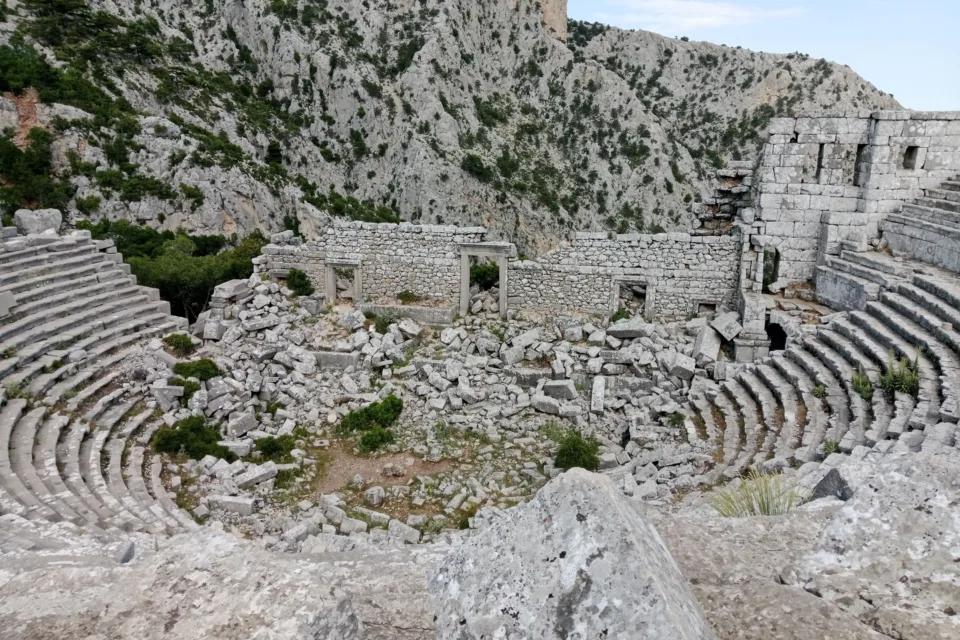
On the orange-growing plain of Finike, a country road runs along the foot of a steep hill. Beside it, a Roman theater opens toward the fields, and in the reeds of the lower city, streams wind among broken walls. Few visitors stop. However, this was once the capital of Lycia, and the place where Augustus lost his chosen heir. This is Limyra.
- Good for
- Ruins at your own pace, Roman history, Lycian tombs
- Best combined with
- Arykanda, Myra, Olympos
The Story of Limyra
To begin with, Lycian inscriptions call the city Zemuri, which shows that people lived here at least from the 5th century BC.
The capital of Pericles
In the 4th century BC, the Lycian ruler Pericles joined a revolt of the satraps against Persian rule and made Limyra the capital of Lycia. However, the Persians later regained control through Mausolus of Caria. Later still, after Alexander, the city honored Ptolemy II of Egypt with a monument, the Ptolemaion, for his help against the invading Galatians.
The death of a Roman heir
Centuries later, Augustus adopted his grandson Gaius Caesar as his heir. Then, in AD 2, Gaius went to Armenia, where he was tricked and badly wounded. On his way home to Rome, he died here at Limyra in AD 4, and a great cenotaph rose in his memory.
What to See at Limyra
The theater
First, see the Roman theater at the foot of the acropolis. The building goes back to the Hellenistic period and was heavily repaired in AD 141, in the years of the generous Lycian benefactor Opramoas of Rhodiapolis, whose city our Rhodiapolis tour visits. The same Opramoas helped rebuild Pinara after an earthquake.
The cenotaph of Gaius Caesar
Next, take the path from the western gate down into the marshy lower city, to the cenotaph of Gaius Caesar. Today, only its massive core on a stone podium survives.

The tomb of Pericles
Then climb toward the acropolis, where the tomb of Pericles once stood, decorated with fine reliefs such as Perseus slaying Medusa. However, many of its carvings are now in the Antalya Museum. Besides, five cemeteries of Lycian tombs surround the city.

The Roman bridge
Finally, look for the Roman bridge east of the city. Besides, with its long row of low, flat arches, it is an early segmental-arch bridge.
Saklısu, the Limyros Stream and Four Hundred Tombs
The ancient city lies at Saklısu in the Finike district, on the southern slopes of Toçak Dağı. Its acropolis holds an inner and a lower castle, with walls, cisterns, a Byzantine church and the heroon of Pericles, whose tomb recalls the Nereid Monument at Xanthos. Limyra has one of the largest groups of rock tombs in Lycia: more than four hundred, many known by name from their inscriptions in the Lycian language. South of the Turunçova–Kumluca road, the Limyros stream splits the lower city in two, and the Ptolemaion stood inside the southern wall. The city was a bishopric under Byzantium and was abandoned after the Arab raids of the 8th and 9th centuries.
The Ptolemaion and the Cenotaph at Limyra
The Lycian name Zemuri may even go back to the Hittite word Zumarri. Then, on the plain below, the Limyros stream divides the lower city into two islands. Inside the Early Byzantine wall, the remains on the western island are older than those on the eastern one.
A round temple for a king
First, look for the Ptolemaion, the monument for Ptolemy II. Today, only its stepped podium survives, and the Byzantine wall runs right over it. Between 1984 and 1993, a team from the Institute for Classical Archaeology of the University of Vienna excavated it. So, from its scattered blocks, archaeologists have pieced it together on paper as a round temple on a square podium.
The reliefs of the cenotaph
Also, the cenotaph of Gaius Caesar went up in AD 4. Besides its architecture, its marble reliefs made it famous. Its high relief, now in the Antalya Museum, shows the realism of the age of Augustus, from 27 BC to AD 14, at exceptional quality. Finally, see the theater and the heroon of Pericles with a guide on our Arykanda and Limyra tour.

Tips for visiting Limyra
Our notes for Limyra
- TheaterPaid for by Opramoas, who also helped Pinara.
- MarshPaths in the lower city can be wet.
- MuseumSee the tomb reliefs in Antalya.
Our suggestion Visit Limyra in the morning, then drive up the Elmalı road to Arykanda.

Because Limyra hides great stories in a corner of the Finike plain. Sit in the theater below the acropolis, find the monument to the grandson Augustus lost here, then look for the low Roman bridge across the stream.
Map
Open in Google Maps (opens in a new tab) Open in Apple Maps (opens in a new tab)
Frequently asked questions
Where is Limyra?
On the plain of Finike in Antalya Province, at the foot of an acropolis hill in ancient Lycia.
Who was Pericles of Limyra?
A Lycian ruler of the 4th century BC who made Limyra the capital of Lycia. His tomb was decorated with fine reliefs, including Perseus slaying Medusa, and parts are now in the Antalya Museum.
What happened to Gaius Caesar at Limyra?
The grandson and heir of Emperor Augustus died here in AD 4 from wounds received in Armenia. A great cenotaph was raised in his memory.
What is the Limyra Bridge?
A long Roman bridge east of the city, an early segmental-arch bridge built with flat arches.
How many rock tombs are there at Limyra?
More than four hundred, and many are known by name from their inscriptions in the Lycian language.