Dolmabahçe Palace
Dolmabahçe Palace on the Bosphorus: the European-style home of the last sultans, with the Crystal Staircase,…
Photo: Turkey Your Way
Carved white stone at the water's edge, under the towers of the Bosphorus Bridge: the Balyans' 19th-century jewel.
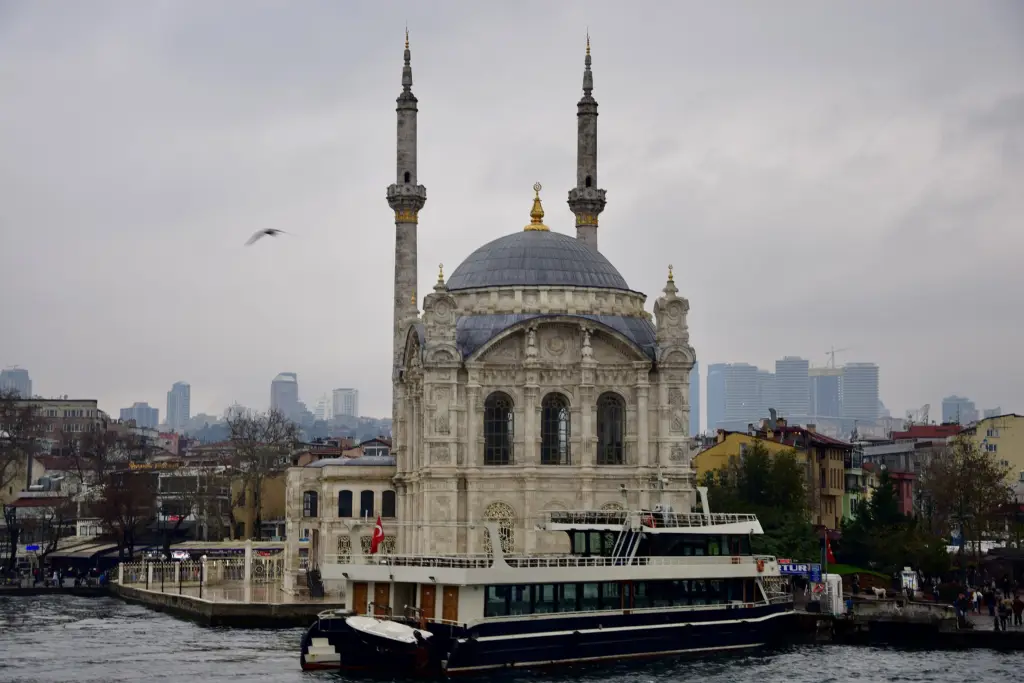
White stone carved like lace, two needle-thin minarets and, right behind, the huge towers of the Bosphorus Bridge: Ortaköy Mosque is a classic view of the Bosphorus. It sits at the very edge of the water, on the pier square of an old village.
Although small inside, Ortaköy Mosque is rich in detail, a 19th-century jewel of Ottoman Baroque. The square around it is lively, so it makes a fine evening stop.

Ortaköy Mosque, officially the Büyük Mecidiye Camii, stands on the pier square of Ortaköy in the Beşiktaş district, on the European shore of the Bosphorus. Sultan Abdülmecid I commissioned it, and its inscription dates it to 1854. Today, the mosque stands very close to the European pylon of the Bosphorus Bridge, now officially the 15 July Martyrs Bridge.
Its architect was Nikoğos Balyan, of the Armenian Balyan family, who also designed the nearby Dolmabahçe Palace and the Dolmabahçe Mosque. Nearby, a Dolmabahçe Palace tour takes you through the last great home of the Ottoman sultans.
Ortaköy Mosque in numbers
A small masjid already stood here from 1721, and it was renewed on the shore in the 1740s. Then, more than a century later, Abdülmecid I ordered the present building.

Later, the 1894 Istanbul earthquake damaged the mosque. In 1909, the Ministry of Foundations repaired it. In the 1960s, however, new cracks appeared, so the General Directorate of Foundations strengthened the ground and renewed the dome, and the mosque reopened in 1969. The General Directorate of Foundations restored it in recent years.

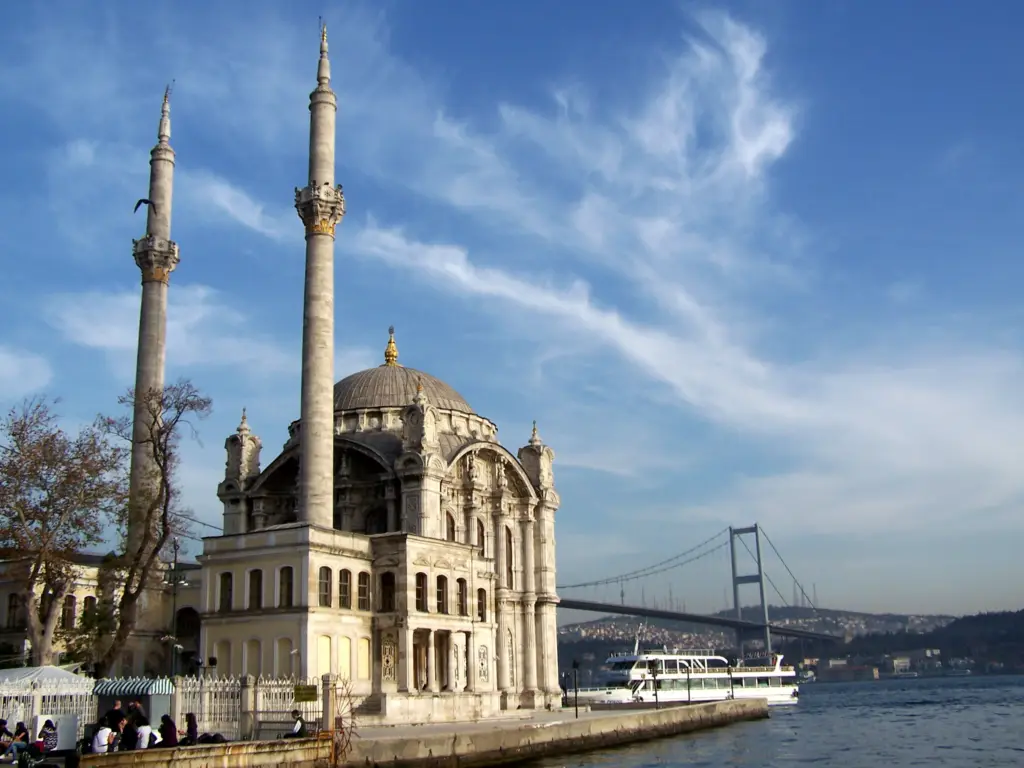
Like other buildings by the Balyans, the mosque mixes Ottoman Baroque with European Neoclassical ideas. What sets it apart, however, is the richness of its carved stone. Engaged columns and reliefs cover the facades, while two rows of large windows fill the prayer hall with light reflected from the water. The minarets, too, have balconies shaped like Corinthian capitals.
Inside, the building has two parts: a two-story imperial apartment for the sultan and a square prayer hall under a single dome. The mihrab (the niche that shows the direction of prayer) and minbar are of marble, while the preacher’s chair is of marble and porphyry. Above, trompe-l’œil paintings of curtained windows and niches decorate the dome. Look also for calligraphy panels by Sultan Abdülmecid himself, who was a skilled calligrapher.

Ortaköy, “the middle village”, is a busy neighborhood on the Bosphorus and home to Galatasaray University and Kabataş High School. Nearby stand the Esma Sultan Mansion, a burnt-out yalı turned event venue, and the Çırağan Palace of Sultan Abdülaziz, now a luxury hotel. Finally, on the hill above, the German architect Bruno Taut once lived in a house that mixed Japanese and European styles.
In Ortaköy, three faiths share one shore road. A few steps from the mosque stand the Etz Ahayim Synagogue and the Greek Orthodox Church of Agios Fokas. Visits to both are limited, so admire them from outside unless you come for a service.
Our notes for Ortaköy
Our suggestion Come late in the afternoon. Visit the mosque between prayers, eat kumpir by the water, and stay until the bridge lights up behind the dome. On a Sunday, add the craft stalls in the side streets.
Seeing Ortaköy from the water is just as good. Our Bosphorus cruise can slow down under the bridge for the classic photograph. On land, our Bosphorus villages tour starts in Ortaköy, and our Bosphorus dinner cruise passes the mosque in the evening. Book either one, and we plan your Ortaköy stop at dusk, when the bridge lights up.
Because it is the Bosphorus postcard come to life. Stand on the pier square between the carved facade and the bridge towers, then step inside to see the sultan's own calligraphy under a painted dome.
Dolmabahçe Palace on the Bosphorus: the European-style home of the last sultans, with the Crystal Staircase,…

Rumelihisarı, the fortress Mehmed II built on the Bosphorus in 1452 to cut off Constantinople: three…

Open in Google Maps (opens in a new tab) Open in Apple Maps (opens in a new tab)
The architect Nikoğos Balyan, for Sultan Abdülmecid I, in 1854.
Büyük Mecidiye Camii, the Great Mosque of Sultan Abdülmecid.
Yes. Dress modestly, remove your shoes and avoid prayer times, especially Friday noon.
For its carved stone facades and its setting at the water's edge, right below the Bosphorus Bridge.
Yes. Several calligraphy panels inside are by Sultan Abdülmecid I himself.