Museum
Adana Museum
One of Türkiye's ten oldest museums, in a restored cotton mill in Adana, with the Hittite…
Photo: John Lubbock / Wikimedia Commons, CC BY-SA 2.0
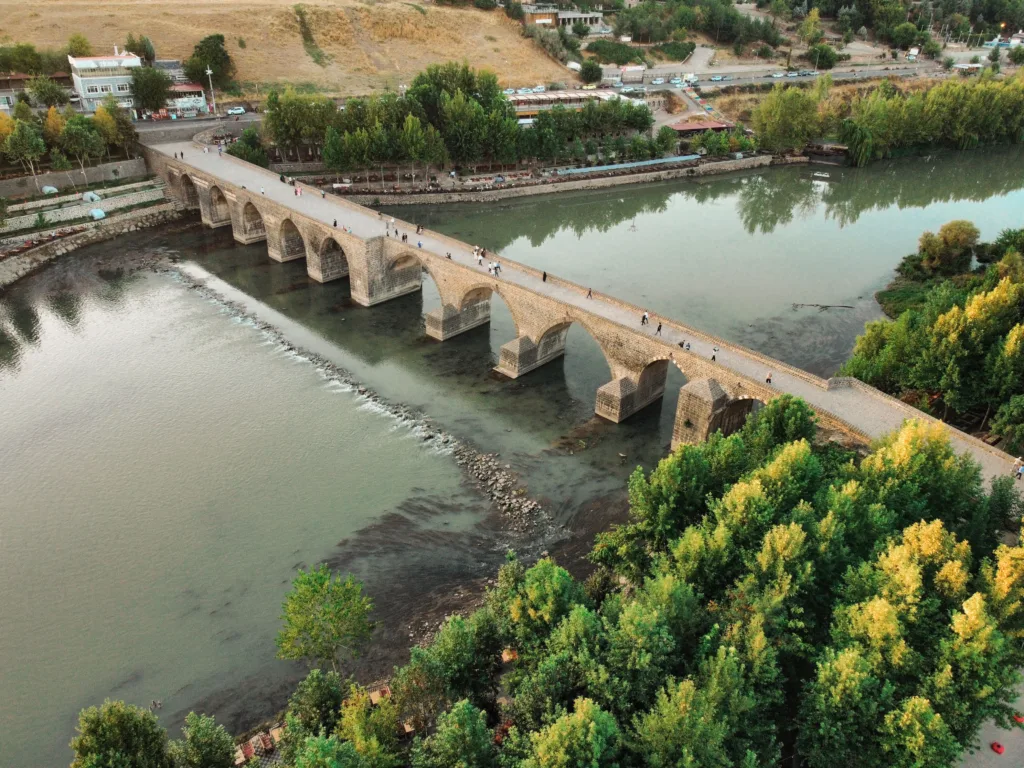
Adana's Roman stone bridge of the 4th century AD, still carrying people across the Seyhan on 14 arches.
Taşköprü, the "stone bridge," has crossed the Seyhan River in Adana since Roman times. Built in the 4th century AD, it still carries people from one bank to the other. So it counts among the oldest bridges in the world still in use. From east to west, its arches run about 300 meters (980 feet) over the water. Since March 2026, lamps have lit the stone at night as well.
The bridge lies in the city itself, and its official address is in the Sinanpaşa quarter of Yüreğir. From the city center, you can reach it by local public transport. On the west bank, the Sabancı Central Mosque, opened in 1998, stands close to the river.
Quick facts
In ancient times, the Seyhan was called the Sarus. Roman builders spanned it in the 4th century AD, when the empire found its wide lands hard to hold. Because of that, good roads and crossings mattered more than ever. For centuries afterward, the bridge served as an important link between Europe and Asia. Even now, its shape keeps the typical features of Roman bridge building.
Later rulers kept the crossing in repair. The Abbasid caliph Harun al-Rashid joined the bridge to Adana Castle with new additions. Early in the 9th century, his son al-Ma'mun, the seventh Abbasid caliph, had it repaired. It received care under the Ottoman sultan Ahmed III, under Kel Hasan Pasha and under Ziya Pasha, governor of Adana. Inscriptions from these last three repairs survive.
In 1928, the Adana Museum first opened to visitors in the madrasa of the Cafer Pasha Mosque, at the head of the bridge. That building no longer stands. Today, the museum fills a restored textile mill in the Döşeme quarter, so you can follow its story at the Adana Museum.

Today, the bridge rests on 14 arches, with 5 smaller relieving arches between them. It stands about 12 meters (39 feet) high. Its middle sits about 2.5 meters (8 feet) higher than its ends, so the walkway climbs gently toward the center and drops again. On average, it is about 9.5 meters (31 feet) wide. From the riverside paths, you see the long row of arches mirrored in the water.
Start on one bank and walk up the gentle rise to the middle. From the top, the Seyhan opens out on both sides of you. Then carry on to the far bank, and look back at the arches from the riverside path. Because so many rulers repaired it, the stones under your feet hold the work of many centuries.
In March 2026, the first stage of a lighting project on the bridge came to an end. Since then, 59 lamps have lit its arches at night. So an evening walk shows the old stone in a new way, with its light reflected in the Seyhan.
The bridge is part of the city streets, so you walk onto it from either bank. From the city center, local public transport takes you there. We walk you over the Taşköprü on the way to an Adana kebab lunch.
On our Adana day, you begin at the bridge in the morning. Then you walk along the west bank to the Sabancı Central Mosque. You sit down for Adana kebab, a registered local name since 2005; our guide to Turkish kebabs explains the styles. After lunch, the day ends at the Adana Museum.
On our 10-day food journey, you drive to Adana from Gaziantep on day six. That day, you see the Taşköprü over the Seyhan and stop for a lunch of Adana kebab. On the next day, you fly on to İzmir and the olive groves of Urla. So the bridge sits between the baklava of Gaziantep and the wine of the Aegean. For more of the region, see our Mediterranean guide.
Updated: October 26, 2026.
Would you like to cross a Roman bridge before an Adana kebab? Our Adana city and food tour starts at Taşköprü in the morning. On a longer trip, our 10-day Turkey food tour stops here too. Morning on the bridge, kebab at noon: send us the day you are in Adana.
Museum
One of Türkiye's ten oldest museums, in a restored cotton mill in Adana, with the Hittite…

The bridge crosses the Seyhan River in the city of Adana, and its official address is in the Sinanpaşa quarter of Yüreğir. You can reach it from the city center by local public transport.
Yes. The bridge is part of the city streets, so you walk onto it from either bank. The walkway climbs gently to the middle, where the river opens out on both sides.
Roman builders spanned the river here in the 4th century AD, and the bridge still carries people across. Inscriptions from Ottoman-era repairs survive.
Yes. Since March 2026, 59 lamps have lit its arches at night, so an evening walk shows the stone reflected in the Seyhan.
Our Adana city and food tour starts at the bridge in the morning, then stops for Adana kebab and ends at the Adana Museum. Our 10-day Turkey food tour stops here too.
 Tour
Private Adana City and Food Tour: Kebab, Bridge and Museum
 Journey
Taste of Turkey in 10 Days: A Private Food Tour from Istanbul to Cappadocia
 Place
Sabancı Central Mosque
 Place
1915 Çanakkale Bridge
 Place
Titus Tunnel, Samandağ
 Place
Limyra
 Place
Galata Bridge
 Place
Diyarbakır Fortress and Hevsel Gardens