

Mosque
Hagia Sophia
Fifteen centuries in one building: Justinian's great church, an Ottoman mosque, a museum and a mosque…
Photo: Turkey Your Way
The Church of Holy Peace: older in its foundation than Hagia Sophia, saved as an arsenal, and filled today with concerts.
In the first courtyard of Topkapı Palace, on the way to the palace gate, stands a red-brick church with a dome. Hagia Irene, the “Church of Holy Peace”, has stood beside Hagia Sophia since Byzantine times. Inside, a great cross outlined in black on gold still fills the apse, a rare survivor of the age of Iconoclasm.
It never became a mosque. Instead, for centuries the palace kept its weapons here, and today classical concerts fill it with music.
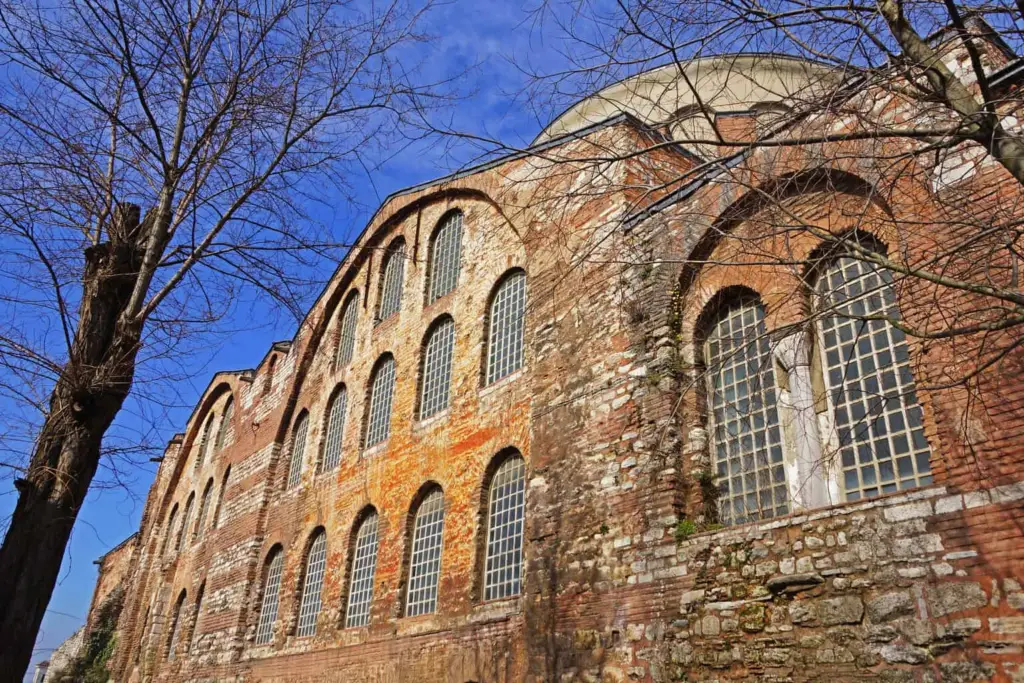
Hagia Irene stands in the outer courtyard of Topkapı Palace, a few steps from Hagia Sophia. The emperors dedicated it to the peace of God, one of three churches the emperors devoted to divine attributes, together with Hagia Sophia, Holy Wisdom, and Hagia Dynamis, Holy Power.
Today the building works as a museum and a concert hall.
Hagia Irene in numbers
Tradition has it that Constantine the Great built the first Hagia Irene in the 4th century, possibly on the site of an older temple. Then, in 532, the Nika revolt swept the city, and the church was badly damaged. Emperor Justinian rebuilt it, and in the atrium you can still see capitals with the monograms of Justinian and Theodora.

After the conquest of 1453, the church found itself inside the walls of Topkapı Palace. However, instead of becoming a mosque, it became the İç Cebehane, the palace’s inner arsenal. Later, it housed weapons and trophies as a military museum, and today the Ministry of Culture and Tourism runs it as a museum. The Imperial Museum first opened here in 1869; our Istanbul Archaeology Museums tour visits its successor below the palace.
In the semidome of the apse, a mosaic cross outlined in black on a gold ground dates from about the 8th century. During Iconoclasm, when the emperors banned images of people, simple crosses like this one took their place.
Below the cross rise six tiers of stone benches in a semicircle, the synthronon, where the clergy once sat. It is the only Byzantine synthronon that survives in Istanbul.
Justinian’s rebuilding kept a basilica plan at ground level but added a cross-domed plan at the gallery level, with the narthex and atrium on the west. The church still has its dome and its peaked roofs.
After the conquest, Mehmed II began to gather precious weapons and war material in the church, and later sultans kept the custom, so it became the İç Cebehane, the inner arsenal. In 1726, Ahmed III reorganized it as a museum of arms, the Dârülesliha. After the Janissary corps was abolished in 1826, most of its weapons and equipment were destroyed. Then, under Sultan Abdülmecid, Fethi Ahmed Pasha set up a new museum here, with one hall of old arms and one of antiquities. Osman Hamdi Bey moved the antiquities to the Tiled Kiosk, the beginning of today’s Istanbul Archaeology Museums, and the church was left to the old weapons, with a small Louis XV-style room for the sultan.

Because of its remarkable acoustics, the building now serves mainly as a concert hall. Every summer since 1980, the Istanbul International Music Festival has held many of its concerts here.

Our notes for Hagia Irene
Our suggestion Visit with your Topkapı ticket in the morning, then check whether a concert is on during your stay. Hearing music in this empty Byzantine church is something few visitors ever get to do.
Because almost everyone walks past it. Step into the oldest church building in Istanbul, look up at the great Iconoclast cross in the apse, and imagine the Janissaries' weapons stacked where concerts now play.
Mosque
Fifteen centuries in one building: Justinian's great church, an Ottoman mosque, a museum and a mosque…

The Istanbul Archaeology Museums beside Topkapı Palace: the Alexander Sarcophagus, the lions of Babylon, the oldest…

Open in Google Maps (opens in a new tab) Open in Apple Maps (opens in a new tab)
Its first foundations go back to Constantine the Great in the 4th century, and after the Nika revolt of 532 Justinian rebuilt it.
No. After 1453 it became the İç Cebehane, the palace's inner arsenal, and later a museum of arms.
In the first courtyard of Topkapı Palace in Sultanahmet, next to Hagia Sophia.
A mosaic cross of about the 8th century, from the Iconoclast period, outlined in black on a gold ground.
Yes. Many concerts of the Istanbul International Music Festival have been held here every summer since 1980.
Yes. In 1726 Ahmed III turned the palace arsenal in the church into a museum of arms, and its later antiquities hall became the nucleus of the Istanbul Archaeology Museums.
 Tour
Byzantine Istanbul Private Tour: Constantinople Beyond Hagia Sophia
 Tour
Private Istanbul Archaeology Museums Tour with a Guide
 Tour
Topkapı Palace Private Tour with the Harem
 Person
Justinian I
 Article
Is Hagia Sophia Worth Visiting During the Restoration?
 Article
Christmas in Istanbul: Masses, Churches and the Real Saint Nicholas
 Place
Fountain of Ahmed III
 Place
Keşlik Monastery
