Photo: Svklimkin / Wikimedia Commons, CC BY-SA 4.0
Fountain of Ahmed III
A carved marble fountain of the Tulip Period at the gate of Topkapı Palace.
Overview
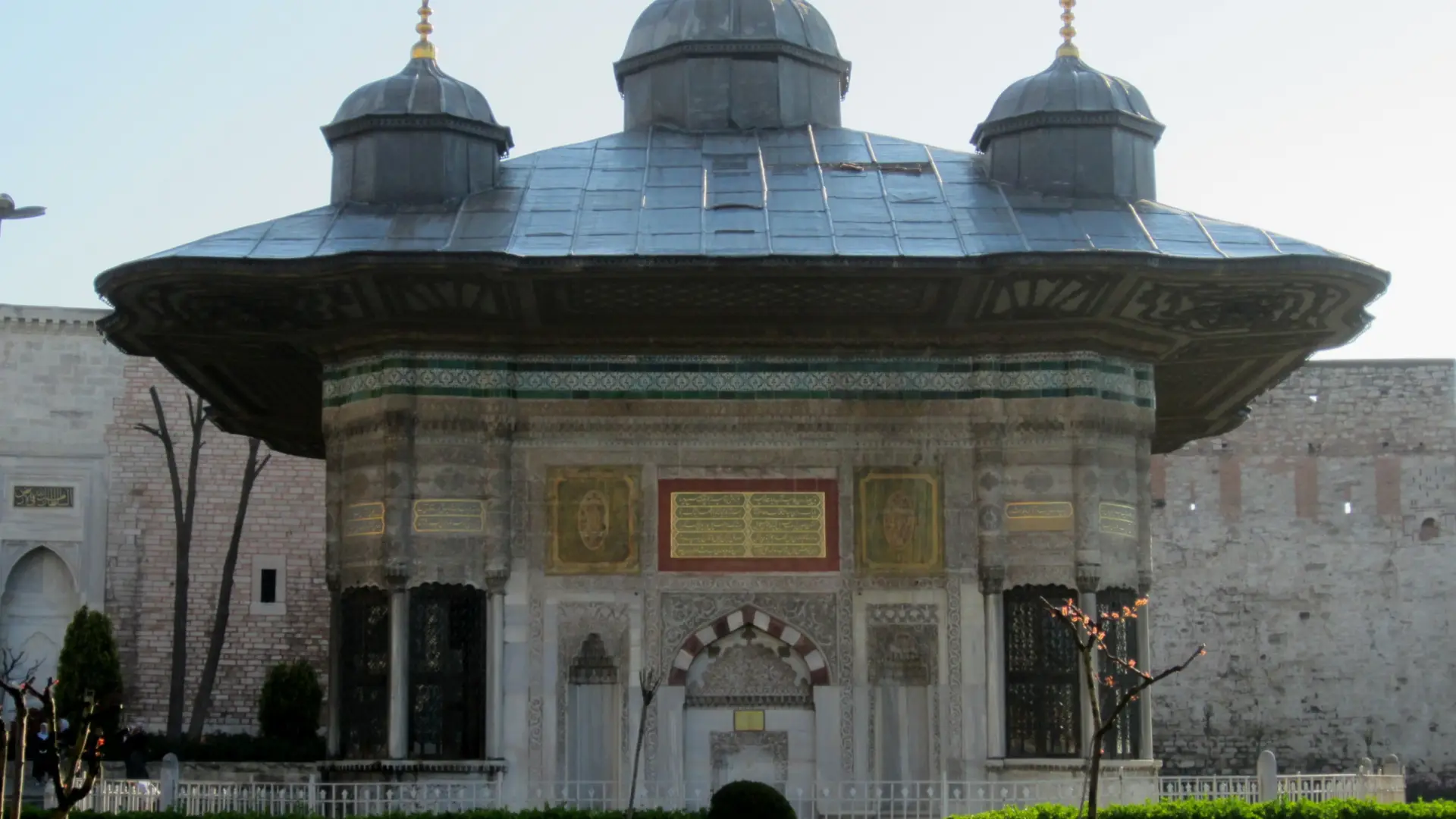
Between Hagia Sophia and the Imperial Gate of Topkapı Palace, a small marble pavilion stands in the square under wide, curving eaves and five little domes. Almost every surface, also, is carved with flowers, vases and fruit, while golden verses run around its walls. So this is the Fountain of Ahmed III, whose inscription dates it to 1728–29, where for two centuries anyone could stop for a free cup of water or sherbet.
- Good for
- Ottoman decorative art, quick stops, photography
- Best combined with
- Topkapı Palace, Hagia Sophia, Hagia Irene
The Story of the Fountain of Ahmed III
A fountain of the Tulip Period
To begin with, Sultan Ahmed III built the fountain in 1728–29, during the years known as the Tulip Period, when the Ottoman court loved gardens, poetry and new decoration. It was, actually, an early and richly carved example of a new type of free-standing fountain in Istanbul. In the same year, the sultan also built a similar but simpler fountain in Üsküdar.
A meeting place
Back then, the fountain was also a social center, where people gathered on their way to and from the palace. Much later, it even appeared on the back of the Turkish 10-lira banknote from 1947 to 1952.
What to See at the Fountain of Ahmed III
The four sebils of the Fountain of Ahmed III
First, walk around the building. Overall, it is a large square block with a drinking fountain, or çeşme, in a carved niche on each side. Inside, at the center, an eight-sided pool supplied all of them with water.

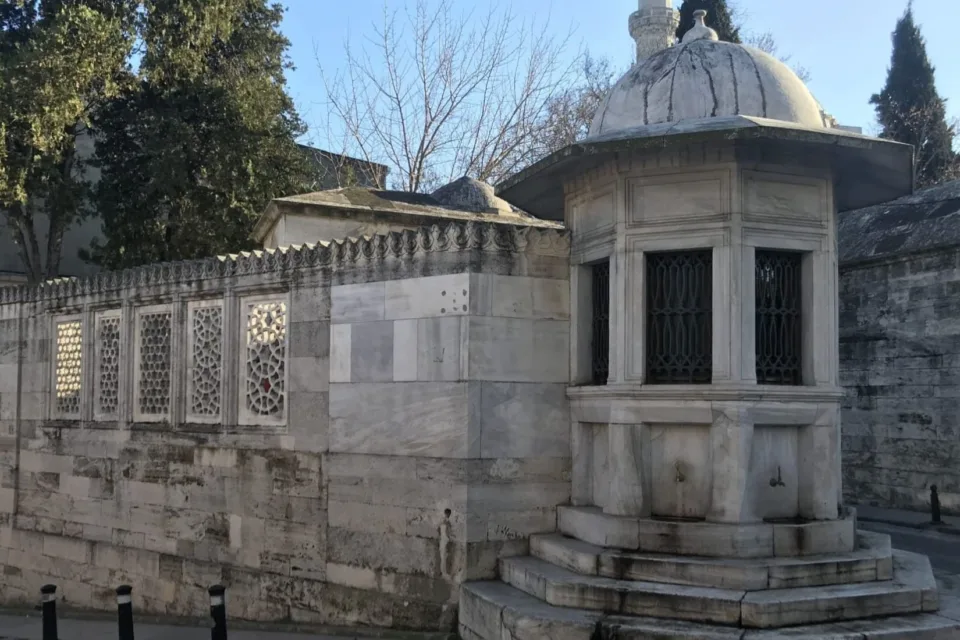
Next, look at the four corners as well. Here, too, each corner holds a sebil behind three bronze grilles. Through them, attendants once handed out cups of water, or of sherbet.

A poem about water
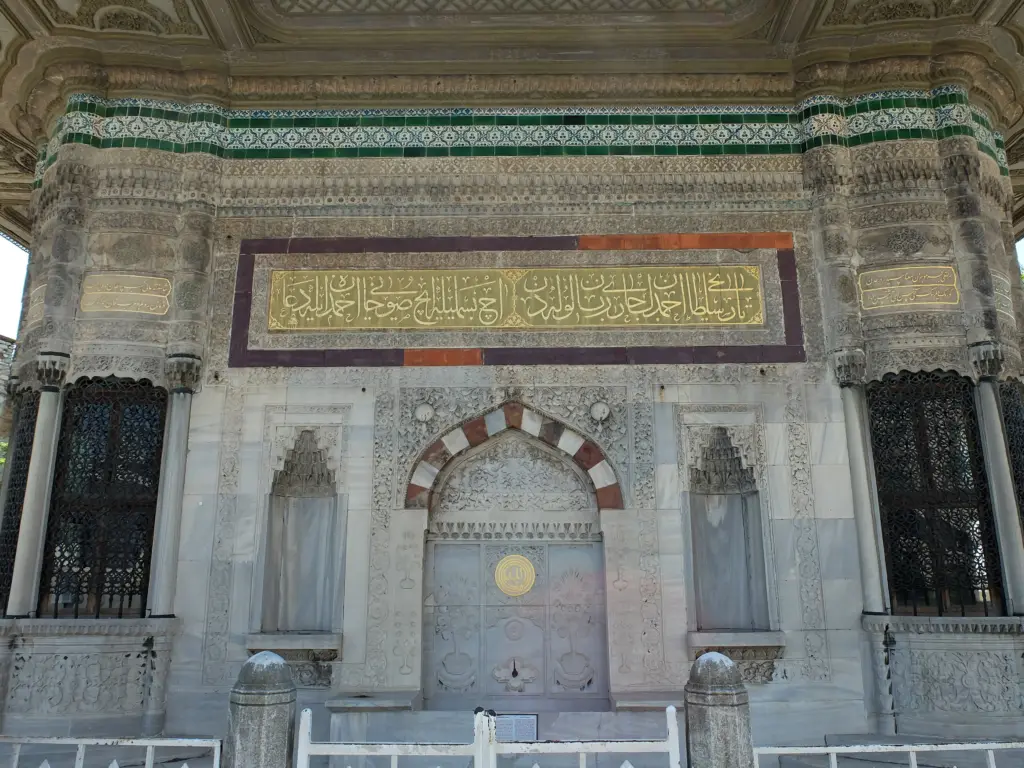
After that, read the walls, at least with your eyes. Above each niche and sebil, for instance, plates of calligraphy framed in blue and red tiles carry a poem about water and its donor, written by Seyyid Hüseyin Vehbi, a chief judge of Aleppo and Kayseri. As a rule, it reads clockwise, starting at the northern sebil. Interestingly, the last verse is a chronogram composed by Ahmed III himself, whose letters also give the date.
The eaves
Finally, look up. Under the broad roof, in turn, the painted eaves and a frieze of tiles circle the whole building.

Tips for visiting the Fountain of Ahmed III
Our notes for the fountain
- BuiltIn 1728–29, by Sultan Ahmed III.
- SebilsFree water and sherbet, once.
- TwinA simpler sister fountain in Üsküdar.
Our suggestion Stop here on your way out of Topkapı Palace, when the afternoon light falls on the carved front.
How to Visit the Fountain of Ahmed III
In practical terms, the fountain stands in the open square in front of the Imperial Gate of Topkapı Palace, just behind Hagia Sophia in Sultanahmet.
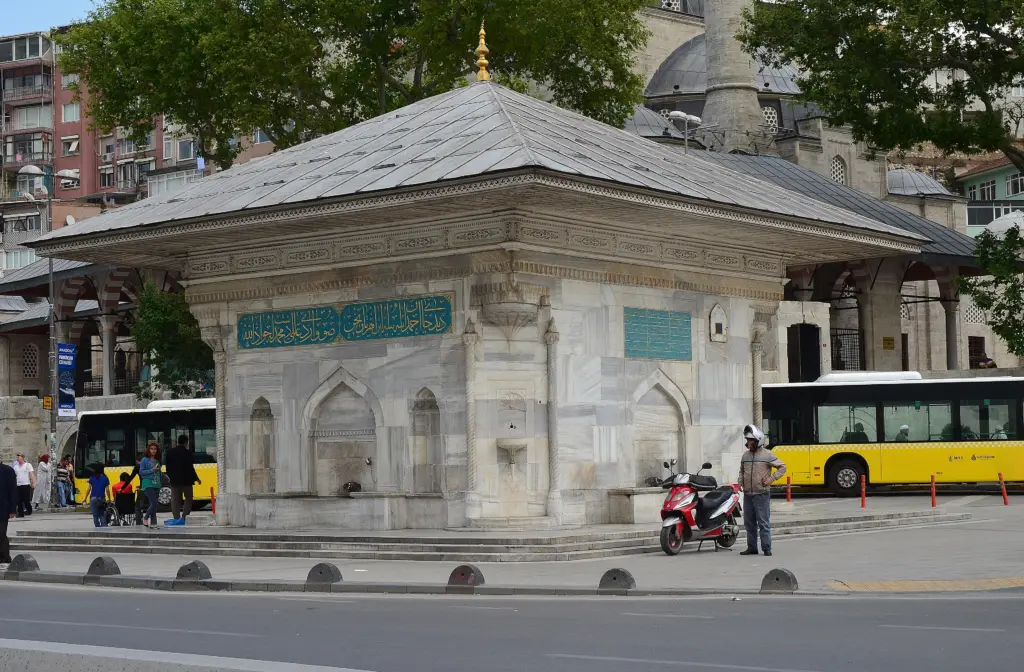
Afterward, pass through the gate to Hagia Irene in the first courtyard of the palace, or walk to the German Fountain on the old Hippodrome, a German gift unveiled in 1901.
Because it is the most beautiful drink stop in Istanbul. Here, for two centuries, anyone could take a free cup of water or sherbet under a poem written for the water.
Map
Open in Google Maps (opens in a new tab) Open in Apple Maps (opens in a new tab)
Frequently asked questions
Where is the Fountain of Ahmed III?
In the square in front of the Imperial Gate of Topkapı Palace, behind Hagia Sophia in Sultanahmet.
When was it built?
In 1728–29, under Sultan Ahmed III, during the Tulip Period.
What is a sebil?
A kiosk with grilled windows where attendants handed out water or sherbet free of charge. This fountain has one at each corner.
Who wrote the poem on the fountain?
Seyyid Hüseyin Vehbi wrote the poem about water; its last verse is a chronogram by Ahmed III.