Ishak Pasha Palace
The Ishak Pasha Palace above Doğubayazıt: a 99-year Ottoman-era palace with Seljuk gates, Persian lions and…
Photo: Turkey Your Way
A pink stone church carved with biblical scenes on a small island in Lake Van, built for an Armenian king in 915–921.
A short boat ride from the southern shore of Lake Van, a small rocky island rises from deep blue water. On it stands a church of pink volcanic stone, its walls covered in carved figures: Adam and Eve, the serpent in Eden, princes, griffins and vines. Akdamar Island and its Armenian Church of the Holy Cross are among the great sights of eastern Turkey, and a masterpiece of medieval Armenian art. For nine days in the east, see our Lost Kingdoms of Eastern Anatolia tour.
So come early, walk around the church slowly, and read its walls like a picture book. Doğubayazıt and the Ishak Pasha Palace lie about three hours away by road, so Van and Doğubayazıt fit into one trip.
Akdamar Island, in Armenian Aghtamar, is the second largest of the four main islands in Lake Van. It covers about 0.7 square kilometers (170 acres) and lies about 3 kilometers (2 miles) from the shore. At its western end, a gray limestone cliff rises 80 meters (260 feet) above the lake, which itself lies 1,912 meters (6,270 feet) above sea level. Our Van Akdamar tour crosses to the island by boat.
Builders raised the church on the island, the Cathedral of the Holy Cross, between 915 and 921. Today, however, it serves as a museum.
Akdamar Island in numbers
King Gagik I Artsruni of the Armenian kingdom of Vaspurakan, who reigned from 908 to 943 or 944, chose the island as one of his residences. Here he built a palace with frescoes, a dock, streets, gardens and orchards. Of all this, however, only the church survives. The architect-monk Manuel built it of pink volcanic tuff, with an interior of about 14.8 by 11.5 meters (49 by 38 feet).
From 1113 to 1895, the island was the seat of the Catholicosate of Aghtamar of the Armenian Apostolic Church, and a monastery grew up around the church. Its ruins, though, still lie to the south of the building.
After 1915, the monastery was abandoned and its buildings fell into ruin. That year began the Armenian genocide of 1915–16, the Ottoman government’s destruction of its Armenian population. For decades afterward, the church stood neglected. In 1951, the writer Yaşar Kemal learned that it was about to be demolished and used his contacts to stop it. Turkey’s Ministry of Culture restored the church in 2005–2006, and it reopened as a museum on March 29, 2007. Since 2010, the authorities have allowed one religious service a year, and the first took place on 19 September 2010.
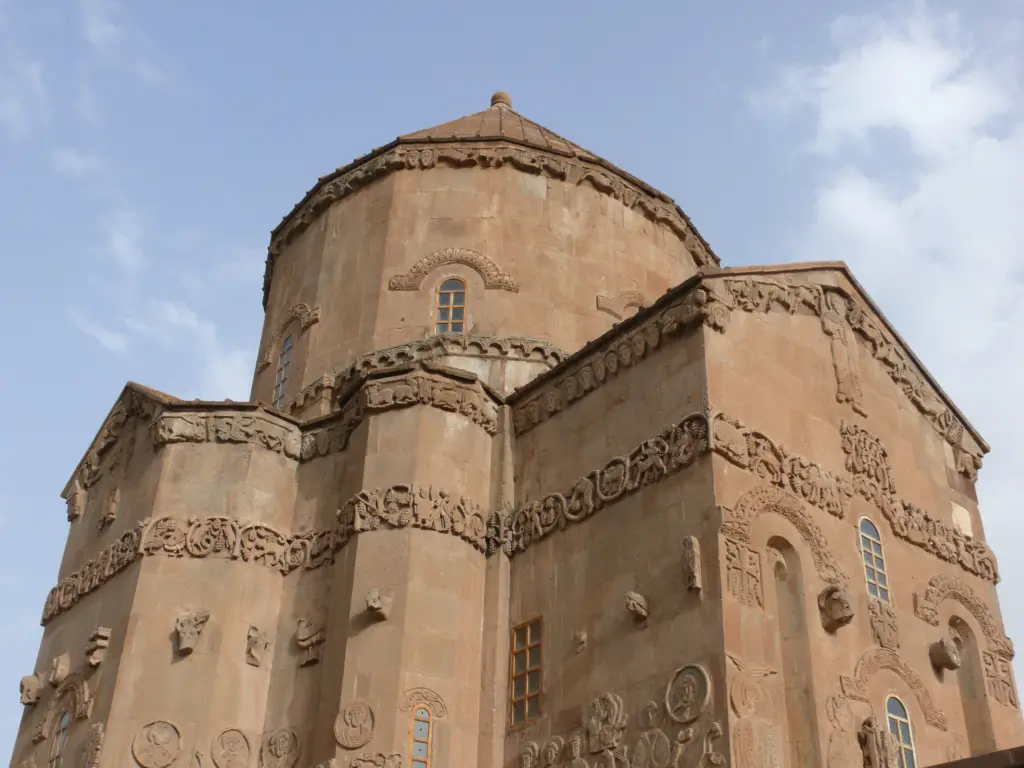
The plan follows a form developed in Armenia centuries earlier, best known from the 7th-century Church of Saint Hripsime at Echmiadzin. What makes Akdamar unique, however, is the outside. Its walls carry an extensive array of reliefs, mostly biblical scenes, in raised stone rather than paint.
Look for the Garden of Eden with the serpent, Adam and Eve, and many other scenes from the Bible. Some scholars also see echoes of Umayyad art, such as a turbaned prince and wine imagery, and of royal Sasanian themes like griffins. So the walls show how Armenian art met the wider world of its time.

A princess named Tamar lived on the island and loved a commoner who swam out to her each night, guided by her light. One night her father smashed the light, and the young man drowned, crying “Akh, Tamar” with his last breath. The poet Hovhannes Tumanyan made the story famous in 1891. The Turkish name Akdamar, meaning “white vein”, sounds similar.
On the island itself, at the same time, a spring provides water on the level ground to the east. Also, since 2010, a small solar power plant has supplied electricity. Across the water, the city of Van and its fortress make the natural base for a visit.

Our notes for Akdamar
Our suggestion Take the first boat from the pier near Gevaş, then picnic under the almond trees on the island before the day boats fill up.
Because few churches tell their stories on the outside like this one. Cross by boat, walk around the Holy Cross, and read Adam and Eve, princes and griffins carved into the pink stone.
The Ishak Pasha Palace above Doğubayazıt: a 99-year Ottoman-era palace with Seljuk gates, Persian lions and…

Lake Van, Turkey's largest lake: a deep soda lake below volcanoes in Eastern Anatolia, with the…
Nature
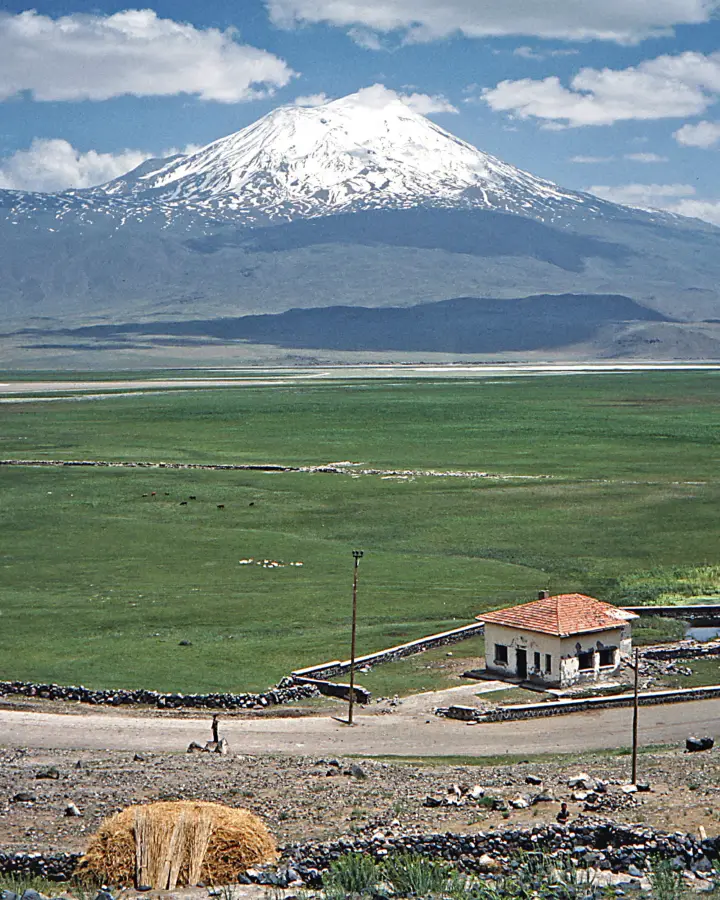
Mount Ararat, Turkey's highest peak: the volcano of Noah's Ark, the first ascent, the 1840 disaster,…

Open in Google Maps (opens in a new tab) Open in Apple Maps (opens in a new tab)
The Armenian Cathedral of the Holy Cross, built in 915–921 and carved with biblical reliefs, and the ruins of its monastery.
By boat from the southern shore of Lake Van; the island is about 3 km (2 miles) offshore.
Yes. After its 2005–2006 restoration it reopened as a museum in 2007, and one religious service a year is allowed.
After 1915 the monastery was abandoned and fell into ruin; that year the Armenian genocide began.
 Tour
Private Van and Akdamar Tour: Lake Van and the Holy Cross
 Place
Ahlat
 Article
Christian Heritage Sites in Turkey: From Antioch to Istanbul
 Article
Van or Doğubayazıt: Lake and Breakfast, or Palace and Ararat
 Article
Kars or Van: Which Eastern Turkey City to Choose
 Place
Keşlik Monastery
 Place
Gey (Yediburunlar)
 Place
The Synagogues of Izmir