Archaeological site
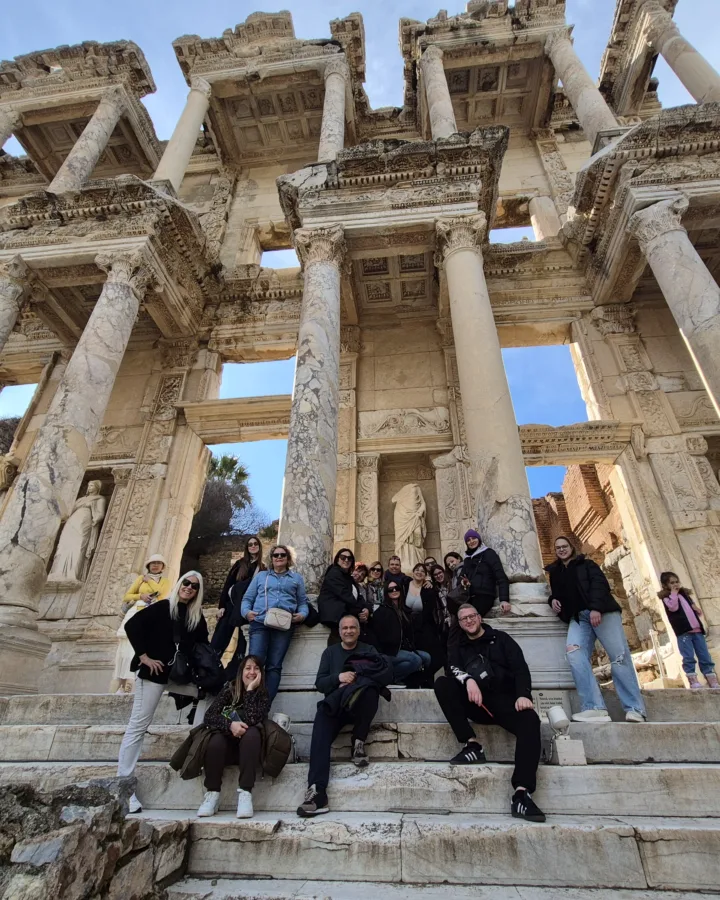
Ephesus
The best-preserved ancient city of the eastern Mediterranean: the Library of Celsus, the Terrace Houses, the…
Photo: Turkey Your Way
A marble city of Roman Caria, built with the favor of Augustus, with a remarkably well-preserved stadium and a museum full of its sculptors' work.
In a valley among olive groves, a marble gateway of four rows of columns stands alone in a meadow. Beyond it lie a temple, a council house and a great ancient stadium. And there is a lot of marble. This is Aphrodisias, the city of Aphrodite and of famous sculptors of the Roman world. Our off the beaten path Turkey tour in 12 days stops here before Ephesus.
Compared with Ephesus, Aphrodisias still feels like a secret. Its sculpture is remarkable, and its museum alone is worth the trip. So give it a full morning, and walk slowly between the monuments. Choosing one? Read Pamukkale or Aphrodisias.
Aphrodisias lies near the village of Geyre in Aydın province, in the fertile valley of the Dandalaz (Morsynus) stream, a branch of the Menderes. The city stood in ancient Caria, and later, under Rome, it became the capital of the province of Caria. Our Aphrodisias tour comes here from Pamukkale or Kuşadası.
In 2017, UNESCO added the site and its marble quarries to the World Heritage List. You can combine it with Pamukkale and Hierapolis, further inland to the east.
At first the city had other Greek names. Then, around the 3rd century BC, it took the name of Aphrodite, the goddess of love. Its own goddess had a unique image, wrapped in a tight robe with bands of carved figures, much like Artemis of Ephesus. Her temple stood at the heart of the town, so pilgrims came from far away.
The city’s great building program began with a local man named Gaius Julius Zoilos. At first he had been a slave of Julius Caesar, until Octavian set him free. Back home, Zoilos led the city to support Octavian against Mark Antony. So when Octavian became Emperor Augustus, Aphrodisias won special privileges. Then the money flowed into marble streets, temples and theaters.

White and blue-gray marble came from quarries right beside the city, so Aphrodisias developed a famous school of sculpture, and its artists worked across the Roman world. The city also kept a school of philosophy and stayed a center of the old gods until the end of the 5th century.
Then, in the 7th century, an earthquake destroyed much of the city. At the same time, its name changed to Stauropolis, “City of the Cross”, to drop its pagan meaning. People simply called it Caria, after the region, which gave the modern village its name, Geyre. After Seljuk raids, the town came under Turkish rule by the end of the 13th century.
The city built a monumental gateway with four rows of columns. Originally, it led from the main street into the forecourt of the sanctuary of Aphrodite. Today, restored, it is the symbol of the site.
Today only columns remain of the temple that stood at the center of the city. Later, Christians turned it into a basilica.

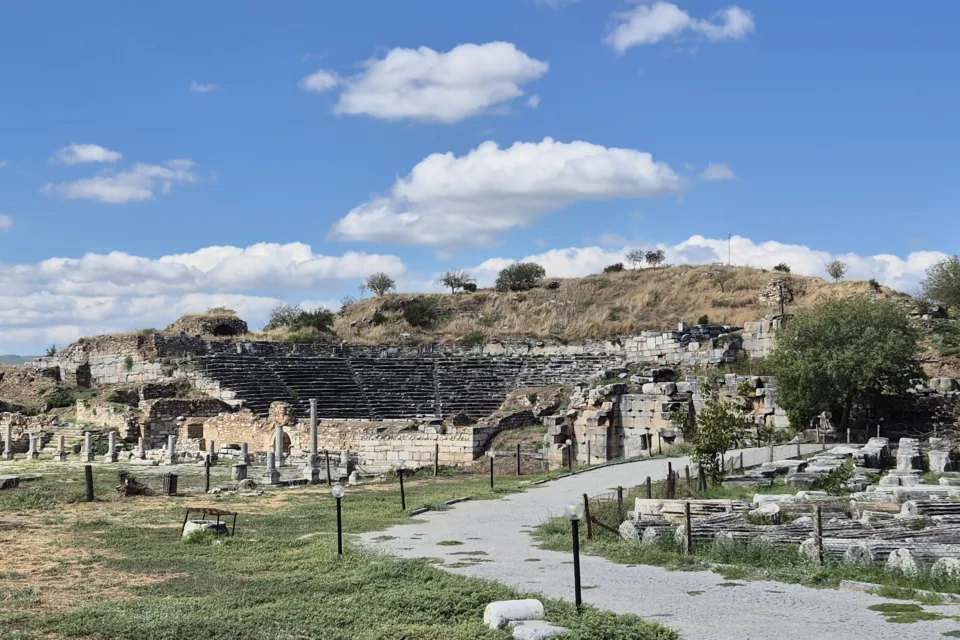
The stadium is also remarkably well preserved. Crowds watched races, games and artistic contests here. Later, the eastern end was turned into an arena for gladiators.

The Sebasteion was dedicated “to Aphrodite, the Divine Augusti and the People”. Above the street, two long porticos once carried carved panels of gods, emperors and conquered nations.

On the north side of the agora, the council house kept its lower rows of marble seats. Later, in the 5th century, it also served as a hall for lectures and performances.

Next to the site, the museum displays the work of the city’s sculptors. Do not miss the long hall of panels from the Sebasteion. The Turkish photographer Ara Güler helped introduce the site to the world, and Professor Kenan Erim of New York University led the excavations for decades.
Our notes for Aphrodisias
Our suggestion Come early and give it half a day. Walk the Sebasteion and the stadium first, then cool off in the museum among the faces carved by the city's own sculptors.
Because here the marble came from next door and the sculptors were the best in Rome. Walk through the Tetrapylon, stand in a stadium for 30,000 people, then meet Claudius and Britannia in the museum's Sebasteion hall.

Open in Google Maps (opens in a new tab) Open in Apple Maps (opens in a new tab)
Yes. It has a remarkably well-preserved stadium and a museum of outstanding Roman sculpture.
Near Geyre in the Karacasu district of Aydın province.
Yes. It combines well with Pamukkale and Hierapolis, which lie further inland to the east.
A complex dedicated to Aphrodite, the Roman emperors and the people, with porticos of carved panels, many now in the site museum.
Yes. The city and its marble quarries were added to the World Heritage List in 2017.
 Journey
Ephesus, Pamukkale and the Turquoise Coast Tour in 8 Days
 Tour
Private Aphrodisias Tour from Pamukkale or Kuşadası
 Article
Pamukkale or Aphrodisias: Which to Visit, or Both?
 Article
Turkey Road Trip: The Best Coastal Routes and Driving Tips
 Article
Is Pamukkale Worth It? Travertines, Hierapolis and Timing
 Article
UNESCO World Heritage Sites in Turkey: All 22
 Place
Laodicea
 Place
Mount Nemrut