Çemberlitaş Hamam
The Çemberlitaş Hamam on Divanyolu: a 1584 bath for Nurbanu Sultan, often credited to Mimar Sinan,…
Photo: Atriplex82 / Wikimedia Commons, CC BY-SA 4.0
The old main street of Istanbul's historic peninsula, on the line of the Byzantine Mese, lined with Ottoman mosques, tombs, baths and libraries.
Divanyolu is the old main street of Istanbul's historic peninsula, running from Sultanahmet toward the Grand Bazaar. For centuries, armies, caravans and court processions passed along it. So pashas and sultans lined it with mosques, schools, libraries, baths and tombs. Today, the T1 tram follows the road, while many of those buildings still stand on either side. At its end, our Grand Bazaar tour takes you into the old bedesten (the domed hall at the heart of a bazaar, for valuable goods).
The road begins in Sultanahmet, at the corner where the old Hippodrome square, Atmeydanı, meets it. Next, it runs west through the old Forum of Constantine, where the Column of Constantine still stands. It passes the Grand Bazaar, and between Hagia Sophia and Beyazıt part of the line also goes by the name Yeniçeriler Caddesi.
Quick facts
In Byzantine Constantinople, the main street was the Mese. It started at the Milion, the zero-mile stone of the empire's roads, and ran east to west for about 2 kilometers (1.2 miles). On the way, it crossed the Forum of Constantine with its porphyry column. Later, Divanyolu followed the same line through the old forum. In turn, its Ottoman name means "the road of the Divan", the imperial council. Armies and caravans marched along it, while great complexes and hans rose on both sides. Court processions used it on their way to Hagia Sophia and the palace gate. At the palace end of the road, the sultans watched them from the Alay Köşkü, a kiosk on the palace wall that faces Divanyolu, now at the edge of Gülhane Park.
On 19 September 1865, the Hocapaşa fire burned the wooden shops along the road. After the fire, the statesman Fuad Pasha had Divanyolu widened. So, to make room, builders pulled back the wall of the Fîruz Ağa Mosque. Later, in the same works under Sultan Abdülaziz, they cut away part of the dressing hall of the Çemberlitaş Hamam (a Turkish bath).
At the head of the road stands the small Fîruz Ağa Mosque. Fîruz Ağa, chief treasurer of Sultan Bayezid II, built it in 1490–91, right where Atmeydanı meets Divanyolu. Behind it lies the Hippodrome of Constantinople.

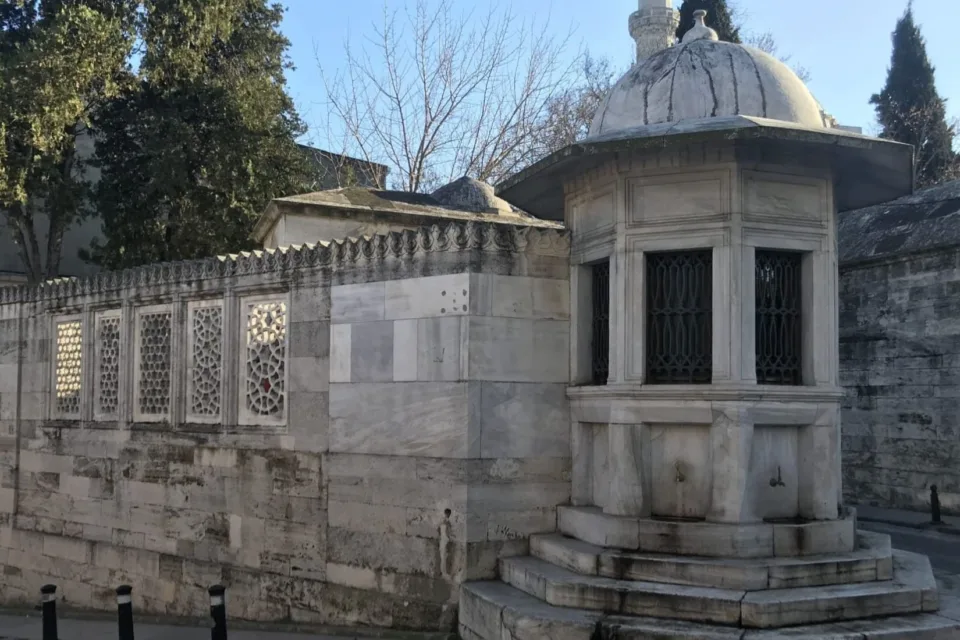
Sultan Mahmud II died on 28 June 1839 and was buried by the road, in the garden of Esma Sultan's palace. Over his grave rose an octagonal tomb, finished in 1840. Its walls are clad in marble in the Empire style, and a large dome covers it. Inside lie eighteen sarcophagi, among them those of Mahmud II and of the later sultans Abdülaziz and Abdülhamid II. For the palace where Abdülhamid II ruled, see our Yıldız Palace tour.
Further along, the porphyry column marks the old Forum of Constantine. Beside it, the Çemberlitaş Hamam of 1584 still welcomes bathers. Earlier, in the 17th century, three viziers of the Köprülü family built complexes along the road. One of them, the Köprülü Library, was founded on Divanyolu at the end of that century.
Because Divanyolu is a public street, you can walk it at any time. On the way, stop for a milk pudding at the Pudding Shop, at Divan Yolu No. 6. Also, the T1 tram stops at Sultanahmet, Çemberlitaş and Beyazıt-Kapalıçarşı, so you can ride one way and walk back. We plan the walk one way and the T1 tram back. At the mosques and tombs, dress modestly.
First, on our hammam experience, we meet at your hotel and walk along Divanyolu, while your guide explains the bath ritual. You choose your bath: the Hürrem Sultan Hamam between Hagia Sophia and the Blue Mosque, the Çemberlitaş Hamam on Divanyolu, or the nearby Cağaloğlu Hamam. You can stroll to the Grand Bazaar at your own pace.
Updated: October 27, 2026.
Would you like to walk the old imperial road on your way to a hammam? Our Istanbul hammam experience starts with a walk along Divanyolu and ends in one of the city's historic baths. The old imperial road leads to the bath; pick your afternoon and we will book the hammam.
The Çemberlitaş Hamam on Divanyolu: a 1584 bath for Nurbanu Sultan, often credited to Mimar Sinan,…

The Column of Constantine at Çemberlitaş: a porphyry column raised for the founding of Constantinople in…

Market
One of the oldest covered markets in the world: how it grew from Mehmed II's jewel…

The Hippodrome of Constantinople, today Sultanahmet Square: the chariot-racing arena of Byzantium with the Obelisk of…

It starts in Sultanahmet, where it meets the old Hippodrome square, and runs west past the Column of Constantine toward the Grand Bazaar. Between Hagia Sophia and Beyazıt, part of the line also goes by the name Yeniçeriler Caddesi.
It follows the line of the Mese, the main street of Byzantine Constantinople. Its Ottoman name means the road of the Divan, the imperial council, and it was widened after the Hocapaşa fire of 19 September 1865.
The Fîruz Ağa Mosque of 1490–91 at the Hippodrome corner, the tomb of Sultan Mahmud II finished in 1840, and the porphyry Column of Constantine. Beside the column, the Çemberlitaş Hamam of 1584 still welcomes bathers.
Yes. Divanyolu is a public street, and the T1 tram stops at Sultanahmet, Çemberlitaş and Beyazıt-Kapalıçarşı, so you can ride one way and walk back. At the mosques and tombs, dress modestly.
Our Istanbul hammam experience starts with a walk along Divanyolu while your guide explains the bath ritual. Then you choose your bath, the Hürrem Sultan Hamam, the Çemberlitaş Hamam or the Cağaloğlu Hamam.