
Photo: Maksym Kozlenko / Wikimedia Commons, CC BY-SA 4.0
Çemberlitaş Hamam
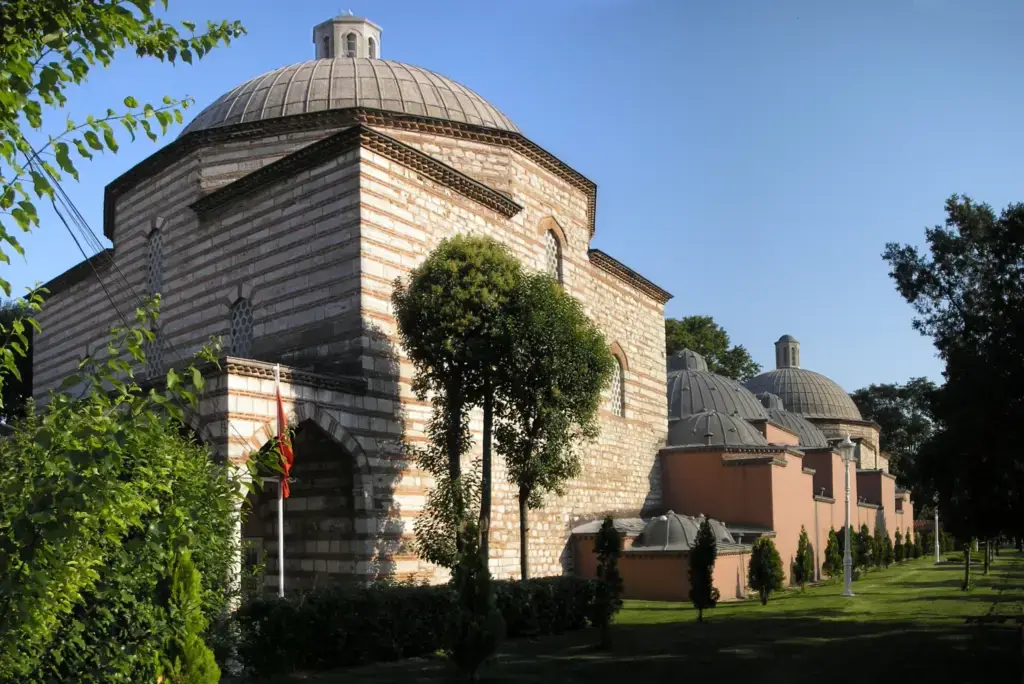
Nurbanu Sultan's bath of 1584 on the old imperial road: a domed hot room ringed by twelve columns, by the Column of Constantine and the Grand Bazaar.
Overview
Step off the tram at Çemberlitaş, and two things rise above the traffic of Divanyolu: the scorched Column of Constantine and, beside it, a cluster of white domes over the shops. See also Divanyolu, the old main street. Under those domes, people have been sweating on warm marble for more than four centuries. This is the Çemberlitaş Hamam (a Turkish bath), the bath of a powerful queen mother.
- Good for
- A classic hammam near the bazaar, history lovers
- Best combined with
- Grand Bazaar, Column of Constantine, Nuruosmaniye Mosque
Nurbanu Sultan’s Bath
In 1584, Nurbanu Sultan, the mother of Sultan Murad III and head of the imperial harem, built the bath as a charitable endowment. It served the people of the city, and at the same time it earned money. It did so well, that its income helped pay for her great mosque complex in Üsküdar, the Atik Valide. Our Sinan mosques tour visits that complex.
Sinan or his team?
People often credit the bath to Mimar Sinan. However, its name is missing from the lists of his works, so its architect is still an open question, although it went up in his years as chief architect.
Inside the Çemberlitaş Hamam
The hot room
First, you pass from the dressing hall through a warm room into the sıcaklık, the hot room. It is square, yet twelve columns and the deep bathing niches around its walls make it look twelve-sided. In the middle lies the göbektaşı, the warm marble navel stone, under a dome.
The old heating
Behind the bath stands the furnace. Much like in Roman baths, hot gases flow under the floor and up through the walls, so the whole building stays warm.
The Inscription of the Çemberlitaş Hamam
For years, the inscription over the door could not be fully read. When it was cleaned in the last repair, it showed the year 992 in the Islamic calendar, or 1584, in a chronogram by the poet Sâî Mustafa Çelebi, so the building is also called the Valide Hamam. Nurbanu built it to fund her charities, above all the Atik Valide complex at Toptaşı in Üsküdar, and she had baths in Üsküdar and Langa as well. Later, the Köprülü family, whose mansion stood next door, endowed a library across the street and built the large Vezir Han behind the bath. In the hot room, Persian and Turkish inscriptions over the doors of the corner cubicles are still waiting to be dated.

Four Centuries of Change
Over time, the bath survived fires, in 1660 and 1782, and earthquakes in the 18th century. Then, in 1868, the city widened Divanyolu after a great fire, and part of the building was cut away. This forced the women’s section to close, and steps were built down to the entrances, because the street had risen around them. Today, almost all of its guests are travelers in search of a historic bath.
The tellaks
In Ottoman times, a busy bath was a small world of its own. Attendants called tellaks scrubbed and washed the bathers, often living in the bath itself, while a hamam anası, the “mother of the bath”, ran the women’s side.
Our notes for the Çemberlitaş Hamam
- TramThe Çemberlitaş stop of the T1 line is right outside.
- BazaarThe Grand Bazaar is a few minutes’ walk away.
- ColumnLook up at the Column of Constantine next door.
- BookingReserve ahead and ask what each package includes.
Our suggestion Pair the bath with the Grand Bazaar: shop in the morning, then come back along Divanyolu for a long, hot afternoon session.

How to Visit the Çemberlitaş Hamam
The bath stands on Divanyolu, next to the Çemberlitaş tram stop, and our Istanbul rainy day tour ends here. We book your package at the Çemberlitaş Hamam and fit it into your day.
Before you go, read our guide to the Turkish bath in Istanbul, or book our Istanbul hammam experience. Next door, see the Column of Constantine, then walk to the Nuruosmaniye Mosque and the Grand Bazaar. For other historic baths, see the Hürrem Sultan Hamam and the Cağaloğlu Hamam.
Because the old imperial road still has its bath. Step off the tram on Divanyolu, lie on the warm navel stone under the dome, and walk out to the Grand Bazaar a new person.
Map
Open in Google Maps (opens in a new tab) Open in Apple Maps (opens in a new tab)
Frequently asked questions
Who built the Çemberlitaş Hamam?
Nurbanu Sultan, mother of Sultan Murad III, built it; its inscription gives 1584. It is often credited to Mimar Sinan, but the lists of his works do not name it.
Where is the Çemberlitaş Hamam?
On Divanyolu, by the Çemberlitaş tram stop and the Column of Constantine, a few minutes from the Grand Bazaar.
What is special about its hot room?
Twelve columns and deep niches make the square room look twelve-sided, with a warm marble navel stone in the middle under the dome.
Is the Çemberlitaş Hamam still in use?
Yes. Today it works as a historic hammam for visitors, and we book your session ahead.
Why is it also called the Valide Hamam?
Because Nurbanu Valide Sultan, mother of Murad III, built it; the inscription over the door gives the year 1584.
You may also like
-
 Tour
Istanbul Hammam Experience: A Turkish Bath in a Sinan Bathhouse
-
 Tour
Private Istanbul Rainy Day Tour: Cistern, Museum and Hammam
-
 Place
Cağaloğlu Hamam
-
 Place
Column of Constantine
-
 Place
Grand Bazaar
-
 Article
Hot Springs in Turkey: Bursa, Pamukkale, Afyon and the Hamam
-
 Place
Divanyolu
-
 Place
Şerefiye Cistern