
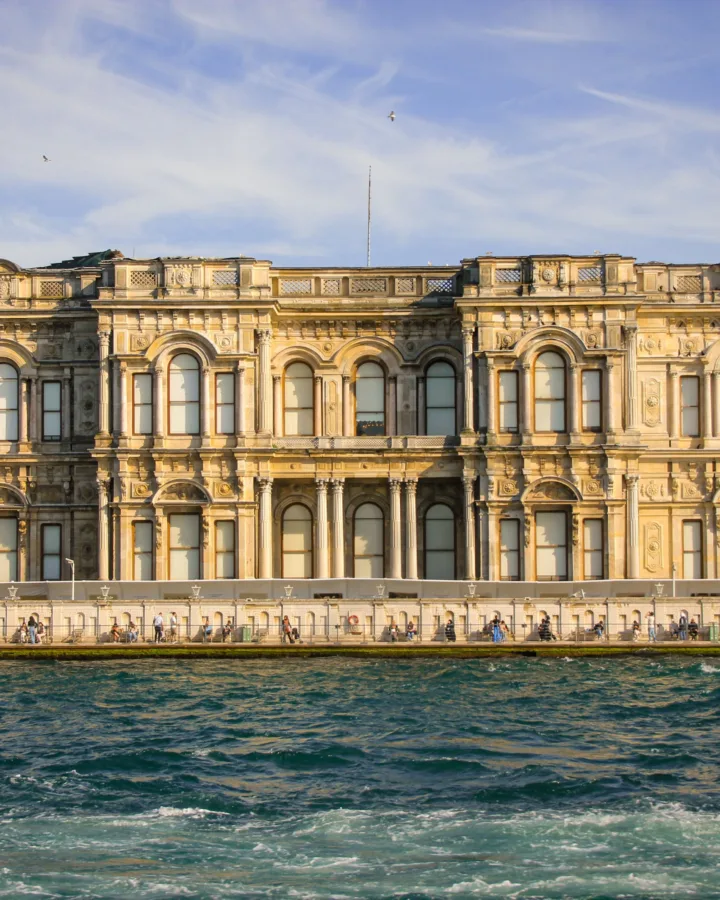
Beylerbeyi Palace
Beylerbeyi Palace on the Asian shore of the Bosphorus: the white summer palace of Sultan Abdülaziz,…
Photo: Turkey Your Way
Ancient Chrysopolis on the Asian shore: Sinan's mosques by the ferry dock, a promenade facing the old city and more than 180 mosques uphill.
Every Turk knows the song: “Üsküdar’a gider iken aldı da bir yağmur,” on the way to Üsküdar, the rain caught us. The old folk song, also known as Kâtibim, has followed this ferry town for more than a century. Yet Üsküdar is no museum piece. It is where the Asian side of Istanbul begins its day, with commuters running for ferries past mosques by Mimar Sinan, and where the city ends its day, with tea on the shore facing the sunset over the old city. By city ferry, join our Istanbul ferry tour.
We often start our Asian-side days here. So here is Üsküdar the way we walk it with guests.
Step off the ferry, and two mosques by Mimar Sinan stand right at the water’s edge. Both belong to the great age of Suleiman the Magnificent and his heirs, and both are worth ten minutes before you go anywhere else.
Facing the ferry square stands the Mihrimah Sultan Mosque, built for Suleiman’s daughter. Locals simply call it the İskele Camii, the Dock Mosque, because for centuries it was the first thing travelers saw as they landed. Its wide porch still shelters people waiting for the ferry on rainy days.
A few steps south, the small Şemsi Pasha Mosque sits almost in the sea. It was built for Şemsi Ahmed Pasha, a statesman descended from the İsfendiyaroğulları. By legend, birds never land on its dome, so Istanbullus know it as the Kuşkonmaz Camii, the mosque where birds do not land. Whether or not you test the legend, sit on its seaside wall for the view across to the palace.
Across the square stands the large Yeni Valide Mosque, built in the early 18th century for the mother of Ahmed III. Nearby, the sultan also built a fountain, the simpler twin of the Fountain of Ahmed III at Topkapı Palace. Look at its tomb, which is open to the sky and covered only with a metal grille.
Üsküdar has many mosques, and several were built for the women of the imperial harem. Behind the busy shopping streets, the lanes climb toward two fine examples.
The Atik Valide Mosque, another work of Sinan, was built for Nurbanu Sultan, the mother of Murad III. Its courtyard and the red and white arches inside sit right beside the ferry square.
A little further up, the small Çinili Mosque, the Tiled Mosque, is lined with blue İznik tiles from top to bottom.

Inland, Karacaahmet is a vast old cemetery. Its old gravestones, carved with turbans and flowers, tell their own story of the Ottoman city.
Üsküdar is an old settlement. Its ancient name, Chrysopolis, is usually read as “the Golden City”, and finds from the Marmaray digs take its past back at least to the 6th–5th centuries BC. Tradition has it that around 410 BC, the Athenian general Alcibiades taxed the ships passing to the Black Sea from here. In AD 324, Constantine won his battle against Licinius at Chrysopolis, and Licinius was killed.
In the 14th century, Orhan Gazi came to Üsküdar and pitched his tent above the Maiden’s Tower, and the Ottomans gained a foothold within sight of Constantinople. To Europeans, however, it became Scutari. Much later, Florence Nightingale nursed wounded British soldiers of the Crimean War in the Selimiye Barracks, just south of the center.
South of the ferry square, a long promenade runs along the water toward Harem. Many locals come here for the sunset. The sun sets behind the domes and minarets of the old city, while the Maiden’s Tower stands alone on its rock just offshore. Tea gardens line the way, and families sit on the low sea wall with simit (a sesame-crusted bread ring) and tea.
From the Salacak pier, small boats cross to the Maiden’s Tower during the day. Behind the coast, the streets of Salacak still hold a few classic Ottoman wooden houses.
Our notes for Üsküdar
Our suggestion Take the ferry over in the late morning, see Sinan's two mosques by the dock, lunch at Kanaat, climb to Atik Valide, then walk the shore to Salacak and stay for the sunset over the old city.
Üsküdar, however, is a whole district, not just a ferry square. Further inland, Çamlıca Hill rises high above the city, with a view over both continents. North along the Bosphorus, the old village of Kuzguncuk, Beylerbeyi with its palace and Çengelköy also belong to Üsküdar.

Because Istanbul looks different from here. Step off the ferry between two mosques by Sinan, climb to the Atik Valide, then walk the Salacak shore as the old city glows across the water.
Beylerbeyi Palace on the Asian shore of the Bosphorus: the white summer palace of Sultan Abdülaziz,…

Çamlıca Hill in Üsküdar: Istanbul's classic viewpoint over the Bosphorus, with tea gardens, the six-minaret Grand…

Neighborhood
A village on the Asian shore of the Bosphorus: wooden houses, a mosque and a church…

The Maiden's Tower, Kız Kulesi, on its islet off Üsküdar: a Byzantine watchtower, Ottoman lighthouse and…

Open in Google Maps (opens in a new tab) Open in Apple Maps (opens in a new tab)
By ferry from Eminönü, Karaköy, Kabataş or Beşiktaş, by Marmaray under the Bosphorus, or on the M5 metro.
Its Ottoman mosques, including two by Mimar Sinan at the ferry dock, and the Salacak promenade facing the Maiden's Tower.
Chrysopolis, the Golden City, founded by Greek colonists from Megara in the 7th century BC.
Yes. She nursed wounded British soldiers at the Selimiye Barracks in the Harem neighborhood.
 Private Beylerbeyi Palace Tour with Küçüksu Pavilion
 Private Üsküdar and Kuzguncuk Walk with the Maiden’s Tower
 Private Sabiha Gökçen Layover Tour: Kadıköy and Üsküdar
 Private Bosphorus Birdwatching Tour: Autumn Migration
 The Sultanate of Women Private Tour: Hürrem, Kösem and the Harem
 Istanbul Asian Side Private Tour: Üsküdar, Kuzguncuk, Kadıköy and Moda
 Mimar Sinan Private Tour: The Great Mosques of Istanbul’s Master Architect
 Private Istanbul Ferry Tour: Two Continents by City Ferry
