Archaeological site
Ephesus
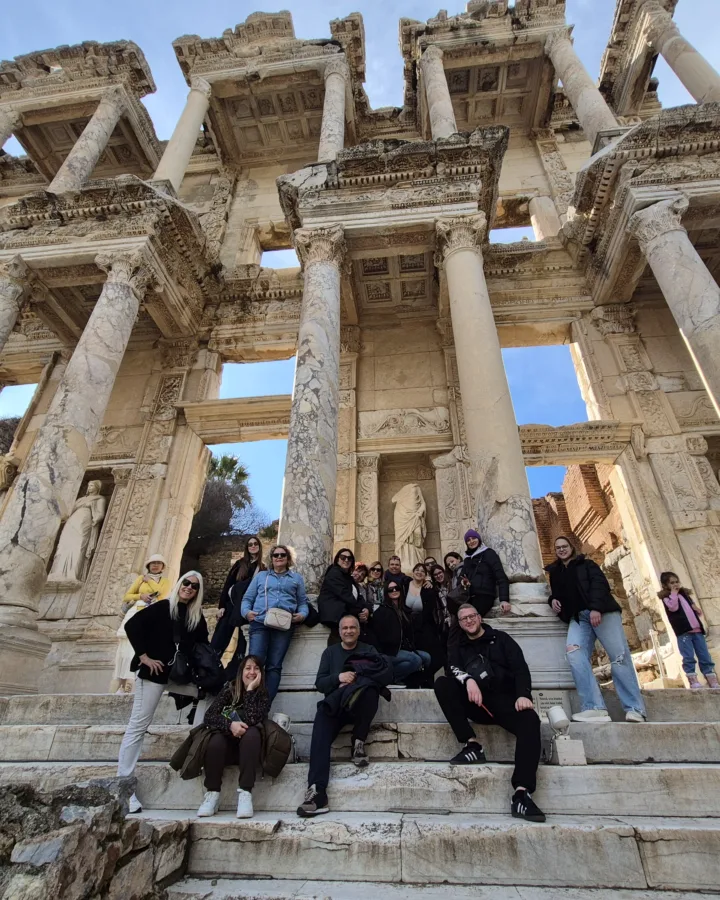
The best-preserved ancient city of the eastern Mediterranean: the Library of Celsus, the Terrace Houses, the…
Photo: Turkey Your Way
The golden capital of Croesus, where the first coins were struck, and where a vast synagogue still stands beside a Roman gymnasium.
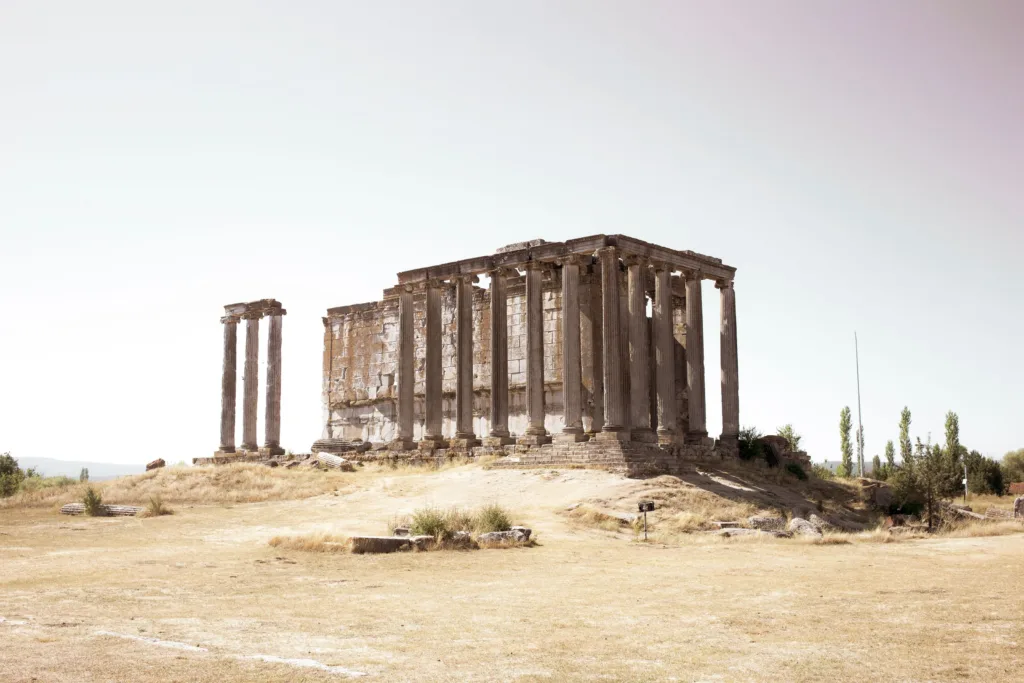
Two tall Ionic columns rise from a valley of eroded red hills, and nearby a marble facade two stories high stands against the sky. This is Sardis, capital of the Lydian kings, where Croesus grew so rich that his name still means wealth. Here, too, people first used coins, and in 2025 UNESCO added Sardis and the Lydian tumuli of Bin Tepe to its World Heritage List. In the same region, our Kula Geopark tour walks among young volcanoes, lava fields and fairy chimneys. Our Sardis Philadelphia tour stops here.
Beside the Roman gymnasium, too, lies one of the most impressive ancient synagogues ever found. American teams have also dug here for more than a century, so every season brings new finds. East of Sardis, see the Kula volcanoes.
Sardis lies in the Hermus valley in Manisa province, beside the village of Sart near Salihli, about 72 kilometers (45 miles) from İzmir on the highway to Ankara. Overall, people lived here for at least 3,500 years. Over that time, the city rose to world importance and then shrank to a few hamlets.
Today, the site has several parts: the Temple of Artemis in the valley of the Pactolus stream, the Roman bath-gymnasium and synagogue by the road, the acropolis on a spur of Mount Tmolus and, further north, the royal burial mounds of Bin Tepe.
Sardis in numbers
In the 7th century BC, Sardis became the capital of Lydia. From here, for example, kings such as Croesus ruled an empire that reached the Halys River in the east. At the same time, gold and silver washed down the Pactolus stream, and archaeologists have found the workshops where the Lydians refined them. Visitors could already see the city from afar, thanks to the three huge burial mounds at Bin Tepe.
Around 547 BC, Cyrus the Great defeated Croesus and sacked Sardis after a short siege. The fire left clear traces that archaeologists still study today. Then, in 334 BC, the city surrendered to Alexander the Great without a fight. Under Hellenistic kings, it gained a gymnasium, a theater and the great Temple of Artemis.
Later still, in Roman times, Sardis prospered as part of the province of Asia. For instance, after a terrible earthquake in 17 AD, Rome sent ten million sesterces to help it rebuild. Sardis also had an early Christian community and appears among the Seven Churches of Asia in the Book of Revelation.
Earlier, in the Hellenistic period, King Antiochus III settled Jews in Sardis. Their community lasted for much of late antiquity. Later, its synagogue was in use from the 4th to the 6th century.
After a Persian raid in 615, Sardis never fully recovered. Later, Timur probably destroyed it in 1402, and by the 1700s only two hamlets remained. From 1910 to 1914, a Princeton University team led by Howard Crosby Butler uncovered the Temple of Artemis and more than a thousand Lydian tombs. In 1958, Harvard and Cornell founded the Archaeological Exploration of Sardis, which still works here every year with the Turkish Ministry of Culture.
The two-story Marble Court of the Roman bath-gymnasium, restored by the excavators, is the most striking sight at Sardis. Behind it, too, lies a huge complex of baths and exercise yards from the late 2nd and early 3rd century AD.

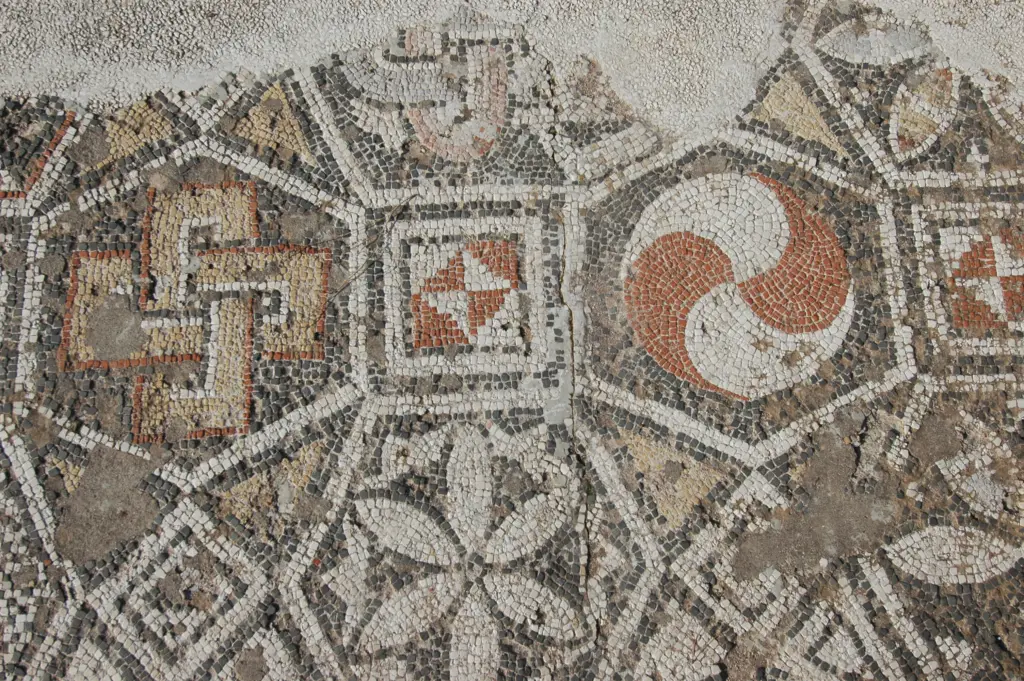
First, excavators found the synagogue in 1962. Its assembly hall could hold nearly a thousand people, and its marble walls and mosaic floors carry more than eighty Greek and seven Hebrew inscriptions. At first sight, its plan resembles an early Christian basilica, with a colonnaded forecourt and a fountain for washing hands before prayer. The discovery changed what scholars thought about Jewish life in the late Roman Empire.

Further up the Pactolus valley stands the Temple of Artemis. Two of its columns still stand tall against the hills. In its precinct, the British explorer George Dennis found a colossal marble head of Faustina the Elder, now in the British Museum.
Finally, north of the city, Bin Tepe, “a thousand mounds”, is the cemetery of the Lydian kings. Today its grassy tumuli rise from the plain beside the Marmara Lake.
The ruins lie right beside the village of Sart and the main road, and the site is open to visitors all year. Every year, an international team of 50 to 80 students and scholars arrives to continue the excavations.
Our notes for Sardis
Our suggestion Start at the Temple of Artemis below the acropolis, then drive back to the gymnasium and the great synagogue, and imagine the gold of King Croesus being refined nearby.
Manisa also has a spring festival built around Mesir Macunu, a spiced sweet paste.
Because three worlds meet in one valley: the gold of the Lydian kings, the marble of a Roman gymnasium, and the mosaics of one of the largest synagogues of antiquity, all still being excavated by American and Turkish teams.
Archaeological site
The best-preserved ancient city of the eastern Mediterranean: the Library of Celsus, the Terrace Houses, the…

Archaeological site
The white travertine terraces of Pamukkale and the Roman spa city of Hierapolis above them: how…

Open in Google Maps (opens in a new tab) Open in Apple Maps (opens in a new tab)
UNESCO listed it in 2025 for its significance as the home of coinage, in the Lydian capital of Croesus.
Yes. Found in 1962, it held nearly 1,000 people and is one of the most impressive ancient synagogues known.
The Archaeological Exploration of Sardis, founded by Harvard and Cornell in 1958, working with the Turkish Ministry of Culture.
About 72 kilometers (45 miles), beside the village of Sart near Salihli on the İzmir–Ankara highway.
The cemetery of the Lydian kings north of Sardis, with large burial mounds rising from the plain.
 Tour
Private Sardis and Philadelphia Tour from Izmir
 Journey
The Seven Churches of Revelation Tour in 5 Days from Izmir
 Article
Mesir Macunu: Manisa’s Spiced Paste and Its Festival
 Article
The Seven Churches of Revelation in Turkey: A Traveler’s Guide
 Person
Alexander the Great
 Person
Croesus
 Person
Herodotus
 Place
Keşlik Monastery