Photo: Ferit BAYCUMAN / Wikimedia Commons, CC BY-SA 4.0
Aigai
A mountaintop city of goat herders and traders: a market hall three stories high, and a letter of complaint to the emperor carved in marble.
Overview
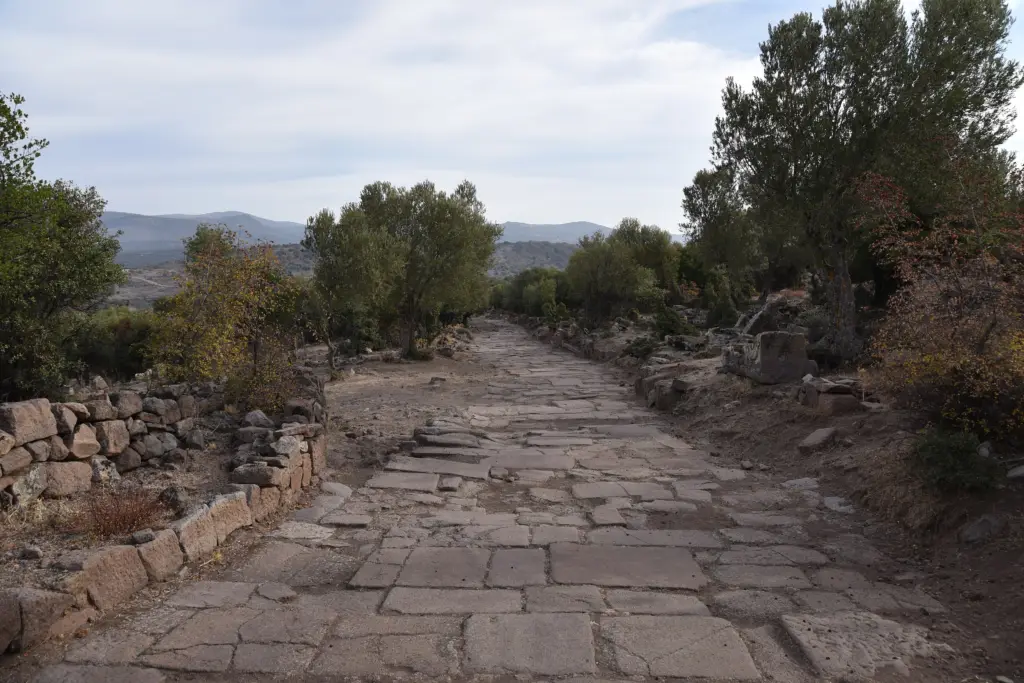
In the Yunt mountains of Manisa, a village road ends below a steep green summit. From there, an ancient paved road climbs through the oaks, and at the top, a wall of dark stone stands taller than the trees. Locals call the ruins Nemrut Kalesi. Historians know them as Aigai, a city of the Aeolian Greeks. With a guide, join our Aigai tour.

- Good for
- Hilltop ruins, mountain walks, ancient everyday life
- Best combined with
- Pergamon, Sardis
The Story of Aigai
Herodotus and Strabo both count Aigai among the twelve cities of the Aeolians on this coast. At first, it belonged to the Lydian kings, and then to the Persians. Later, in the 3rd and 2nd centuries BC, it lived its golden age under the Attalid kings of nearby Pergamon, who gave it a market hall and a temple of Apollo.
Wars and an earthquake
However, the city suffered too. In 156 BC, King Prusias II of Bithynia destroyed it in a war with Pergamon, and after Rome brokered peace, Aigai received 100 talents in compensation. Then, in AD 17, a great earthquake struck, and Emperor Tiberius sent aid to rebuild it.
What to See at Aigai
The market hall of Aigai
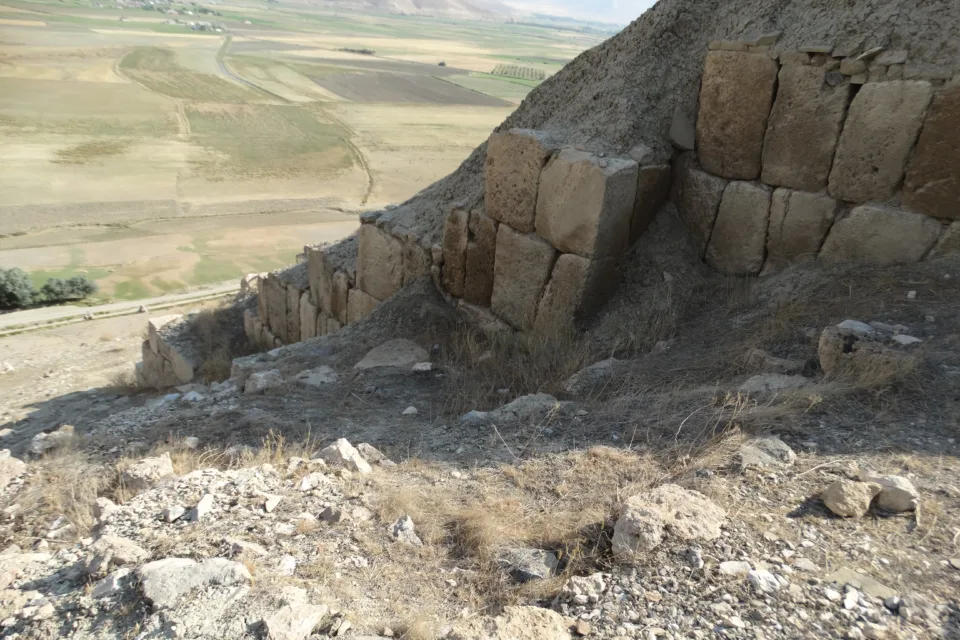
First, find the market hall on the eastern side of the plateau. It once rose three stories, about 11 meters (36 feet) high, and it ran for 82 meters (269 feet) along the slope. In Roman times, builders renewed its upper floor. Today, its great wall still towers over the oaks.
The council house
Next, walk to the council house, where the citizens met to run their city. Its curved rows of seats still stand among the trees. Besides, look for the terraces of the acropolis, the gymnasium, the meat and fish market and the foundations of three temples.

The sanctuary of Apollo
Also, about 5 kilometers (3 miles) to the east, by the river, stand the remains of an Ionic temple of Apollo from the 1st century BC. Its cella still rises about 6 meters (20 feet).
A Complaint About Goat Skins
In 2022, archaeologists read a marble inscription of the 2nd century AD from the council house. In it, the people of Aigai complained about the greed of Roman tax collectors. So they sent a man named Fortunatus to the emperor to report the taxes on goat skins. Later, the emperor fixed the tax at one sixth and promised to enforce it. Thanks to this stone, we know that the city lived from its goats and the trade in their skins.

Greetings to the bathers
Similarly, in 2016 the excavators found a mosaic of the sea god Poseidon in the cold room of a bath. Below it, a Greek inscription greets everyone who bathes there.
Our notes for Aigai
- NameLocals call the ruins Nemrut Kalesi.
- VillageThe site lies near Yuntdağı Köseler.
- ExcavationA team from Ege University in İzmir excavates here.
- ShoesThe old road to the top is steep and rough.
Our suggestion Walk up to Aigai in the morning, then spend the afternoon at Pergamon.
Aigai on a Private Tour from İzmir
Our Aigai tour picks you up anywhere in İzmir for a half day in the Yunt mountains, with your own guide and driver. For more mornings of this length, see our half-day tours. Under the kings of Pergamon, Aigai was a busy trading town. It was famous for parchment made from goat skin, so the letter to Rome about goat-skin taxes fits its story well. Your guide walks you through the three-story market hall, the council house and the stadium, and then lunch waits in the village. Parchment, a three-story market hall and lunch in the village: give us your morning near İzmir.
Because few ruins feel this lost in the hills. Walk up the old paved road through the oaks, stand under the great wall of the market hall, and remember the goat traders who once wrote to Rome about their taxes.
Map
Open in Google Maps (opens in a new tab) Open in Apple Maps (opens in a new tab)
Frequently asked questions
Where is Aigai?
In Manisa Province, near the village of Yuntdağı Köseler, almost on top of Gün Dağı in the Yunt mountains. Locals call the ruins Nemrut Kalesi.
What is there to see at Aigai?
The great wall of a three-story market hall, a council house, terraces of the acropolis, a gymnasium, temple foundations and ancient paved roads.
What is the goat-skin inscription of Aigai?
A marble inscription of the 2nd century AD, read in 2022, in which the citizens complained about greedy Roman tax collectors and sent an envoy named Fortunatus to the emperor. It shows that the city lived from goats and goat skins.
Who excavates Aigai?
A team from Ege University in İzmir, led by Ersin Doğer, excavates here.