

Mosque
Hagia Sophia
Fifteen centuries in one building: Justinian's great church, an Ottoman mosque, a museum and a mosque…
Photo: Turkey Your Way
A village on the Asian shore of the Bosphorus: painted wooden houses, a mosque and a church side by side, and a garden its neighbors saved.
Kuzguncuk is the Istanbul neighborhood that people describe as a village. It lies on the Asian shore of the Bosphorus, tucked into a small green valley. Its wooden houses are painted red, blue and ochre. Down by the water, a mosque and a church stand side by side with domes of the same height. Further up, a synagogue keeps its doors open on Saturdays. And a vegetable garden survived because the neighbors stood in front of the bulldozers. By car along the Asian shore, join our Asian Bosphorus villages tour. With a guide, join our Jewish heritage tour in Istanbul.
It is a place to slow down. There are no big monuments here, so you need no tickets either. Instead, you find a living example of what Istanbul used to be: Muslims, Jews, Greeks and Armenians sharing one street for centuries.
Kuzguncuk belongs to the Üsküdar district, on the Asian side of Istanbul. It sits on the Bosphorus between Üsküdar and Beylerbeyi, under the Bosphorus Bridge. The neighborhood climbs a short valley from the shore road, with one main street, İcadiye Caddesi, and a web of steep lanes.
Because Kuzguncuk is small, you can see it in a couple of hours. However, it is best enjoyed slowly, with a long breakfast, a walk through the lanes and a coffee by the water. For a slow morning, join our Turkish breakfast and coffee tour.

| Time you have | What we suggest |
|---|---|
| 1–2 hours | İcadiye Caddesi, the mosque and the church, the garden and the shore |
| Half a day | Add breakfast, the synagogue by appointment and a walk up to Nakkaştepe |
| A full day | Combine Kuzguncuk with Üsküdar, Beylerbeyi Palace and a ferry back |

Kuzguncuk means “little raven” in Turkish, but nobody is sure why. One story names a holy man, Kuzgun Baba, who lived here in the time of Sultan Mehmed II. Another explanation sees a Turkish echo of an older Greek name, Kosinitza. In Byzantine times, the area may have been called Chrysokeramos, “golden tile”, after a church with a gilded roof.
Over the centuries, Kuzguncuk grew into a Jewish neighborhood on the Asian side of the city. Jewish families from the old city and, later, Sephardic families from Spain made it their home. Greek Orthodox families lived here as well, and later, in the 18th century, Armenians arrived. For generations, these communities shared the same streets, bakeries and coffee houses. Each had its own church or synagogue, a few steps from the others.
In the 20th century, however, most non-Muslim residents left. The 6–7 September pogrom of 1955, emigration and later departures emptied many houses. Later, the architect and poet Cengiz Bektaş began restoring old houses together with residents and other architects. His work helped save the neighborhood’s character, and Kuzguncuk became a favorite of writers, artists and film crews.
On the shore road, the Kuzguncuk Mosque and the Armenian Church of Surp Krikor Lusavoriç (St. Gregory the Illuminator) stand next to each other. For a long time there was no mosque in the center of the neighborhood. Then the mosque was built in the courtyard of the church, and the Armenian congregation helped with the funds. Today, fittingly, their domes rise to the same height, a symbol of how Kuzguncuk’s communities lived together.
The church itself began as a wooden building and was later rebuilt in stone. The church opens for services and special days.
On İcadiye Caddesi stands the Beth Yaakov Synagogue, an old synagogue on the site of an earlier building. Few Jewish families still live in Kuzguncuk, yet the synagogue remains active. Families whose roots are here keep it alive, and services are held on Saturdays. Visits are only possible by prior arrangement with the Chief Rabbinate.
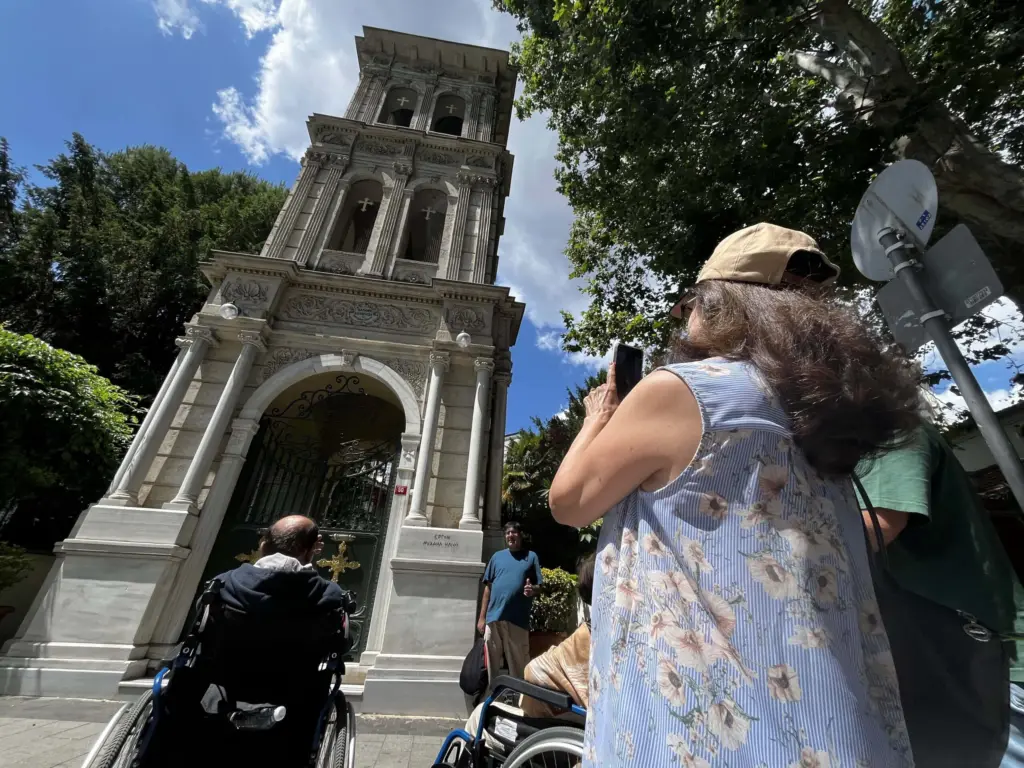
Kuzguncuk also has two Greek Orthodox churches, Ayios Georgios and Ayios Panteleimon. They are usually closed; still, their walls and gardens are part of the neighborhood’s skyline. Look for the Greek inscriptions above old gates and doorways as you walk.

The main street climbs from the shore through the heart of the neighborhood. Along it you find small bakeries, a greengrocer, antique and design shops and cafés with tables on the pavement. Above them stand well-preserved wooden houses. Then turn into the side streets to see bay windows, little front gardens and doors painted in bright colors.
In the middle of the neighborhood lies a large vegetable garden, the bostan. For generations, a family had worked it until developers wanted the land. Later, a zoning change allowed building on the land, and residents repeatedly blocked construction. Some even stood in front of the bulldozers to save the trees. After a sit-in, the municipality and residents agreed that nothing would be built and that the garden would stay open to all. Today neighbors still grow vegetables, while families sit under the trees. It is a moving place.
From 1986, the TRT series Perihan Abla was filmed in Kuzguncuk, and it made the neighborhood famous across Türkiye. After the series ended, the city also named a street after its beloved heroine. Since then, many other films and series have used Kuzguncuk’s streets, so do not be surprised to meet a film crew.
At the northern edge of the neighborhood, the small Üryanizade Mosque stands by the water. It initially began as a prayer room. From here, walk along the shore toward Beylerbeyi, under the Bosphorus Bridge. You will pass waterside mansions and anglers fishing from the quay.
Climb the lanes behind Kuzguncuk to Nakkaştepe, a park on the hill above the neighborhood. From the top, you look down over the roofs to the Bosphorus, the bridge and the European shore.
Kuzguncuk through the week
Kuzguncuk still feels like a place where everyone knows everyone. Shopkeepers greet regulars by name, cats sleep on the doorsteps and on weekends families come from all over the city for breakfast.

Every Wednesday, a neighborhood street market sets up in Kuzguncuk. It is a market for locals, not for visitors: village cheeses, olives, seasonal fruit and vegetables, herbs, eggs and household goods, with vendors calling out their prices. Come in the morning, buy a bag of whatever fruit is in season and watch Kuzguncuk do its weekly shopping. It is a truly local hour in the neighborhood.
On Saturdays and Sundays, Istanbul families come to Kuzguncuk’s cafés for a long Turkish breakfast. Join them, then walk on from İcadiye into the side lanes.
On the same Asian shore, Çengelköy is another Bosphorus village, with wooden mansions and tea by the water.
For dinner, the fish restaurant Ismet Baba has long served the neighborhood by the water.
Above Üsküdar, Çamlıca Hill offers a wide view over the southern Bosphorus.
Because Kuzguncuk shows you the Istanbul of many faiths not in a museum but on a street. A mosque and an Armenian church share a courtyard and the height of their domes, a synagogue still opens on Saturdays, and a vegetable garden survives in the middle of a megacity because the neighbors would not let it go. Come on a weekday morning, have breakfast on İcadiye Caddesi and walk slowly: this is one of the gentlest corners of the city.
Mosque
Fifteen centuries in one building: Justinian's great church, an Ottoman mosque, a museum and a mosque…

Mosque
Mimar Sinan's mosque for Suleiman the Magnificent on Istanbul's Third Hill: its story, the tombs of…

Open in Google Maps (opens in a new tab) Open in Apple Maps (opens in a new tab)

Co-Founder & Lead Guide · English and Italian · All of Türkiye
Rubil Gündüz, co-founder and lead guide of Turkey Your Way: a licensed guide in English and Italian since 2002, leading private tours in Istanbul and across Anatolia.
Meet Rubil GündüzYes. It is a charming neighborhood, with wooden houses, a mosque and a church side by side, a synagogue and a community garden.
We drive you there along the Bosphorus, or we take the ferry to Üsküdar with you and walk about 30 minutes by the water.
Beth Yaakov Synagogue can be visited only by prior arrangement through the Chief Rabbinate; we arrange it for you.
The Kuzguncuk Mosque was built in the courtyard of the Armenian church of Surp Krikor Lusavoriç, with help from the Armenian congregation.
A historic vegetable garden that residents protected from construction for years; since 2014 it has stayed open to everyone.
A Wednesday morning, for the street market.
 Tour
Private Üsküdar and Kuzguncuk Walk with the Maiden’s Tower
 Tour
Istanbul Asian Side Private Tour: Üsküdar, Kuzguncuk, Kadıköy and Moda
 Tour
Private Jewish Heritage Tour in Istanbul: Balat to Kuzguncuk
 Tour
Private Turkish Breakfast and Coffee Tour in Istanbul
 Tour
Turkish TV Series Tour in Istanbul: Balat, Kuzguncuk and the Yalıs
 Person
Mimar Sinan
 Article
Turkish Breakfast: What to Eat and Where to Go
 Place
Balat
