Mimar Sinan
The village boy from central Anatolia who became chief architect of the Ottoman Empire for fifty years and shaped the skyline of Istanbul.

Stand on the Galata Bridge at sunset and look at the hills of the old city. Many of the domes and minarets that shape that skyline actually came from one mind. That mind belonged to Mimar Sinan, who was the chief architect of the Ottoman Empire for almost fifty years. He built mosques, bridges, baths, schools, aqueducts and palaces from the Balkans to Arabia. Yet he started life as a village boy in central Anatolia, and he did not design his first great mosque until he was about fifty. Our Mimar Sinan tour follows his work across Istanbul.
The Ottomans called him Koca Sinan, “Sinan the Great”. He named three mosques as his apprenticeship, his journeyman work and his masterpiece. Legends still cling to his buildings, and even his skull had a strange fate. You can still see his work all over Istanbul and far beyond it.
Who Was Mimar Sinan?
Mimar Sinan was born around 1488–1490 in Ağırnas, a village near Kayseri in central Anatolia. His family was Christian; historians still debate whether they were Armenian or Greek. In 1512 he was taken into the devşirme, the Ottoman system that recruited Christian boys for the palace and the army. He converted to Islam, learned carpentry and building, and then joined the Janissaries, the sultan’s elite infantry.
“Mimar” simply means “architect”. Sinan held the title of Chief Architect from 1539 until his death in 1588. He designed or supervised several hundred buildings. One list of his works counts 476, of which about 196 still stand.
Mimar Sinan in eight dates
- c. 1490Born in Ağırnas, near Kayseri
- 1512Taken into the devşirme
- 1539Named chief architect
- 1548The Şehzade Mosque
- 1557The Süleymaniye Mosque
- 1567The Büyükçekmece bridge
- 1575The Selimiye Mosque, Edirne
- 1588Dies in Istanbul
Mimar Sinan, the Engineer of Süleyman’s Wars
Before he built mosques, Sinan built for the army. As a Janissary officer he marched on the campaigns of Sultan Süleyman the Magnificent: Belgrade, Mohács, Vienna and Baghdad. His talent showed in practical problems. During the Persian campaign of 1535, for example, he built ships to carry the army and its guns across Lake Van.
Then, during the Moldavian campaign of 1538, the army needed a bridge across a marshy river. The story goes that Sinan built it in a matter of days, after an earlier bridge had failed. The feat especially impressed the sultan and his grand vizier. Shortly afterwards, in 1539, Grand Vizier Lütfi Pasha appointed him Architect of the Abode of Felicity, the chief architect of the empire. He was about fifty years old.
Apprentice, Journeyman, Master
Sinan himself described three mosques as the stages of his career. The Şehzade Mosque was his apprenticeship, the Süleymaniye his journeyman work and the Selimiye in Edirne his masterpiece. Whether or not he used exactly these words, the three buildings show how his ideas grew.

The Şehzade Mosque (1548)
Süleyman commissioned this mosque in memory of his beloved son Mehmed, who died young in 1543. Sinan used a perfectly symmetrical plan: a central dome supported by four half-domes, one on each side. So the result is balanced and full of light. Yet he later felt that the four heavy piers were too visible. For the rest of his life he searched for ways to make the structure lighter and the space more unified.

The Süleymaniye Mosque (1557)
On the third hill of Istanbul, Sinan built the mosque of Süleyman the Magnificent, completed in 1557. It is not a single building but a complex. Around the mosque also stand schools, a hospital, a soup kitchen, a bath, shops and the tombs of Süleyman and his wife Hürrem Sultan. Inside, the great dome rests on a system of arches and half-domes that hides its supports and opens a vast, harmonious space.
The Selimiye Mosque in Edirne (1575)

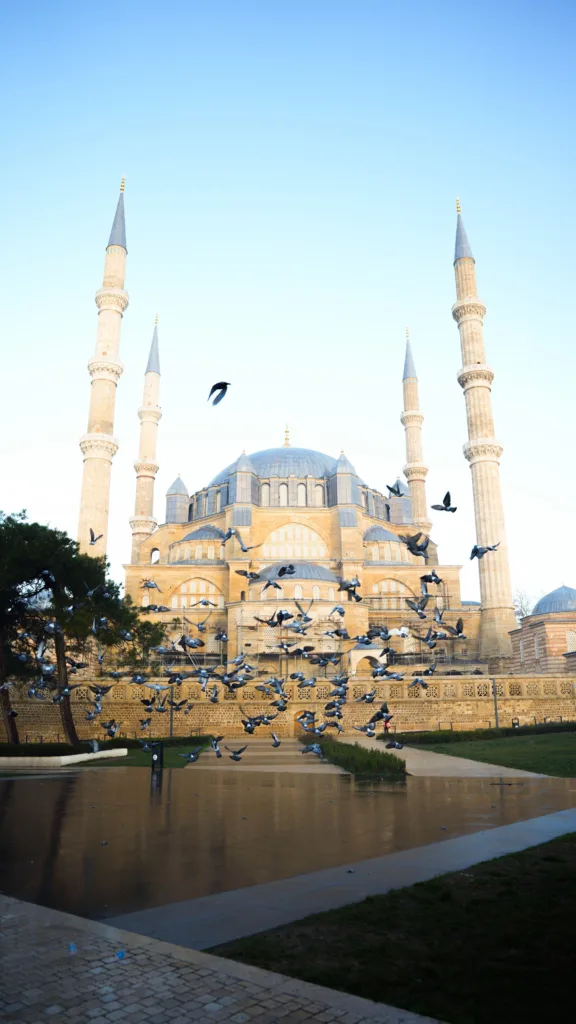
Later, in his eighties, Sinan built his masterpiece in Edirne for Sultan Selim II. Here he finally achieved the unified space he wanted. One immense dome rests on eight piers, and the walls seem to dissolve into windows. Sinan claimed that the Selimiye’s dome was larger than that of Hagia Sophia. The two domes are close in diameter, and the crown of the Selimiye sits lower above the floor. Still, measured from its base, the dome is taller. Today the Selimiye and its complex are a UNESCO World Heritage Site.
Secrets Mimar Sinan Hid in the Süleymaniye
The Süleymaniye is full of stories that guides love to tell. Some are documented, others are traditions:
- Four minarets, ten balconies: the minarets carry ten balconies in total. Tradition links the number to Süleyman, because he was the tenth Ottoman sultan.
- The soot room: a well-known tradition says that air channels drew the smoke of hundreds of oil lamps into a small room above the entrance. There the soot was collected and made into ink for calligraphers.
- Sound: clay jars set into the dome are said to help the acoustics, so that a voice carries clearly through the whole space.
- Earthquakes: the mosque has stood through more than four centuries of Istanbul earthquakes, a tribute to Sinan’s engineering.
- His own tomb: at the corner of the complex, Sinan built himself a small, modest tomb.
Mimar Sinan in Istanbul, Beyond the Great Mosques
The great imperial mosques are only part of Sinan’s work. Still, his smaller buildings can be even more moving.
Rüstem Pasha Mosque

Hidden above the shops of the Spice Bazaar area, this mosque for the grand vizier Rüstem Pasha is lined almost entirely with İznik tiles. Tulips, carnations and other flowers cover the walls in red, blue and turquoise. So it has one of the most colorful interiors among Sinan’s mosques.
Sokollu Mehmed Pasha Mosque
On a steep slope below the Hippodrome, Sinan built a jewel-like mosque for the grand vizier Sokollu Mehmed Pasha and his wife Esmahan Sultan, completed around 1572. Its tiles are especially fine, and small pieces said to come from the Black Stone of the Kaaba in Mecca sit in gold frames above the entrance, in the mihrab (the niche that shows the direction of prayer) and on the minbar.
The two Mihrimah Sultan Mosques
Sinan built two mosques for Mihrimah Sultan, daughter of Süleyman and Hürrem. One stands by the water in Üsküdar, the other on the highest point of the land walls at Edirnekapı. Legend says Sinan loved the princess, whose name means “sun and moon”. The story goes that on one evening of the year the sun sets behind one mosque as the moon rises behind the other. It is only a legend, but it is a beautiful way to remember two buildings full of light. Higher up the same hill in Üsküdar, his Atik Valide Mosque for the queen mother Nurbanu is one of his later works. Down by the water, his tiny Şemsi Pasha Mosque of 1580 sits almost in the sea. One of his last designs, the Zal Mahmud Pasha Mosque in Eyüp, was only finished in 1590, after his death.
Baths, schools and water works by Mimar Sinan
Sinan also built public Turkish baths such as the Haseki Hürrem Bath beside Hagia Sophia and the Çemberlitaş Bath. He designed madrasas such as the Caferağa Madrasa near Hagia Sophia, now a crafts center. He rebuilt Istanbul’s water supply. The Kırkçeşme system brought water from the Belgrade Forest through aqueducts such as Mağlova, one of his great works of engineering.
The bridge at Büyükçekmece
West of the city, the long stone bridge at Büyükçekmece, completed in 1567, crosses the lagoon in four sections. Sinan was so proud of it that he left his own mark there, an honor he rarely gave himself.
Beyond Istanbul
Beyond Istanbul, Mimar Sinan’s office worked across the whole empire. Its buildings include the Süleymaniye complex in Damascus and caravanserais and bridges along the great roads. In Bosnia, the Mehmed Paša Sokolović Bridge at Višegrad, a UNESCO World Heritage Site, is attributed to him. One of his students, Mimar Hayruddin, built the famous Old Bridge at Mostar.
His Students and the Taj Mahal Legend
Mimar Sinan also trained a generation of architects. Sedefkâr Mehmed Ağa later built the Blue Mosque, and Davud Ağa succeeded him as chief architect. A popular legend even claims that one of his pupils helped design the Taj Mahal in India. No reliable evidence supports it. Nevertheless, the story shows how far Sinan’s reputation traveled.
The Death of Mimar Sinan, His Tomb and a Lost Skull
Mimar Sinan died in Istanbul on July 17, 1588, at nearly one hundred years old. He was buried in the modest tomb he had designed at the corner of the Süleymaniye complex. However, his rest was not undisturbed. In 1935, researchers of the Turkish Historical Society opened the tomb for an anthropological study and measured his skull. The skull was taken away, and it has never been found since. Historians still treat it as lost.
Mimar Sinan Today
Today Sinan’s name is everywhere in Türkiye, from Istanbul’s fine arts university to streets and schools. It even reaches into space: in 1976 the International Astronomical Union gave his name to a 134-kilometer (83-mile) crater on the planet Mercury. Yet the best way to meet him is still on foot, under his domes.
Our notes for Sinan lovers
- His own tombHe designed a modest tomb for himself at the corner of the Süleymaniye complex.
- AğırnasHis birthplace near Kayseri has a house museum and an underground city.
- The apprentice’s workSinan himself said: the Şehzade was his apprentice work, the Süleymaniye his journeyman work, and the Selimiye his masterpiece.
Our suggestion Visit his small tomb at the corner of the Süleymaniye. It is often empty, and it is one of the most moving places in Istanbul.

You may also like
-
 Tour
Mimar Sinan Private Tour: The Great Mosques of Istanbul’s Master Architect
-
 Journey
Turkey Architecture Tour in 8 Days: Sinan, Seljuk Stone and Wooden Mosques
-
 Place
Mağlova Aqueduct
-
 Place
Rüstem Pasha Mosque
-
Place
Şehzade Mosque
-
Place
Selimiye Mosque
-
 Place
Sokollu Mehmed Pasha Mosque
-
 Place
Süleymaniye Mosque