
Photo: Turkey Your Way
Süleymaniye Mosque
Sinan's great mosque for Suleiman, inaugurated in 1557: a luminous dome, ten minaret balconies, imperial tombs and the best view over the Golden Horn.
Overview
Seen from the Galata Bridge, one mosque rules the skyline of old Istanbul. There, four slender minarets frame a cascade of domes on the city’s third hill, high above the Golden Horn. This is the Süleymaniye, the mosque that Mimar Sinan built for Suleiman the Magnificent at the height of the Ottoman Empire. Inside, the space is wide and luminous. Our Mimar Sinan tour spends time here and at Sinan’s tomb beside it.
Suleiman wanted a mosque to match his empire, so Sinan gave him one. Sinan himself lies in a small tomb just outside its walls. See also the tomb of Mimar Sinan, by the Süleymaniye. One room caught the candle smoke to make ink. Across the street, a bean restaurant has faced the mosque for a century.
- Good for
- Architecture lovers, first-time visitors, photographers
- Best combined with
- Rüstem Pasha Mosque, Spice Bazaar, Valens Aqueduct, Şehzade Mosque
Why the Süleymaniye Mosque Is Our Favorite
The Süleymaniye Mosque stands on the Third Hill of Istanbul, in the Fatih district, overlooking the Golden Horn. Construction began in 1550 and the mosque was inaugurated in 1557. It is not a single building but a külliye (the complex around a mosque: school, kitchen, bath and tombs), a whole complex built around the mosque: four madrasas, a school, a medical school and a hospital, a public kitchen, a caravanserai, a bath and shops. Together with the city’s other historic areas, it belongs to the UNESCO World Heritage Site of the Historic Areas of Istanbul.
The Süleymaniye is an active mosque, but it is open to visitors outside prayer times. Dress modestly, and women should also cover their hair.
The Süleymaniye in numbers
- 1557the year the mosque was inaugurated
- 4minarets at the corners of the courtyard
- 10minaret balconies for the 10th sultan
The dome of the Süleymaniye Mosque
The central dome rises about 53 meters (174 feet) above the floor, close to the height of Hagia Sophia‘s dome a short walk away.
Sinan and Suleiman: Building the Süleymaniye
A mosque for the Magnificent
By 1550, Suleiman had ruled for thirty years over an empire that stretched from Hungary to the Indian Ocean. The TV series Magnificent Century later told his story to millions of viewers. He wanted a mosque to match his reign, so he gave the task to his chief architect, Mimar Sinan. Sinan, then about sixty, spent seven years on the project. Marble came from across the empire, and workers even took columns from the old Hippodrome of Constantinople. For eight days on this theme, see our art and architecture tour of Turkey.
The tenth sultan
Together, the four minarets carry ten balconies, including six on the two tallest. Popular tradition links the number to Suleiman’s place as the tenth Ottoman sultan. The two tallest minarets each have three balconies and reach about 76 meters (249 feet).
Fire, earthquake and restoration
Since then, the Süleymaniye has survived a great deal. A huge fire in 1660 damaged it, after which Sultan Mehmed IV restored it. Later, part of the dome collapsed in the earthquake of 1766. During World War I, ammunition stored nearby caught fire and damaged it again. A major restoration strengthened the dome and returned the mosque to its present state.

Inside and Around the Süleymaniye Mosque
The prayer hall of the Süleymaniye Mosque
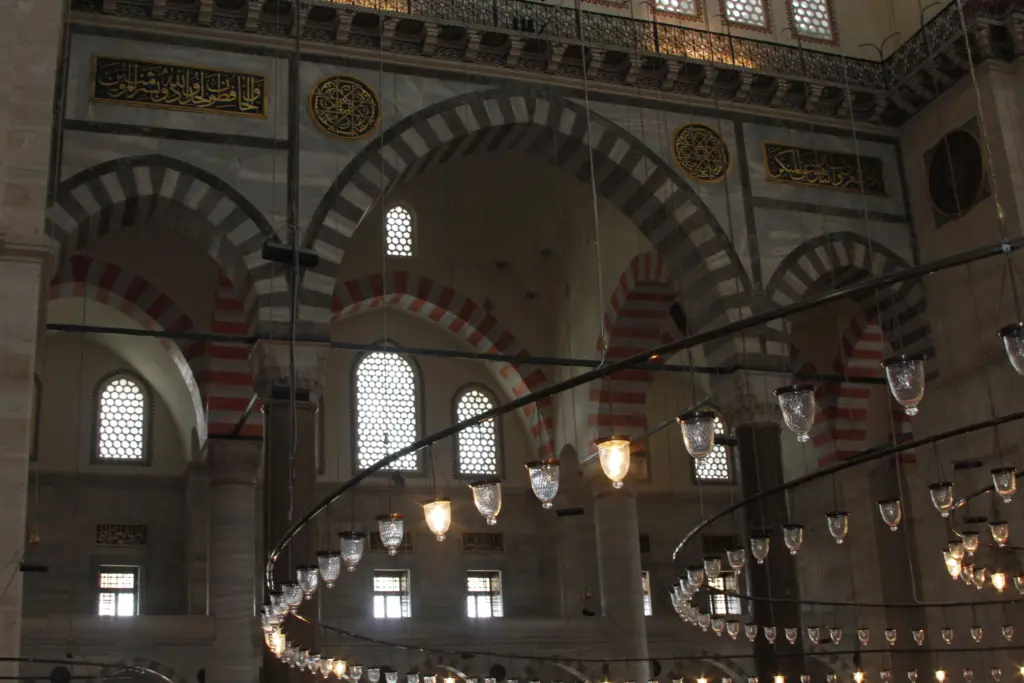
First, step inside and look up. The great dome rests on four huge piers, but Sinan hid much of their mass in the walls, so the space feels open and light. Inside, rings of lamps hang low over the carpets, just above head height. Around you, dozens of windows also let in daylight from every side.
The stained glass and the tiles
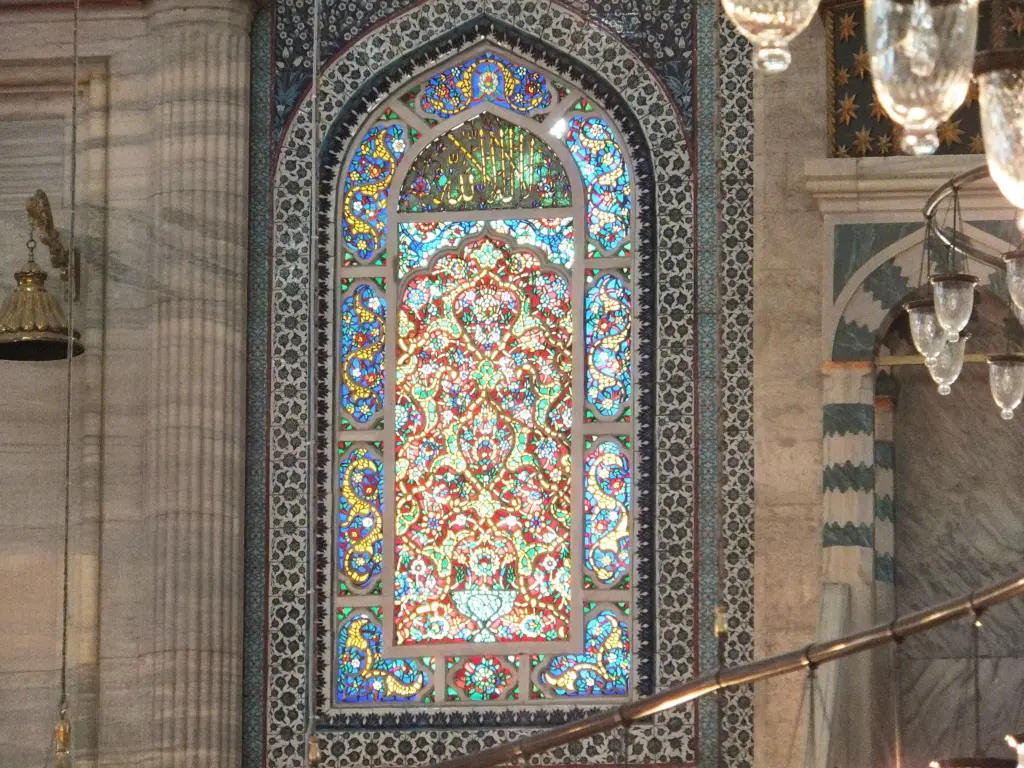
On the qibla wall, around the mihrab (the niche that shows the direction of prayer), colored glass windows glow between panels of İznik tiles. Tradition credits the glass to a master known as Sarhoş İbrahim. Then look closely at the 16th-century İznik tiles around the mihrab.
The great columns

Four enormous monolithic columns support the arches along the sides of the prayer hall. Like much of the mosque’s marble, they were probably taken from older buildings. In this way, their story links the Süleymaniye directly to the Roman and Byzantine city that came before it.
The legend of the ink room
Sinan designed a small room above the main entrance to catch the smoke of the thousands of oil lamps that once lit the mosque. The soot, the story goes, was then turned into ink for calligraphers. It is a lovely tale, often repeated by guides; however, historians have not confirmed that Sinan designed the room for that purpose.
The tombs of the Süleymaniye Mosque

Behind the mosque, in a walled garden cemetery, stand two tombs. Suleiman’s octagonal mausoleum, finished in 1566, is decorated inside with İznik tiles; his daughter Mihrimah Sultan also lies there. Next to it is the smaller tomb of his wife Hürrem Sultan, completed in 1558.
The tomb of Mimar Sinan

Just outside the complex, at a street corner to the north, a small open tomb holds the architect himself. Sinan designed it for himself, modest and elegant, within sight of the mosque. Since few visitors find it, stop and pay your respects. Read the full story of his life in our Mimar Sinan guide.
The view over the Golden Horn

Afterward, walk to the terrace on the north side of the courtyard. From here the Golden Horn, the bridges, Galata Tower and the hills of Beyoğlu spread below you. It is a wonderful free view, especially at sunset. Our seven hills of Istanbul tour stops here on the third hill.
The Hill Around the Mosque
The Süleymaniye neighborhood
Around the mosque, the old quarter of Süleymaniye still has wooden Ottoman houses, back streets and small workshops. The madrasas of the complex now hold a library and offices, while students hurry between them. Then wander the lanes on the slope toward the Golden Horn, where the city feels a century older.
Beans, Boza and Tea on the Süleymaniye Hill
Erzincanlı Ali Baba and the bean houses
Opposite the mosque, a row of small restaurants serves the same simple meal: white beans with rice and pickles. The best known is Erzincanlı Ali Baba. The beans are the famous large dermason beans from Erzincan, cooked slowly in copper pots until they are soft. It is a cheap, honest lunch, so Istanbul office workers have loved it for generations. For more places like it, read our guide to the esnaf lokantası, the tradesmen’s restaurant.
- Kuru fasulye: white beans in a tomato sauce, with buttery rice.
- Turşu: pickles on the side.
- Tea in the courtyard: in the cafés around the complex.
Our notes for the Süleymaniye hill
- Erzincanlı Ali BabaOpposite the mosque since 1924, now run by the founder’s grandchildren. Beans and rice cooked in copper pots over charcoal.
- Vefa BozacısıTen minutes away in Vefa, selling boza.
- The terraceBehind the courtyard, a wide free view over the Golden Horn.
- Sinan’s tombAt the northern corner of the complex, small and modest, in the garden he designed for himself.
Our suggestion Visit the mosque late in the afternoon, walk out to the terrace for the Golden Horn at sunset, then have beans opposite the mosque. In winter, end the evening with a glass of boza in Vefa.
For more about the drink, read our guide to boza, and for more of Sinan’s work, see his other great mosque, the Selimiye in Edirne.
How to Visit the Süleymaniye Mosque
Visiting the Süleymaniye Mosque
- Entry: no ticket; visits pause at prayer times, especially at midday on Fridays.
- Dress code: cover shoulders and knees; women cover their hair. Shoes come off at the door. See our guide to Istanbul mosque etiquette.
- Time needed: about an hour, including the tombs and the terrace.
- Getting there: about 15 minutes’ walk uphill from Eminönü and the Spice Bazaar, or from the Vezneciler metro station.
Local tips for the Süleymaniye Mosque
- Come in the morning or late afternoon, when no prayer is under way.
- Do not miss the terrace behind the courtyard, especially for the view at sunset.
- Find Sinan’s tomb at the northern corner of the complex before you leave.
- Have lunch opposite the mosque at one of the bean houses, then walk down to Eminönü.
- Walk down to the Spice Bazaar afterward through the old market streets.
Because it is Istanbul at its most serene. Sit under the dome in the morning light, find Sinan's own small tomb outside the walls, stand on the terrace above the Golden Horn and then eat Erzincan beans across the street, as Istanbul has done since 1924.

Map
Open in Google Maps (opens in a new tab) Open in Apple Maps (opens in a new tab)
Gallery
Frequently asked questions
Who built the Süleymaniye Mosque?
Mimar Sinan, for Suleiman the Magnificent, between 1550 and 1557.
Where is Mimar Sinan buried?
In a small open tomb he designed himself, just outside the northern corner of the Süleymaniye complex.
Who is buried at the Süleymaniye Mosque?
Suleiman the Magnificent and his daughter Mihrimah Sultan in his tomb, and Hürrem Sultan in her own tomb next to it.
Is the Süleymaniye worth visiting if I have seen the Blue Mosque?
Yes. It is Mimar Sinan's great mosque for Suleiman, with its terraces over the Golden Horn.
Where can I eat near the Süleymaniye?
Opposite the mosque, at the bean houses such as Erzincanlı Ali Baba, open since 1924.

You may also like
-
 Tour
Islamic Heritage of Istanbul Private Tour: Mosques, Relics and Sufi Lodges
-
 Journey
Istanbul 3 Day Tour: The Old City, the Bosphorus and the Neighborhoods
-
 Journey
Istanbul and Cappadocia in 4 Days: A Private Tour with a Flight
-
 Journey
Istanbul and Cappadocia Tour in 5 Days: Two Continents and a Valley of Fairy Chimneys
-
 Journey
Istanbul and Ephesus in 3 Days: A Private Tour with a Flight
-
 Journey
Istanbul in 2 Days: A Private Tour of the Old City, the Bazaars and the Bosphorus
-
 Journey
Istanbul, Ephesus and Pamukkale in 5 Days: A Private Tour
-
 Tour
Mimar Sinan Private Tour: The Great Mosques of Istanbul’s Master Architect