Mudurnu
Mudurnu in Bolu: an early Ottoman Ahi town of timber houses on the Silk Road, the…
Photo: Dosseman / Wikimedia Commons, CC BY-SA 4.0
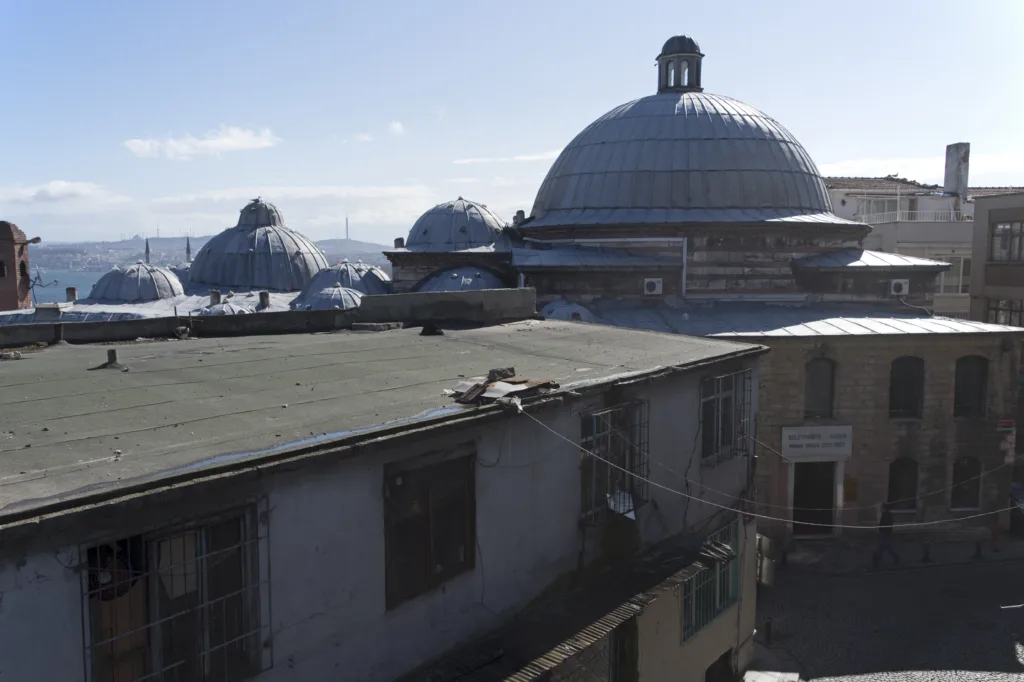
An old double bathhouse of the tanners' quarter in central Bolu.
On İzzet Baysal Caddesi in central Bolu, a cluster of low domes rises between shops. This is the Tabaklar Hamamı, the old bath of the tanners’ quarter. Our Bolu city tour stops here to see it from outside.
Nobody knows exactly when or by whom the bath was built, but it dates from the 16th century. It belongs to the foundation of Sokullu Mehmet Paşa, and its income once supported a mosque that no longer survives.
It is a double bath, with a men’s and a women’s side; the women’s side is much smaller. The walls are of rubble stone with stone cornices. Today, only the cooling and hot rooms remain. The cooling and washing areas have vaults, while the hot rooms have domes, with small cells in the corners.
Our notes for the Tabaklar
Our suggestion Pair it with the Büyük Cami and the Bolu Museum on a short walk through the center.
The bath needed many repairs. In the 20th century, the building was restored. However, the dressing room is gone, so today you see only the cooling and hot rooms. Researchers have also drawn the bath as it looked in 1863, so its old plan is known.
The foundation behind the bath carries the name of Sokullu Mehmet Paşa, an Ottoman grand vizier. In Istanbul, his wife Esmahan Sultan, a daughter of Selim II, built a mosque for him in 1571, and Mimar Sinan designed it. So a small bath in Bolu belongs to the same foundation story as one of Sinan’s Istanbul mosques. Also, the bath’s income once paid for a mosque here in Bolu, which no longer survives.
Also, the Tabaklar is not the oldest bath in town. Yıldırım Bayezid built a mosque and a bath in Bolu as early as the late 14th century, and the Büyük Cami stands on the site of his mosque. So the bathhouses of the center go back to the 14th century. Then, if you want a longer walk, Bolu itself goes back to Roman Claudiopolis, and the Bolu Museum shows finds from that city.
The bath is in the center of Bolu, a few minutes on foot from the Büyük Cami and the Bolu Museum. We plan your bath at the Tabaklar Hamamı on your Bolu day.

Would you like to see Bolu with a local guide? The bath of Sokullu Mehmet Paşa is on our Bolu city tour, between the museum and lunch; for the whole province, read our Bolu guide.
Because it is a small piece of Ottoman Bolu in the middle of a modern street. Look up at the domes of the hot rooms.
Mudurnu in Bolu: an early Ottoman Ahi town of timber houses on the Silk Road, the…

Göynük in Bolu: a Cittaslow town of timber houses, the tomb of Akşemseddin built in 1464,…

Sünnet Lake Nature Park near Göynük in Bolu: a forest lake among the ten nature parks…

The Bolu Museum: archaeology from the Neolithic to Byzantium, Roman marble busts of Artemis and Hermes,…

The Büyük Cami of Bolu: founded by Yıldırım Bayezid, rebuilt on the same site after a…

The Yıldırım Bayezid Mosque in Mudurnu: built in 1382 by the future Sultan Bayezid I, with…

Lake Abant in Bolu: a clear mountain lake at 1,328 meters among pine and beech forests,…

Yedigöller north of Bolu: seven lakes dammed by landslides in a deep beech and fir forest,…
Open in Google Maps (opens in a new tab) Open in Apple Maps (opens in a new tab)
Its exact date and architect are unknown, but it dates from the 16th century.
Tabaklar means tanners; the bath stands in the old Tabaklar quarter and is also called the Debbağlar Bath.
No. In 2021 it was leased out as a shop and a cafeteria.
An Ottoman grand vizier; in 1571, his wife Esmahan Sultan, daughter of Selim II, built the Sokullu Mehmet Paşa Mosque in Istanbul for him.