

Viewpoint
Galata Tower
The Genoese Tower of Christ of 1348: its story from prison and fire lookout to the 2024 reopening, the legend of Hezarfen's flight, the view from the gallery and tips for your…
Photo: Turkey Your Way
More than a tower: Genoese walls, a poet's Sufi lodge, bankers' stairs and the walk down to Karaköy, in Istanbul's most layered neighborhood.
Some Istanbul neighborhoods are known by a single photograph, and Galata is one of them: a stone tower with a pointed cap, old apartment blocks crowding around it, and narrow lanes falling toward the water. On foot, join our Galata history walk. Many people take the picture, walk once around the tower, then leave. For ten days with a camera, see our Turkey photography tour.
However, the real story of Galata starts away from the tower. Genoese merchants once lived behind its walls. Later, bankers and insurance houses built their headquarters on its lower streets. Today, the same doors open onto design studios, coffee roasters and rented apartments. A few steps away, a Mevlevi lodge, a Gothic church turned mosque and the grand halls of Ottoman banking are still there. At the lodge, our whirling dervish ceremony evening explains the sema (the whirling ceremony of the Mevlevi dervishes) before you watch it.
Galata lies on the European side of Istanbul, in the Beyoğlu district, on the slopes rising from the northern shore of the Golden Horn. Today the name usually means the tower and the old streets around it. Historically, however, Galata also included the harbor and trading quarter by the water, so its story cannot be separated from Karaköy’s.
Pera, a name you will meet often, comes from the Greek for “the other side” and later came to mean the upper slopes, today’s Beyoğlu. The steep hill between them shaped everything here: trade by the water, homes, walls and churches on the slope, and later the apartment blocks.
| Time you have | What we suggest |
|---|---|
| 1 hour | The tower from outside, a short walk and photographs |
| 2–3 hours | The tower, Serdar-ı Ekrem and Galip Dede streets, a coffee |
| Half a day | Add the Mevlevi lodge, the Camondo Stairs and Bankalar Caddesi |
| A full day | Galata and Karaköy together, a museum, dinner and live jazz |
Nobody knows for certain. One theory links it to the Greek gala, milk, after the dairy herds once grazed here; Evliya Çelebi tells a version of this story. Another points to the Italian calata, a landing place for ships, which fits a Genoese harbor. A third theory connects it to the Galatians, the Celtic people of ancient Anatolia. In Byzantine times the area was called Sykai, “the figs”, and Peran en Sykais, “the fig orchards on the other side”, may have given Pera its name. So even the name of Istanbul’s most cosmopolitan quarter moves between languages.
Because Galata keeps every one of its lives. In a walk of a few hundred meters you pass a Genoese tower, a lodge where one of the great Ottoman poets lived, a street of ouds and guitars, the stairs of a banking family and the empire's Wall Street turned into a library. Then the hill drops you into Karaköy, among ferries and trams. Walk it slowly, from the top down, and let each street tell its story.
In the 14th century Galata was a walled colony of the Republic of Genoa, a seafaring power that traded across the Black Sea and the eastern Mediterranean. Although it lay across the water from the Byzantine capital, it had its own government, its own harbor and its own walls. In 1348 the Genoese built the present tower as the high point of those defenses, a lookout over the settlement and the sea lanes, not a viewing platform.
After the Ottoman conquest of 1453 Galata surrendered peacefully, and its trading life went on. Over the following centuries Muslims, Greeks, Armenians, Jews and European merchant families lived and worked side by side here. That mix is not a romantic legend: you can still read it in the churches, synagogues, mosques, street names and buildings.
Later, in the 19th century, Galata became the financial heart of the empire. Bankers, insurers and trading houses filled the lower streets, while families built tall European-style apartment blocks on the slopes above. Most of the Genoese walls disappeared as the city grew, but fragments survive in odd corners and thick stone walls. Not every irregular wall is Genoese, though; comparing old maps with today’s streets is the best way to trace the lost walled town.
Galata in numbers
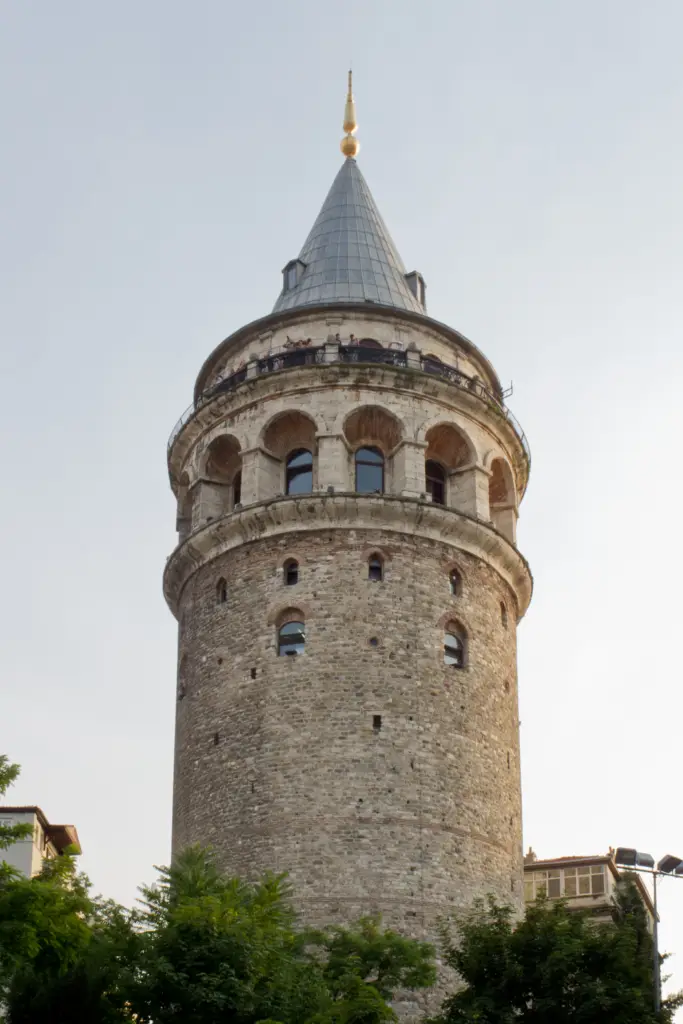
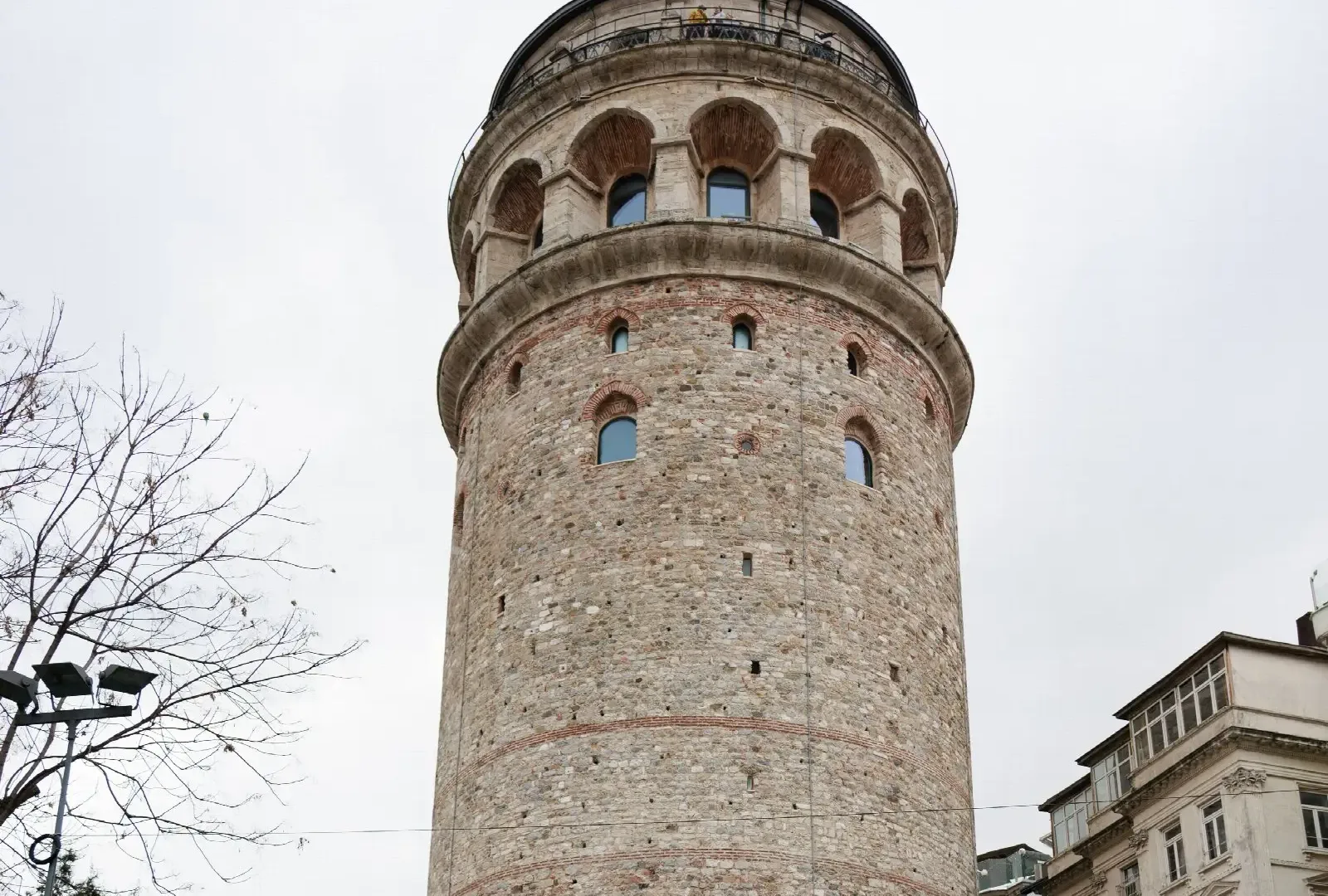
Rising above the old streets, Galata Tower has watched over Istanbul since 1348. Later, under the Ottomans, it served for a time as a prison and later as a fire watchtower, a vital job in a city of wooden houses. Earthquakes, fires and restorations have changed it many times, so what you see is not the building of a single century.
From the gallery, the whole geography of the city comes together: the Golden Horn below, the domes of Süleymaniye and Sultanahmet across the water, the Bosphorus and Üsküdar to the east. Rather than only taking pictures, watch how the Golden Horn, the Bosphorus and the Sea of Marmara meet; at that moment you understand why this city mattered for so long.
The tower is open every day, and an evening session follows the day visits. Foreign visitors need a ticket, and we arrange it with your visit. Allow 45–90 minutes. An elevator does not make every part of a medieval tower step-free, so visitors with limited mobility or a fear of heights should ask us about access first.
Is it worth going up? For a first visit, and especially for anyone who loves panoramas, yes. But if you want photographs of the tower, the streets around it are better. Inside you see the city, while outside you see the tower. Try both if you have time.
Galata Tower’s most famous story, however, comes from the 17th-century traveler Evliya Çelebi. In his Book of Travels he writes that Hazerfen Ahmed Çelebi, after test flights at Okmeydanı, strapped on wings, launched himself from the tower and glided across the Bosphorus to Doğancılar Square in Üsküdar. Sultan Murad IV rewarded him, the story goes, then exiled him to Algiers because he feared a man with such powers.
Did it happen? We cannot say. Evliya Çelebi is the only source, and no independent record confirms the flight. Still, stand by the tower, look across to the Asian shore and imagine trying it without engines or parachutes. Whether history or legend, the story has tied Galata to the human dream of flight.
The tower has a gentler legend too: couples who climb it together for the first time, people say, will marry. It is modern city folklore rather than an old tradition, but a charming one.
Start at Tünel Square, then walk down Galip Dede Caddesi. Once a street of antique dealers, booksellers and stamp shops, it is now Istanbul’s street of musical instruments: guitars and keyboards next to bağlama, oud, ney and violins. Because the shops cluster together, musicians come here to compare, buy and find a repairer. Even if you do not play, look at the woodwork of a handmade oud. Just ask before you photograph or touch an instrument.

Halfway down the street, it is easy to pass the Galata Mevlevihanesi without noticing it. Founded in 1491, it soon became one of Istanbul’s great centers of the Mevlevi order, the whirling dervishes. A Mevlevi lodge was never only a place of prayer and sema; music, poetry, calligraphy and learning all grew here.
Its most famous sheikh was Şeyh Galip (1757–1799), one of the greatest poets of classical Ottoman literature and the author of Hüsn ü Aşk (Beauty and Love). He became sheikh of the lodge in 1791, spent his last years here and is buried in its garden. One of his best-known couplets reads:
Hoşça bak zâtına kim zübde-i âlemsin sen
Merdüm-i dîde-i ekvân olan âdemsin senLook well at yourself, for you are the essence of the world; you are the human being, the pupil in the eye of creation.
Think about it: on the slope where visitors now walk with paper coffee cups past guitar shops, one of the greatest Ottoman poets lived more than two centuries ago. In the museum you can see the hall of the sema, dervish cells, instruments and calligraphy; do not miss the garden with its carved tombstones, whose shapes once told the rank of the person buried below.
The museum is usually closed on Mondays, and a ticket is required. Hours change by season, so ask us to confirm before you plan a visit.
A few steps from the tower, Serdar-ı Ekrem Caddesi shows Galata’s transformation clearly. Cobblestones, tall 19th-century apartment blocks, ornate doors and small balconies line it, and today design shops, vintage stores and cafés fill the ground floors. However, if you only look at the shop windows, you will miss the best part. Look up especially at the bay windows, the carved stone above the windows, the iron balconies and the rooflines. Galata sometimes recalls Genoa, Paris or an old Mediterranean port, yet it copies none of them; it grew out of Istanbul’s own cosmopolitan history.
Further along, one of the grandest buildings on the street, the Doğan Apartmanı has changed owners and names several times. Its present name honors Doğan, the son of the later owner Kazım Taşkent. The building is organized around a large inner courtyard and shows the move from the Ottoman mansion to the modern city apartment. It is private property, not a museum, so admire the façade from the street and do not enter the courtyard or stairs uninvited.
Everyone photographs the tower, but people who really walk Galata remember its stairs. Because of the steep slope, countless stepped passages connect streets at different levels; some are simple and practical, others are architecture in their own right. Around Bereketzade, below the tower, small flights of steps and narrow passages link the lanes between old stone walls. One warning: the same staircase often appears online under different names, and not every pretty flight of steps is the Camondo Stairs.
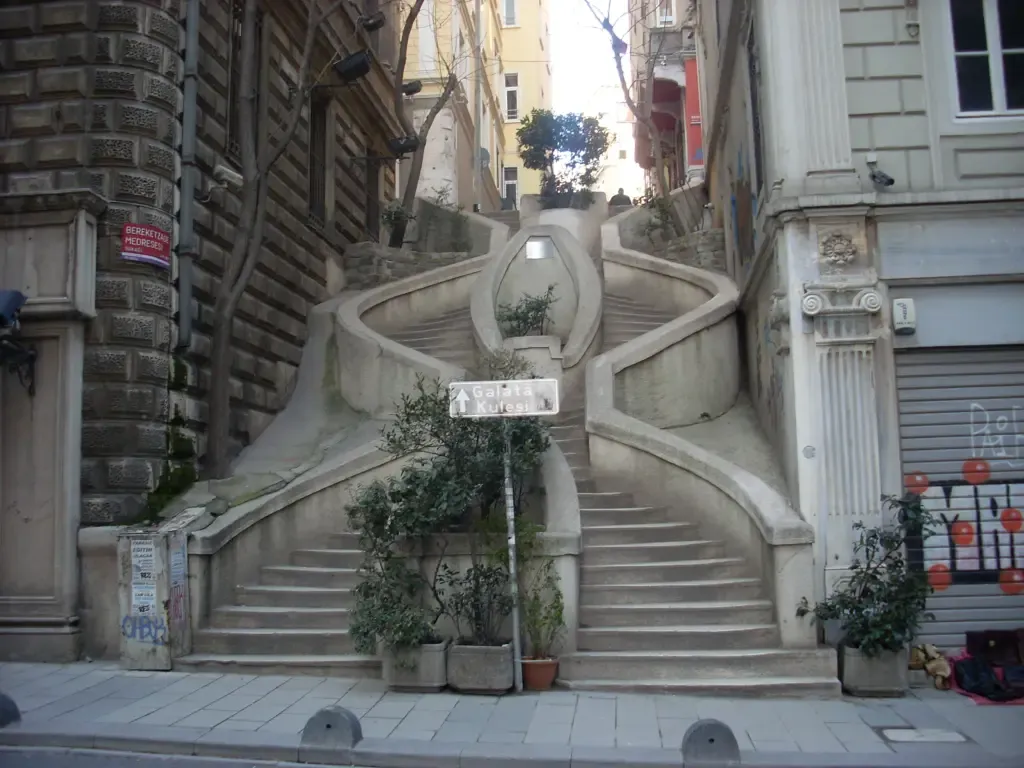
Further down, Galata’s most photographed stairs curve toward Bankalar Caddesi in two elegant, symmetrical flights. They are linked to the Camondo family, Jewish bankers who were among the most influential financiers of the 19th-century Ottoman Empire; Abraham Salomon Camondo was known for both his banking and his philanthropy. One story says he built the stairs so his grandchildren could walk to school more easily; another says the curves were meant to stop anyone who fell from rolling all the way down. Both are lovely stories, but neither is proven. On Bankalar Caddesi itself, the Baltazzi Han of 1836 is now the Galata Istanbul Hotel.
For a photograph, try a symmetrical frame from directly below, or wait for one person to cross. Do not block the steps for long: this is a public passage, not a stage set. After your photograph, keep going down until you reach Bankalar Caddesi.
Bankalar Caddesi, historically Voyvoda Caddesi, was the Wall Street of the Ottoman Empire. Leaving the residential lanes above, you suddenly walk between heavy stone façades, monumental doors and institutional architecture designed to project financial power. The change of scale is no accident: up the hill people lived, down here they did business with Europe.
The most famous building is the former Ottoman Bank, designed by Alexandre Vallaury. Today it is SALT Galata, a cultural center with exhibitions, a research library and archive, the Ottoman Bank Museum, a bookshop and a café. No ticket is needed; it closes on Mondays and some public holidays. A building once dedicated to money now serves research and culture, which tells Galata’s story through architecture.
Galata’s religious buildings are also the clearest record of its many communities. On the way down to Karaköy, look for the Arap Camii (Arab Mosque), a 14th-century Dominican church with a Gothic bell tower that the Ottomans turned into a mosque. A legend dates a first mosque here to the Arab siege of 716–717, but it has no basis; the building is the documented medieval church. Nearby, the Catholic Church of Saints Peter and Paul hides behind a modest entrance, and Galata’s Jewish heritage lives on in synagogues such as Neve Şalom and the Ashkenazi Synagogue. Visiting hours vary and security rules apply, especially at synagogues, so do not expect to walk in freely. Treat these places as the homes of living communities, not just architecture. See also the Yeraltı Mosque.
If the slope tires you, Istanbul solved that problem in 1875. Opened on January 17, 1875, Tünel is an underground funicular between Karaköy and Beyoğlu, among the oldest underground railways in the world, second only to London’s. Originally designed by the French engineer Eugène-Henri Gavand and first powered by steam, it runs about 573 meters (1,880 feet) in roughly 90 seconds. Our suggestion: walk down through Galata to Karaköy, then ride Tünel back up. So you cross the same hill twice, once on old stones and once with 19th-century engineering.
However, the best pictures of Galata do not always put the tower in the middle. Sometimes a worn staircase, an old doorway or a shopkeeper opening up in the morning tells a stronger Istanbul story.
Viewpoint
The Genoese Tower of Christ of 1348: its story from prison and fire lookout to the 2024 reopening, the legend of Hezarfen's flight, the view from the gallery and tips for your…

Galata is now known for its restored apartments as much as for its cafés: high ceilings, old wooden doors, stone staircases and small balconies attract independent travelers, couples and longer stays. Waking up a few minutes from the tower and walking to Karaköy or İstiklal in the evening is a big part of the appeal.
There is another side, though. As homes become boutique hotels, short-term rentals and shops, the neighborhood changes, and long-term rents and everyday life come under pressure. The shift is not only about short-term rentals; real estate, culture and new businesses are all part of it. Galata is not just “the area with beautiful rental flats”; romantic apartment life and residents’ daily needs share the same streets.
If you rent: ask whether the listing has a permit for short-term rentals. Also ask about the elevator, the floor, night noise from bars, the stairs with luggage, heating and cooling, and how check-in works. Some of Galata’s most beautiful buildings are not the easiest with big suitcases.
Around the tower, history lives in apartment blocks and cobbles; as you go down, the character changes. Karaköy was for centuries the working harbor of the city: shipping offices, warehouses, trading houses, small workshops and ferry piers. Today, however, restaurants, specialty coffee, design shops and cultural spaces have moved into many of the old buildings, and Galataport has changed the waterfront. Yet not all of Karaköy has become a tourist zone; hardware traders and everyday business still fill many streets. Galata lets you look down on the city, while Karaköy puts you in its flow at street level.
In the evening, the tower is lit, the street lamps warm the stone façades and the cafés and restaurants fill up. Galata is not Taksim’s nightlife, because its evenings are about walks and small places. For live music, Nardis Jazz Club on Galata Kulesi Sokak is one of the city’s best-known jazz venues. Reservations are made by phone or email, so check the program and book ahead.
Dozens of cafés face the tower, but you do not need a tower view for a good coffee. A view and a good meal are two different choices, so pick the place for what it does best.
At Galip Dede Caddesi 85/A, in the World House building a few minutes from the tower, this small café is a short stop between the music shops and the tower. Order a Turkish coffee, or instead ask for the coffee of the day and whatever has been baked fresh. Come on a weekday morning or before noon.
On a small side street, at Tatarbeyi Sokak 8, Old Java is a roaster for travelers who care about the coffee itself: single-origin filter coffee, espresso, cold brew and a good breakfast and lunch menu. Ask the barista which beans they are pouring that day before you order. So it makes a good break between the tower and the walk down to Karaköy.
Finally, end the walk the traditional way. Karaköy Güllüoğlu makes baklava in Karaköy in the tradition of Gaziantep. Choose pistachio or walnut, share a few kinds and drink a Turkish coffee, ideally unsweetened, to balance the syrup.
Walk from the top down. Start at Tünel Square and finish on the Karaköy waterfront; allow 3–5 hours with stops, longer with museums.
| Stop | Why it matters |
|---|---|
| Tünel Square | The historic funicular and the top of Galata |
| Galata Mevlevi Lodge | Şeyh Galip, Sufi music and poetry |
| Galip Dede Street | Musical instruments and street life |
| World House Café | A coffee break on the slope |
| Serdar-ı Ekrem Street | Apartment blocks, architecture, design shops |
| Doğan Apartmanı | 19th-century apartment life |
| Galata Tower | The Genoese, the Hazerfen legend and the view |
| Bereketzade | Stairs and the old lanes |
| Old Java Coffee Roasters | Coffee on a side street |
| Camondo Stairs | A banking family’s elegant gift |
| Bankalar Caddesi and SALT Galata | The empire’s financial street, now culture |
| Arap Camii | A Gothic church that became a mosque |
| Karaköy | The harbor and today’s city life |
| Karaköy Güllüoğlu | Baklava to end the day |
The stops are not on one straight line, so expect a few side turns. The most common mistake is to walk straight down from the tower and miss everything along the way. Instead, look at a doorway, turn into a side street, read the date on a building, then walk on.
Taxis are rarely worth it: the streets are narrow, some are closed to cars and traffic is slow. If you stay in Galata, ask your host for the nearest drop-off point for your luggage. For our picks, see the best boutique hotels in Galata and Karaköy.
For travelers who love historic buildings and walking, yes: İstiklal, Karaköy, cafés, restaurants and transport are all close. It suits independent travelers and couples best. On the other hand, it is less suited to heavy luggage, guests who struggle with stairs or anyone who needs complete quiet: many buildings have no elevator, and some streets are noisy at night. Choose by the building’s age, floor, elevator, slope and noise, not only by the photographs.
Updated:
Open in Google Maps (opens in a new tab) Open in Apple Maps (opens in a new tab)
The Genoese built the present tower in 1348 as part of the walls of their colony.
Yes, to go up, and we arrange your ticket. Walking around the tower and the old streets needs no ticket.
Yes. It opens every day, with an evening session as well; check current hours on the official museums portal before you go.
Evliya Çelebi says he flew from the tower to Üsküdar, but no independent source confirms it, so it remains a legend.
They are two halves of the same historic town: Galata is the slope around the tower, Karaköy the harbor quarter by the water.
On the lower slope, leading down to Bankalar Caddesi, a short walk below the tower rather than right in front of it.
 Tour
Private Istanbul Photography Walk at Sunrise
 Tour
Private Istanbul Jazz Night in Beyoğlu
 Tour
Private Galata and Karaköy Evening Walk in Istanbul
 Tour
Private Jewish Heritage Tour in Istanbul: Balat to Kuzguncuk
 Person
Evliya Çelebi
 Article
Whirling Dervishes in Turkey: The Sema and Where to See It
 Place
Balat
 Place
Cihangir
