
Photo: Turkey Your Way
Van Fortress
The citadel of a kingdom that rivaled Assyria, on a rock above the bluest lake in Turkey.
Overview
On the eastern shore of Lake Van, a long ridge of pale rock rises sheer from a green plain. Along its top run walls and towers, and in its cliffs open the dark doorways of royal tombs. Almost three thousand years ago, this was Tushpa, the capital of Urartu, a kingdom of the eastern highlands strong enough to challenge Assyria. Today, Van Fortress is one of the great ancient sites of eastern Turkey, and the view from the top takes in the whole blue lake. Our Urartu tour in 9 days begins here.
So bring good shoes, come in the late afternoon, and stay for the sunset over the water.

- Good for
- History lovers, photographers, walkers
- Best combined with
- Akdamar Island, Hoşap Castle, the Van breakfast, Lake Van
Van Fortress, the Citadel of Urartu
To begin with, the fortress stands just west of the modern city of Van, between the city and the lake. The rock is about a kilometer long and very narrow, with steep cliffs on both sides. Also, its builders used the rock itself as part of the defense, so walls, stairs and chambers are cut straight into the stone.
Van Fortress in numbers
- 9th–7th c. BCbuilt by the kingdom of Urartu
- 3languages in the Xerxes inscription
- 27lines in each column of the inscription
- 20 mheight of the inscription above the ground (66 ft)
History of Van Fortress
Tushpa, capital of Urartu
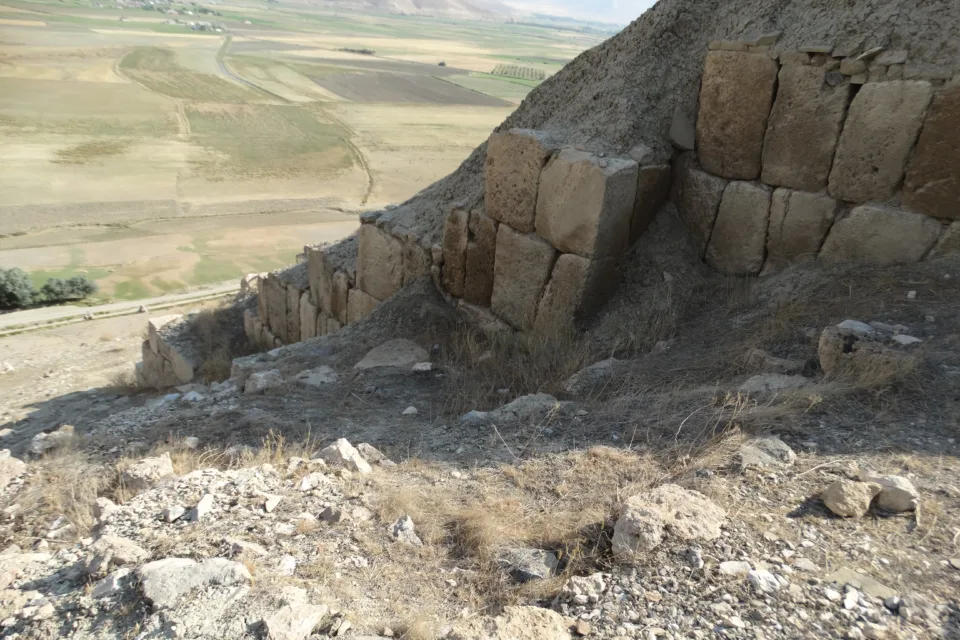
In the 9th century BC, the kings of Urartu made this rock the heart of their capital, Tushpa. From here, in turn, they ruled a land of fortresses, canals and vineyards across the highlands where Turkey, Armenia and Iran meet today. In general, their builders laid the lower courses of the walls in large stone blocks without mortar and raised the upper parts in mud brick.
Many masters
After Urartu fell, however, the fortress passed from hand to hand. Medes, Persians, Armenians, Parthians, Romans, Sassanids, Byzantines, Arabs, Seljuks, Safavids and Ottomans each held it. Finally, Russian troops took it during the First World War. So the walls you see today mix Urartian foundations with medieval and Ottoman repairs. Near Van, see the Urartian castle of Çavuştepe.

What to See at Van Fortress
The Xerxes inscription
On the south face of the rock, about 20 meters (66 feet) above the ground, a smooth panel carries an inscription of the Persian king Xerxes from the 5th century BC. Its three columns, each of 27 lines, also repeat the same text in Old Persian, Elamite and Babylonian. In it, Xerxes records that his father Darius had the niche cut but left it empty. It survives in almost perfect condition, and it is best seen from the path below.

The rock tombs and the royal stable
Then, along the cliffs, the Urartian kings cut burial chambers deep into the rock, reached by steep steps. Further up, a large hall carved in the stone, known as the royal stable, held oxen and sheep for sacrifice to the gods of Urartu. It is about 20 meters (66 feet) long.
The ruins of old Van
At the foot of the rock, on its south side, lay the old walled town of Van, home to Armenian and Muslim families for centuries. During World War I, Russian forces occupied Van in 1915, and the old walled city below the fortress burned. That same year began the Armenian genocide of 1915–16, the Ottoman government’s destruction of its Armenian population. Today, only a few mosques, a brick minaret and the outlines of streets rise from the grass, a moving place to walk.
Our notes for Van Fortress
- Lost findsAn American expedition dug here in 1938–40, but most of its finds and notes sank with the ship Athenia in 1940.
- ShoesThe paths are steep and rocky in places. Wear real walking shoes.
- Breakfast firstStart the day with a Van breakfast in the city, then come to the fortress in the cool morning or at sunset.
- WaterThere is little shade on the rock. Bring water in summer.
Our suggestion Climb up about an hour and a half before sunset. Walk west along the rock to the end, where the cliff drops to the plain, and watch the sun go down over Lake Van.
How to Visit Van Fortress
Getting there
The fortress lies a short drive west of the city center, on the road toward the lake. Also, taxis and city minibuses run there from the center. Our eastern Turkey and Black Sea tour climbs it on its last morning.
When to go
Late spring to early autumn is best. In winter, wear warm shoes with a good grip for the snowy paths. At any time of year, however, the late afternoon light is the most beautiful.
Seeing Van Fortress with us
Our eastern Turkey tour includes the fortress, Akdamar Island and the shores of Lake Van. We arrange your visit to the fortress as part of a Van day.
Because few places let you stand on three thousand years of history with a lake like an inland sea below. Climb the rock at sunset, read the words of Xerxes in the cliff, and look down on the ruins of old Van.

Map
Open in Google Maps (opens in a new tab) Open in Apple Maps (opens in a new tab)
Gallery
Frequently asked questions
How old is Van Fortress?
The kingdom of Urartu built it between the 9th and 7th centuries BC, on the rock of its capital, Tushpa.
What does the Xerxes inscription at Van say?
It is a royal inscription of the Persian king Xerxes from the 5th century BC, written in Old Persian, Elamite and Babylonian, praising the god Ahuramazda and recording that his father Darius prepared the niche.
How long do I need for Van Fortress?
About two hours to walk along the rock, or longer if you also walk through the ruins of the old town below.
When is the best time to visit Van Fortress?
Late afternoon, when the light turns the rock gold and the sun sets over Lake Van.
Is Van Fortress hard to climb?
The paths are steep and uneven in places, so wear good shoes and take water in summer.

You may also like
-
 Tour
Private Van and Akdamar Tour: Lake Van and the Holy Cross
-
 Place
Lake Van
-
 Article
The Karahantepe Statue: A Human Seated on a Leopard
-
 Article
Göbeklitepe vs Karahantepe: Which to See, With a 2-Day Route
-
 Article
Hittites in Turkey: Who They Were and Where to See Them
-
 Place
Beçin Castle
-
 Place
Antioch of Pisidia
-
 Place
Çavuştepe