

Lake Van
Lake Van, Turkey's largest lake: a deep soda lake below volcanoes in Eastern Anatolia, with the…
Photo: Leon petrosyan / Wikimedia Commons, CC BY-SA 4.0
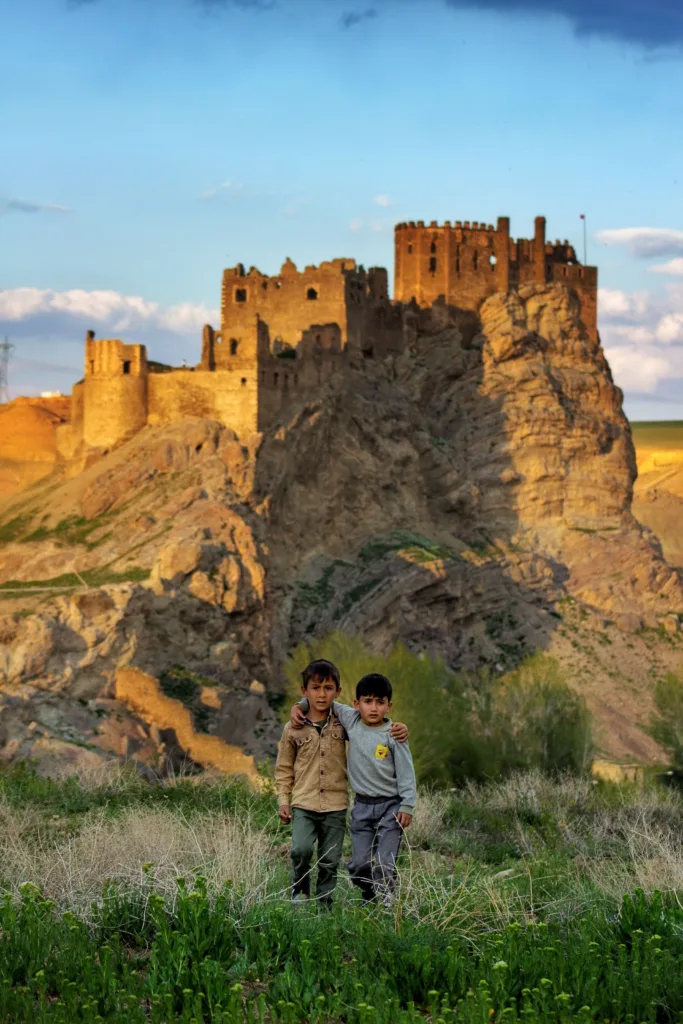
Sardurihinili, the Urartian castle that King Sarduri II founded near Van, with temples to two gods on one ridge.
Çavuştepe is the Urartian castle that King Sarduri II founded in the mid-8th century BC, about 25 km (16 miles) southeast of Van. In its own day, its builders called it Sardurihinili, the city of Sarduri. Along one ridge, a lower and an upper castle each held a temple, and each temple served a different god. Because of that, it stands apart: no other Urartian castle has two temples to two separate gods.
Above the plain, the castle crowns two hills at the western end of the Bol mountains, in the Gürpınar district of Van. Just below it, you find the village that shares its name. From the top, it watches over the Gürpınar plain and the roads that cross it. The castle lies 10 km (6 miles) from the town of Gürpınar, and the Van–Hakkari road passes just to its north.
Quick facts
The kings of Urartu ruled from Tushpa, their capital on the rock that is now the Van Fortress. There, Sarduri I founded the capital in the late 9th century BC. Less than a century later, Sarduri II built this castle and gave it his own name. Like the kings before him, he has a rock tomb at Tushpa. So a visit to both sites follows one king from his castle to his grave.
In the 1960s, the archaeologist Afif Erzen began the first digs on the ridge. His report on the 1964 season came out in the same year. Digs at the necropolis to the north also taught a great deal about how the Urartians buried their dead.

To the west, the lower castle runs 800 meters (2,620 feet) along the back of the ridge. Here, walls of neatly cut limestone sit straight on the bedrock. Inside, the buildings follow one another from east to west: stables, stores, the temple, the palace and its cisterns. Around the palace lay workshops, kitchens and even a toilet. At the highest point of the lower castle stands the temple of the god Irmushini. On the outside, its door opens to the east, its front was built of basalt, and it carries an inscription in cuneiform. Nearby, a structure called Uçkale probably had a religious use as well.
About 30 meters (100 feet) higher, the smaller upper castle stands on the eastern hill. Within walls of large stone blocks, it holds a square temple with a portico. This temple belonged to Haldi, the chief god of Urartu, and rooms for his cult stood around it.
Altogether, the castle stretches for about 1 km (0.6 miles). On its east and west sides, two ditches cut into the rock guarded the walls. In places, the walls still stand 5 to 6 meters (16 to 20 feet) high. Inside, look for the cisterns carved into the bedrock, a water store and a postern cut through the rock. Then, about 1 km north of the castle, lies its necropolis. There, four kinds of grave came to light: chamber tombs, urn graves, sarcophagi and simple earthen graves.
Because the site lies by the Van–Hakkari road, a car or driver from Van reaches it easily. The site is open every day. We plan your drive from Van to Çavuştepe and back by the Van Fortress. Since the two castles sit on a long ridge, wear shoes for walking on rock and gravel.
On our Urartu journey, Çavuştepe comes on the second day. First, you visit the Van Fortress, the old capital. You drive southeast to the castle of Sarduri II. The next day, the route follows the shore of Lake Van to Ahlat. If you have an extra day, add our Van and Akdamar tour to see the church on Akdamar Island.
Updated: October 26, 2026.
Would you like to stand between two Urartian temples on one ridge? Our 9-day Urartu tour brings you to Çavuştepe after the Van Fortress. The ridge comes after Van Fortress, so we place it in your journey once we know your dates.
Lake Van, Turkey's largest lake: a deep soda lake below volcanoes in Eastern Anatolia, with the…
Open in Google Maps (opens in a new tab) Open in Apple Maps (opens in a new tab)
It is an Urartian castle about 25 km (16 miles) southeast of Van, in the Gürpınar district, on two hills above the Gürpınar plain. The Van–Hakkari road passes just to its north, so a car or driver from Van reaches it easily.
Yes. The site is open every day. Ask us to confirm the hours; we pair Çavuştepe with the Van Fortress.
King Sarduri II founded it in the mid-8th century BC and named it Sardurihinili, the city of Sarduri. His rock tomb lies at Tushpa, today's Van Fortress.
A lower castle with the temple of the god Irmushini and its cuneiform inscription, and an upper castle with the temple of Haldi, the chief god of Urartu. Look also for walls up to 5 to 6 meters (16 to 20 feet) high and cisterns carved into the bedrock.
Our 9-day Urartu tour brings you here on the second day, after the Van Fortress. The next day, the route follows the shore of Lake Van to Ahlat.
 Journey
Urartu Tour in 9 Days: Lost Kingdoms of Eastern Anatolia, from Van to Ani
 Article
The Karahantepe Statue: A Human Seated on a Leopard
 Article
Göbeklitepe vs Karahantepe: Which to See, With a 2-Day Route
 Article
Hittites in Turkey: Who They Were and Where to See Them
 Place
Beçin Castle
 Place
Antioch of Pisidia
 Place
Kastabala
 Place
Gölyazı
