

Neighborhood
Galata
More than a tower: Genoese walls, a Mevlevi lodge, bankers' stairs and the walk down to…
Photo: Turkey Your Way
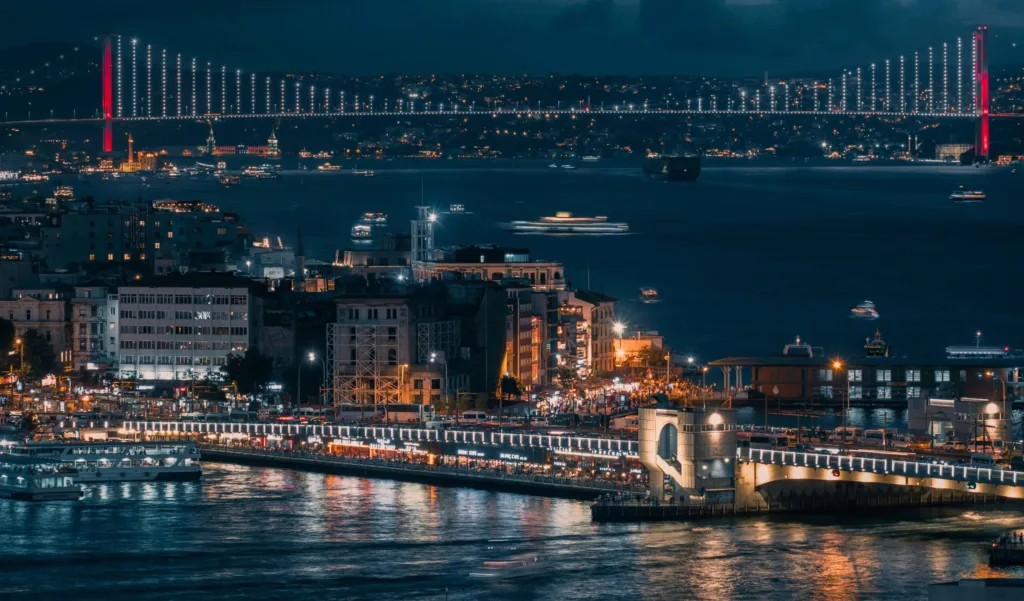
The old Genoese harbor of Galata: ferries, banks, churches, synagogues and a Gothic mosque at the mouth of the Golden Horn.
Karaköy is easy to cross on the way to somewhere else. You step off the tram at the Galata Bridge, look up at the Galata Tower and start climbing. That, however, is a mistake. After all, Karaköy is the old harbor of the city. In just a few streets it holds a Gothic church turned mosque, the banks that once financed an empire, a Sinan hammam, a famous baklava shop and good simple lunches. Our Galata history walk starts at that church, the Arap Mosque. For the classic kind of lunch, see our guide to the esnaf lokantası. See also the Yeraltı Mosque.
We send our own guests here in the morning, when the ferries are full of commuters and the bakeries are still busy. So here is Karaköy the way we walk it.
Karaköy sits on the northern shore of the mouth of the Golden Horn, in the Beyoğlu district of Istanbul. It is the modern name for the harbor of old Galata. Above it, the hill of Galata climbs toward Pera. Below it, the Galata Bridge crosses to Eminönü and the old city.
For centuries, everything that came to Istanbul by sea came through here: merchants, sailors, refugees, troops and, today, cruise passengers. That is why the quarter still feels like a crossroads today. Even now, banks, hardware shops, churches, synagogues, mosques and new galleries share the same few streets.
Karaköy through time
This is the route we use with first-time guests. It takes about three hours at an easy pace, plus lunch, so start early.

Take a city ferry from Kadıköy or Üsküdar. The crossing is short. It is also a good way to understand Karaköy, because the quarter was built to face the water. As you land, look left to the Galata Bridge and right to the cruise ships at Galataport.
Yes, locals do eat baklava in the morning. Karaköy Güllüoğlu, for one, opened here in 1949, and has made baklava here ever since. So order a small plate of pistachio baklava with a glass of tea. Alternatively, for a full Turkish breakfast, try Namlı Gurme near the pier, a deli and breakfast hall. For a slow morning, join our Turkish breakfast and coffee tour.
Right next to the pier, the Karaköy fish market is busiest in the morning, when the catch is freshest. There, hand-written signs name the fish of the season. Later in the day, however, the grills sell balık ekmek, grilled fish in bread with onion and lettuce.

Afterwards, walk inland into the hardware streets. Here, hidden among workshops, stands the Arap Mosque. Originally, Dominican friars built it as a church in the early 14th century, and its Gothic vaults survive from that church. Look up at the square tower, which now serves as a minaret. Around 1475, the Ottomans turned the church into a mosque. After 1492, Muslim refugees from Spain settled around it, so people still call it the Arab Mosque.
Around the mosque lies Perşembe Pazarı, the “Thursday Market,” although it works every weekday. Here, shops along Tersane Street sell tools, pipes, chains and spare parts, and porters push carts through the lanes. Few tourists come here, and that is exactly why we do. This, then, is the working Karaköy.

Next, climb to Voyvoda Street, better known as Bankalar Caddesi, the “Street of Banks.” In the 1890s, the Ottoman Bank had its headquarters here, and Italian and Austrian insurance companies opened offices next door. Today, the old Ottoman Bank building houses SALT Galata, with a library, exhibitions and the Ottoman Bank Museum. A few doors along, a bank building of 1876 is now The Bank Hotel Istanbul. Just off the street, the curving Camondo Stairs, a gift of the Sephardic banker Abraham Camondo, lead up toward the Galata Tower. Nearby, among the hardware shops, the Arap Mosque still keeps the Gothic bell tower of an early 14th-century Dominican church.
Karaköy has always been mixed. After 1453, Genoese, Venetian and Catalan traders lived here next to Greeks, Armenians and Jews. Later, Sephardic Jews from Spain and, after the Russian Revolution, White Russian refugees settled here too.
So within a few minutes’ walk you will find:
Many churches and synagogues open only for services or with permission, so we never promise entry. Instead, we always plan the walk around what is open that day.

Karaköy is one of the best places in Istanbul to eat well without a tourist menu. These are the places we send our guests to, and why.
Eat like Karaköy
Our suggestion Do lunch, not dinner, here. At midday the lokantas cook for the tradesmen of the quarter, and that is when Karaköy tastes most like itself.
If you walk north along the shore, Karaköy turns into Tophane, the district of the old Ottoman cannon foundry. Here, once again, the quarter changes.
The Kılıç Ali Pasha Hammam is a work of Mimar Sinan, built for an Ottoman admiral. After a long restoration, it reopened. Women bathe in the morning and men from the late afternoon, so book your session ahead. For how a visit works, see our guide to the Turkish bath.
Ever since Istanbul Modern first opened here in 2004, galleries have moved into old warehouses and hans. On Mumhane Caddesi, artSümer shows contemporary Turkish art inside Laroz Han. Further on, the new waterfront of Galataport holds the cruise terminal, Istanbul Modern in its Renzo Piano building and the Tophane square with its clock tower.
We add the current exhibitions at SALT Galata to your day in Karaköy. And if you would like a local guide to open the doors that are hard to find alone, our guides in Istanbul can walk it with you.
Because Karaköy is where Istanbul still works for a living. Come by ferry, eat baklava for breakfast, walk the hardware lanes to a Gothic mosque, and lunch where the tradesmen do.
Neighborhood
More than a tower: Genoese walls, a Mevlevi lodge, bankers' stairs and the walk down to…

Viewpoint
The Genoese Tower of Christ of 1348: its story from prison and fire lookout to the…

Galataport, Istanbul's cruise port in Karaköy, the local way: arriving by ship, the clock tower that…
Neighborhood
Istanbul's Asian-side heart: ancient Chalcedon, the 'city of the blind', the market streets, Çiya Sofrası, the…

Open in Google Maps (opens in a new tab) Open in Apple Maps (opens in a new tab)
It is Istanbul's old port quarter, known for its ferry pier, Bankalar Caddesi, the Gothic Arap Mosque, galleries and good lunch spots.
Try Karaköy Lokantası for a tradesmen's lunch, Fasuli for Black Sea style beans, Karaköy Güllüoğlu for baklava and the fish market for balık ekmek.
Karaköy is the modern name for the old harbor of Galata, the quarter below the Galata Tower.
Take the T1 tram across the Galata Bridge, a city ferry from Kadıköy or Üsküdar, or the Tünel funicular down from İstiklal Avenue.
A morning plus lunch covers the ferry pier, the Arap Mosque, Bankalar Caddesi and a good meal.
 Tour
Beyoğlu and Galata Private Tour: Karaköy, İstiklal and Cihangir
 Journey
Classic Turkey in 10 Days: Istanbul, Cappadocia, Ephesus and Pamukkale
 Tour
Istanbul Asian Side Private Tour: Üsküdar, Kuzguncuk, Kadıköy and Moda
 Tour
Private Galata and Karaköy Evening Walk in Istanbul
 Tour
Private Istanbul Art Tour: Istanbul Modern and Pera Museum
 Tour
Private Istanbul Night Photography Tour: Bridges and Domes
 Tour
Private Jewish Heritage Tour in Istanbul: Balat to Kuzguncuk
 Place
Camondo Stairs
